Center for Youth Relationship Development, The College of New Jersey, Ewing, NJ 08628, USA.
J Clin Child Adolesc Psychol. 2010;39(1):35-50. doi: 10.1080/15374410903401112.
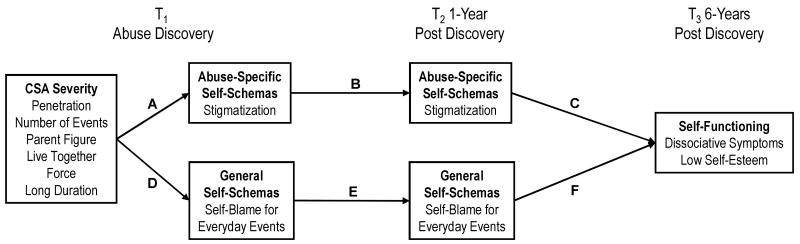
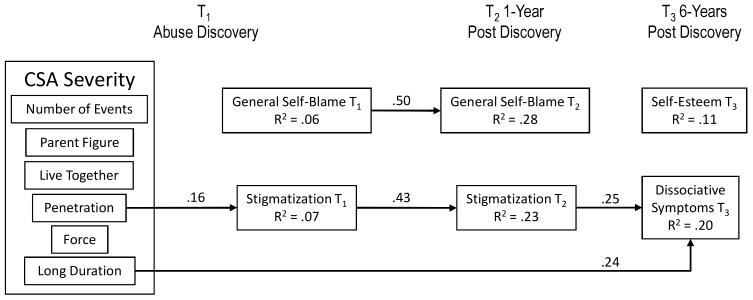
Potential pathways from childhood sexual abuse (CSA) to negative self-schemas to subsequent dissociative symptoms and low global self-esteem were examined in a prospective longitudinal study of 160 ethnically diverse youth with confirmed CSA histories. Participants were interviewed at the time of abuse discovery, when they were 8 to 15 years of age, and again 1 and 6 years later. Abuse-specific indicators of stigmatization, in particular the combination of shame and self-blame more than general self-blame attributions for everyday events, explained which youth with CSA histories experienced more dissociative symptoms and clinically significant levels of dissociation. Abuse-specific stigmatization was found to operate as a prospective mechanism for subsequent dissociative symptoms but not self-esteem.
本前瞻性纵向研究调查了 160 名具有经证实的 CSA 病史的种族多样化青年,旨在研究从儿童期性虐待 (CSA) 到消极的自我图式,再到随后的分离症状和低总体自尊的潜在途径。参与者在虐待发现时(8 至 15 岁)、1 年后和 6 年后接受了访谈。具体的耻辱感指标,尤其是羞耻感和自责感的组合,而不是对日常事件的一般自责归因,解释了哪些具有 CSA 病史的青年经历了更多的分离症状和临床上显著的分离水平。发现特定于虐待的耻辱感是随后发生分离症状的前瞻性机制,但不是自尊的机制。