Prev Chronic Dis. 2010 May;7(3):A51. Epub 2010 Apr 15.
Better understanding of the health problems of refugees and people who are granted political asylum (asylees) in the United States may facilitate successful resettlement. We examined the prevalence of risk factors for and diagnoses of chronic disease among these groups in Massachusetts.
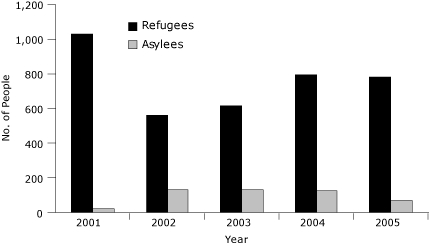
We retrospectively analyzed health screening data from 4,239 adult refugees and asylees who arrived in Massachusetts from January 1, 2001, through December 31, 2005. We determined prevalence of obesity/overweight, hypertension, coronary artery disease (CAD), diabetes, and anemia. Analyses included multivariate logistic regression to determine associations between CAD and diabetes with region of origin.
Almost half of our sample (46.8%) was obese/overweight, and 22.6% had hypertension. CAD, diabetes, and anemia were documented in 3.7%, 3.1%, and 12.8%, respectively. People from the Europe and Central Asia region were more likely than those from other regions to have CAD (odds ratio, 5.55; 95% confidence interval, 2.95-10.47).
The prevalence of obesity/overweight and hypertension was high among refugees and asylees, but the prevalence of documented CAD and diabetes was low. We noted significant regional variations in prevalence of risk factors and chronic diseases. Future populations resettling in the United States should be linked to more resources to address their long-term health care needs and to receive culturally appropriate counseling on risk reduction.
更好地了解在美国的难民和政治避难者(庇护者)的健康问题,可能有助于他们成功重新安置。我们研究了马萨诸塞州这些人群的慢性疾病风险因素和诊断的流行情况。
我们回顾性分析了 2001 年 1 月 1 日至 2005 年 12 月 31 日期间抵达马萨诸塞州的 4239 名成年难民和庇护者的健康筛查数据。我们确定了肥胖/超重、高血压、冠心病(CAD)、糖尿病和贫血的患病率。分析包括多变量逻辑回归,以确定 CAD 和糖尿病与原籍地区之间的关联。
我们的样本中近一半(46.8%)为肥胖/超重,22.6%患有高血压。分别有 3.7%、3.1%和 12.8%的人患有 CAD、糖尿病和贫血。来自欧洲和中亚地区的人比来自其他地区的人更容易患 CAD(比值比,5.55;95%置信区间,2.95-10.47)。
难民和庇护者中肥胖/超重和高血压的患病率较高,但有记录的 CAD 和糖尿病的患病率较低。我们注意到风险因素和慢性疾病的流行存在显著的地域差异。未来在美国重新安置的人群应与更多资源联系,以满足他们的长期医疗保健需求,并获得关于降低风险的文化上适当的咨询。