Center for Alcohol and Addiction Studies, Brown University, Providence, RI, USA.
Addiction. 2010 Mar;105(3):452-65. doi: 10.1111/j.1360-0443.2009.02814.x.
To evaluate moderators and mediators of brief alcohol interventions conducted in the emergency department.
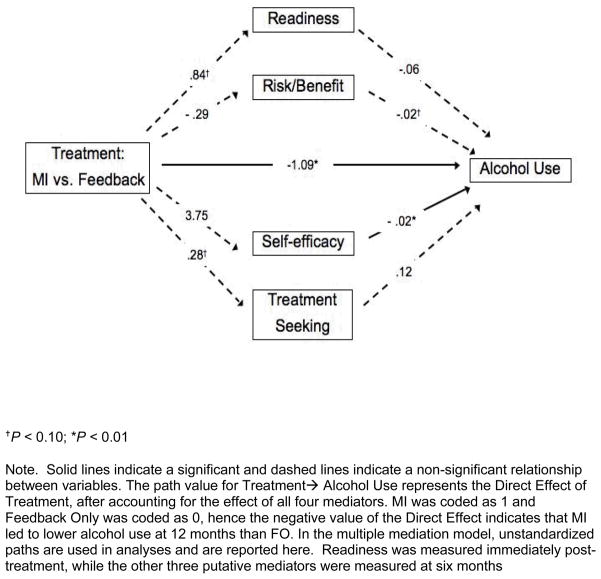
Patients (18-24 years; n = 172) in an emergency department received a motivational interview with personalized feedback (MI) or feedback only (FO), with 1- and 3-month booster sessions and 6- and 12-month follow-ups. Gender, alcohol status/severity group [ALC+ only, Alcohol Use Disorders Identification Test (AUDIT+) only, ALC+/AUDIT+], attribution of alcohol in the medical event, aversiveness of the event, perceived seriousness of the event and baseline readiness to change alcohol use were evaluated as moderators of intervention efficacy. Readiness to change also was evaluated as a mediator of intervention efficacy, as were perceived risks/benefits of alcohol use, self-efficacy and alcohol treatment seeking.
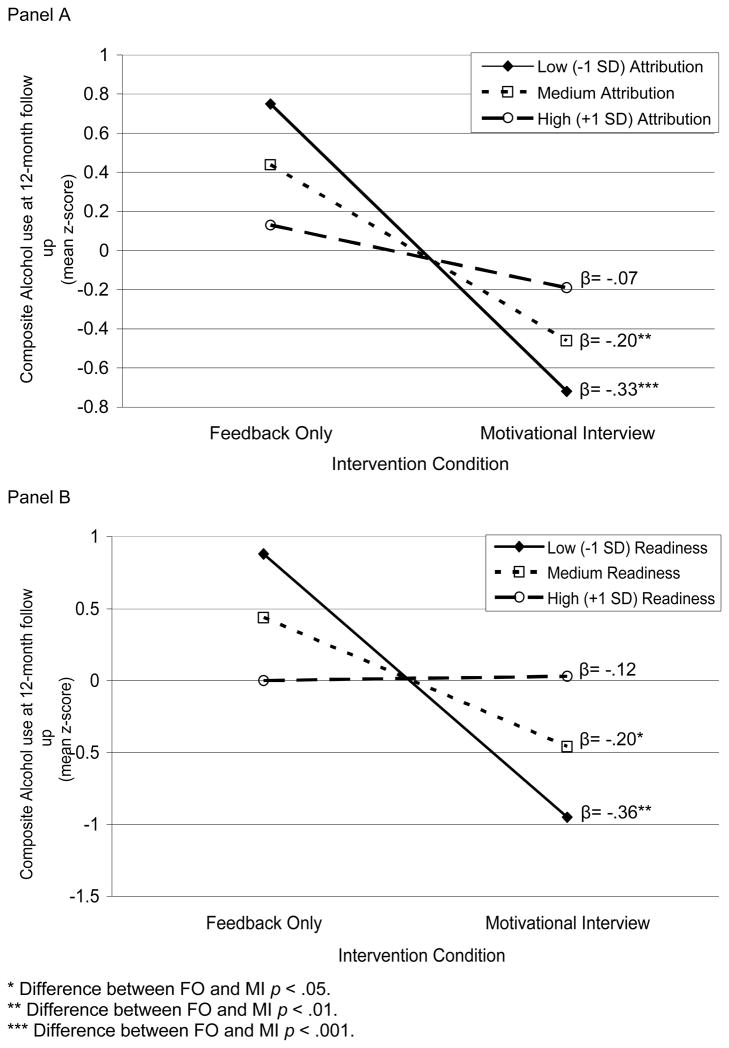
Alcohol status, attribution and readiness moderated intervention effects such that patients who had not been drinking prior to their medical event, those who had low or medium attribution for alcohol in the event and those who had low or medium readiness to change showed lower alcohol use 12 months after receiving MI compared to FO. In the AUDIT+ only group those who received MI showed lower rates of alcohol-related injury at follow-up than those who received FO. Patients who had been drinking prior to their precipitating event did not show different outcomes in the two interventions, regardless of AUDIT status. Gender did not moderate intervention efficacy and no significant mediation was found.
Findings may help practitioners target patients for whom brief interventions will be most effective. More research is needed to understand how brief interventions transmit their effects.
评估急诊科实施的简短酒精干预的调节因素和中介因素。
急诊科的患者(18-24 岁;n=172)接受了基于动机的访谈,包括个性化反馈(MI)或仅反馈(FO),并进行了 1 个月和 3 个月的强化疗程以及 6 个月和 12 个月的随访。性别、酒精状况/严重程度组[仅 ALC+、仅 AUDIT+、ALC+/AUDIT+]、将酒精归因于医疗事件、对事件的厌恶程度、对事件的严重程度的感知以及改变酒精使用的初始准备情况被评估为干预效果的调节因素。改变的准备情况也被评估为干预效果的中介因素,以及感知到的酒精使用的风险/益处、自我效能和酒精治疗寻求。
酒精状况、归因和准备情况调节了干预效果,即在医疗事件发生前没有饮酒的患者、对事件中酒精的归因较低或中等的患者以及改变酒精使用的准备情况较低或中等的患者,与接受 FO 的患者相比,在接受 MI 12 个月后酒精使用量较低。在仅 AUDIT+的组中,与接受 FO 的患者相比,接受 MI 的患者在随访时的酒精相关伤害率较低。在接受两种干预措施的患者中,在医疗事件发生前饮酒的患者在两种干预措施中没有表现出不同的结果,而与 AUDIT 状况无关。性别未调节干预效果,也未发现显著的中介作用。
研究结果可能有助于临床医生针对最有可能从简短干预中获益的患者进行治疗。需要进一步研究以了解简短干预如何传递其效果。