Department of Cell and Molecular Physiology, Loyola University Chicago Stritch School of Medicine, Maywood, Illinois, United States of America.
PLoS One. 2010 Apr 12;5(4):e10143. doi: 10.1371/journal.pone.0010143.
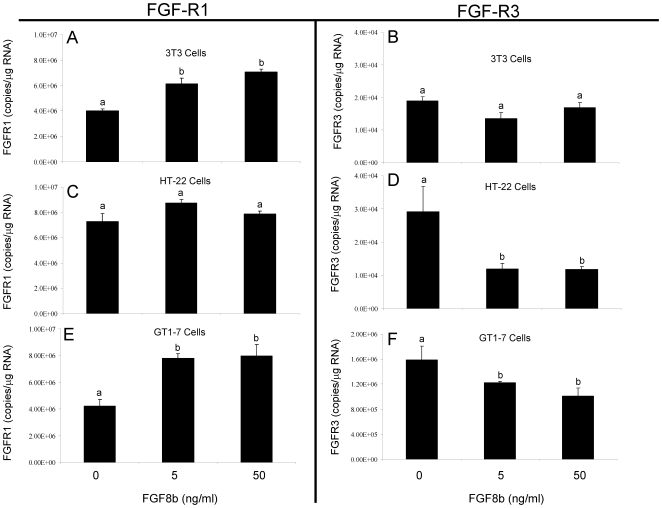
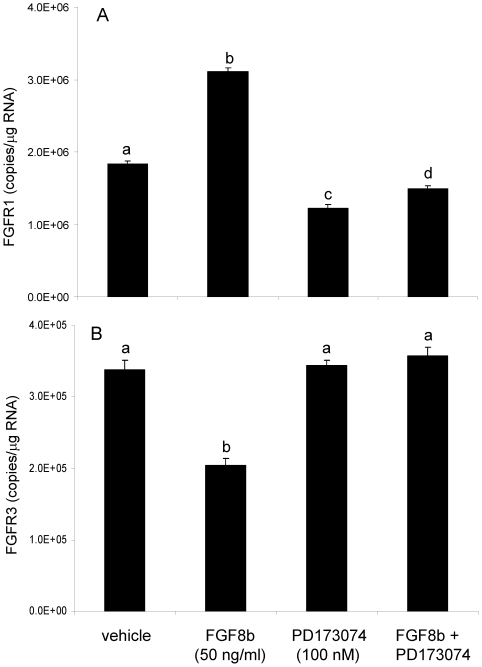
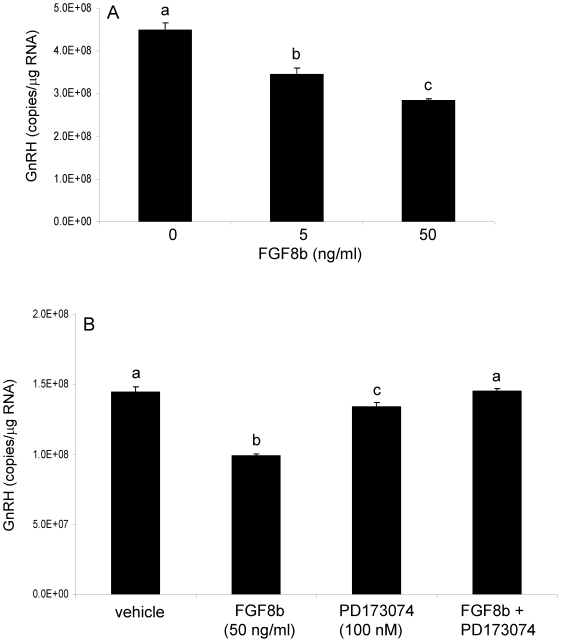
Fibroblast growth factors (FGFs) mediate a vast range of CNS developmental processes including neural induction, proliferation, migration, and cell survival. Despite the critical role of FGF signaling for normal CNS development, few reports describe the mechanisms that regulate FGF receptor gene expression in the brain. We tested whether FGF8 could autoregulate two of its cognate receptors, Fgfr1 and Fgfr3, in three murine cell lines with different lineages: fibroblast-derived cells (3T3 cells), neuronal cells derived from hippocampus (HT-22 cells), and neuroendocrine cells derived from hypothalamic gonadotropin-releasing hormone (GnRH) neurons (GT1-7 cells). GnRH is produced by neurons in the hypothalamus and is absolutely required for reproductive competence in vertebrate animals. Several lines of evidence strongly suggest that Fgf8 is critical for normal development of the GnRH system, therefore, the GT1-7 cells provided us with an additional endpoint, Gnrh gene expression and promoter activity, to assess potential downstream consequences of FGF8-induced modulation of FGF receptor levels. Results from this study suggest that the autoregulation of its cognate receptor represents a common downstream effect of FGF8. Further, we show that Fgfr1 and Fgfr3 are differentially regulated within the same cell type, implicating these two receptors in different biological roles. Moreover, Fgfr1 and Fgfr3 are differentially regulated among different cell types, suggesting such autoregulation occurs in a cell type-specific fashion. Lastly, we demonstrate that FGF8b decreases Gnrh promoter activity and gene expression, possibly reflecting a downstream consequence of altered FGF receptor populations. Together, our data bring forth the possibility that, in addition to the FGF synexpression group, autoregulation of FGFR expression by FGF8 represents a mechanism by which FGF8 could fine-tune its regulatory actions.
成纤维细胞生长因子(FGFs)介导了广泛的中枢神经系统发育过程,包括神经诱导、增殖、迁移和细胞存活。尽管 FGF 信号对正常中枢神经系统发育至关重要,但很少有报道描述调节大脑中 FGF 受体基因表达的机制。我们测试了 FGF8 是否可以在三种具有不同谱系的鼠细胞系中自我调节其两个同源受体,FGFR1 和 FGFR3:成纤维细胞衍生的细胞(3T3 细胞)、源自海马的神经元细胞(HT-22 细胞)和源自下丘脑促性腺激素释放激素(GnRH)神经元的神经内分泌细胞(GT1-7 细胞)。GnRH 由下丘脑的神经元产生,对于脊椎动物的生殖能力绝对必要。有几条证据强烈表明 Fgf8 对于 GnRH 系统的正常发育至关重要,因此,GT1-7 细胞为我们提供了另一个终点,Gnrh 基因表达和启动子活性,以评估 FGF8 诱导的 FGF 受体水平调节的潜在下游后果。本研究结果表明,其同源受体的自我调节代表了 FGF8 的常见下游效应。此外,我们表明,在同一细胞类型内,Fgfr1 和 Fgfr3 受到不同的调节,暗示这两个受体在不同的生物学角色中发挥作用。此外,Fgfr1 和 Fgfr3 在不同的细胞类型中受到不同的调节,表明这种自我调节以细胞类型特异性的方式发生。最后,我们证明 FGF8b 降低了 Gnrh 启动子活性和基因表达,这可能反映了改变的 FGF 受体群体的下游后果。总之,我们的数据提出了这样一种可能性,即除了 FGF 协同表达组之外,FGF8 对 FGFR 表达的自我调节代表了 FGF8 可以微调其调节作用的一种机制。