Steno Diabetes Center, Copenhagen, Denmark.
Diabetes. 2010 Jul;59(7):1585-90. doi: 10.2337/db09-1774. Epub 2010 Apr 27.
Various methods are used to quantify postprandial glycemia or glucose variability, but few have been compared and none are standardized. Our objective was to examine the relationship among common indexes of postprandial glycemia, overall hyperglycemia, glucose variability, and A1C using detailed glucose measures obtained during everyday life and to study which blood glucose values of the day provide the strongest prediction of A1C.
In the A1C-Derived Average Glucose (ADAG) study, glucose levels were monitored in 507 participants (268 type 1 diabetic, 159 type 2 diabetic, and 80 nondiabetic subjects) with continuous glucose monitoring (CGM) and frequent self-monitoring of blood glucose (SMBG) during 16 weeks. We calculated several indexes of glycemia and analyzed their intercorrelations. The association between glucose measurements at different times of the day (pre- and postprandial) and A1C was examined using multiple linear regression.
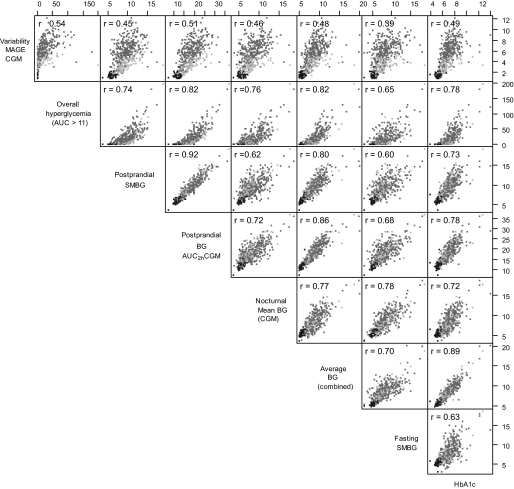
Indexes of glucose variability showed strong intercorrelation. Among postprandial indexes, the area under the glucose curve calculated from CGM 2 h after a meal correlated well with the 90-min SMBG postprandial measurements. Fasting blood glucose (FBG) levels were only moderately correlated with indexes of hyperglycemia and average or postprandial glucose levels. Indexes derived with SMBG strongly correlated with those from CGM. Some SMBG time points had a stronger association with A1C than others. Overall, preprandial glucose values had a stronger association with A1C than postprandial values for both diabetes types, particularly for type 2 diabetes.
Indexes of glucose variability and average and postprandial glycemia intercorrelate strongly within each category. Variability indexes are weakly correlated with the other categories, indicating that these measures convey different information. FBG is not a clear indicator of general glycemia. Preprandial glucose values have a larger impact on A1C levels than postprandial values.
目前有多种方法可用于量化餐后血糖或血糖变异性,但这些方法之间尚未进行充分比较,也没有标准化方法。本研究旨在使用日常实际生活中获得的详细血糖测量数据,检验餐后血糖、总体高血糖、血糖变异性和糖化血红蛋白(HbA1c)等常用指标之间的关系,并研究一天中哪些血糖值对 HbA1c 的预测作用最强。
在 A1C 衍生平均血糖(ADAG)研究中,通过连续血糖监测(CGM)和频繁自我血糖监测(SMBG),在 16 周内监测了 507 名参与者(268 名 1 型糖尿病患者、159 名 2 型糖尿病患者和 80 名非糖尿病患者)的血糖水平。我们计算了几种血糖指标并分析了它们之间的相关性。采用多元线性回归分析了一天中不同时间(餐前和餐后)的血糖测量值与 HbA1c 之间的关系。
血糖变异性指标之间具有很强的相关性。在餐后指标中,餐后 CGM 2 h 血糖曲线下面积与 SMBG 90 min 餐后测量值相关性较好。空腹血糖(FBG)水平与高血糖和平均或餐后血糖水平的相关性仅为中等程度。SMBG 结果与 CGM 结果具有很强的相关性。一些 SMBG 时间点与 HbA1c 的相关性强于其他时间点。总体而言,对于两种类型的糖尿病患者,餐前血糖值与 HbA1c 的相关性强于餐后血糖值,对于 2 型糖尿病患者尤其如此。
各分类内的血糖变异性和平均及餐后血糖指标之间具有很强的相关性。变异性指标与其他分类之间的相关性较弱,表明这些指标提供了不同的信息。FBG 不能作为总体血糖的明确指标。餐前血糖值对 HbA1c 水平的影响大于餐后血糖值。