Department of Paediatrics and Child Health, St. Mary's hospital Lacor, Gulu, Uganda P.O Box 180, Gulu, Uganda.
BMC Pediatr. 2010 May 6;10:31. doi: 10.1186/1471-2431-10-31.
Lactose intolerance is a common complication of diarrhoea in infants with malnutrition and a cause of treatment failure. A combination of nutritional injury and infectious insults in severe protein energy malnutrition reduces the capacity of the intestinal mucosa to produce lactase enzyme necessary for the digestion of lactose. The standard management of severe malnutrition involves nutritional rehabilitation with lactose-based high energy formula milk. However, some of these children may be lactose intolerant, possibly contributing to the high rate of unfavorable treatment outcomes. This study was therefore designed to establish the prevalence of lactose intolerance and associated factors in this population.
A descriptive cross sectional study involving 196 severely malnourished children with diarrhoea aged 3-60 months was done in Mwanamugimu Nutrition Unit (MNU), Mulago hospital between October 2006 and February 2007.
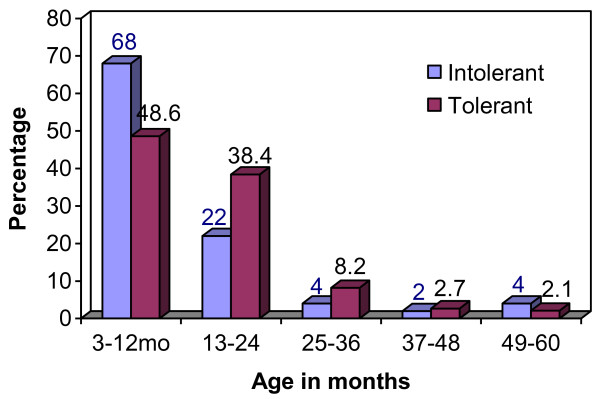
During the study period, 196 severely malnourished children with diarrhoea were recruited, 50 (25.5%) of whom had evidence of lactose intolerance (stool reducing substance >or= 1 + [0.5%] and stool pH < 5.5) and it occurred more commonly in children with kwashiorkor 27/75 (36.0%) than marasmic-kwashiorkor 6/25 (24.0%) and marasmus 17/96 (17.7%). Oedematous malnutrition (p = 0.032), perianal skin erosion (p = 0.044), high mean stool frequency (p = < 0.001) and having >or=2 diarrhoea episodes in the previous 3 months (p = 0.007) were the independent predictors of lactose intolerance. Other factors that were significantly associated with lactose intolerance on bi-variate analysis included: young age of 3-12 months; lack of up to-date immunization; persistent diarrhoea; vomiting; dehydration, and abdominal distension. Exclusive breastfeeding for less than 4 months and worsening of diarrhoea on initiation of therapeutic milk were the other factors.
The prevalence of lactose intolerance in this study setting of 25.5% is relatively high. Routine screening by stool pH and reducing substances should be performed especially in the severely malnourished children with diarrhoea presenting with oedematous malnutrition, perianal skin erosion, higher mean stool frequency and having had >or=2 diarrhoea episodes in the previous 3 months. Use of lactose-free diets such as yoghurt should be considered for children found to have evidence of lactose intolerance and whose response on standard therapeutic milk formula is poor.
乳糖不耐受是营养不良婴儿腹泻的常见并发症,也是治疗失败的原因之一。在严重蛋白质能量营养不良中,营养损伤和感染性损伤会降低肠道黏膜产生乳糖酶的能力,而乳糖酶是消化乳糖所必需的。严重营养不良的标准治疗方法是用含乳糖的高能配方奶进行营养康复。然而,这些儿童中的一些可能患有乳糖不耐受,这可能是导致治疗效果不佳的高发生率的原因之一。因此,本研究旨在确定该人群中乳糖不耐受的患病率及其相关因素。
本研究是一项描述性的横断面研究,于 2006 年 10 月至 2007 年 2 月在穆拉戈医院的姆万纳米古米营养单位(MNU)招募了 196 名年龄在 3-60 个月之间患有腹泻的严重营养不良儿童。
在研究期间,共招募了 196 名患有腹泻的严重营养不良儿童,其中 50 名(25.5%)有乳糖不耐受的证据(粪便还原物质>或=1+[0.5%],粪便 pH 值<5.5),且在患有夸西奥科罗病的儿童中更为常见(75 名中的 27 名,36.0%),而非夸西奥科罗-马拉萨姆基奥罗病(25 名中的 6 名,24.0%)和马拉萨姆病(96 名中的 17 名,17.7%)。水肿性营养不良(p=0.032)、肛周皮肤糜烂(p=0.044)、高平均粪便频率(p<0.001)和在过去 3 个月中有>或=2 次腹泻发作(p=0.007)是乳糖不耐受的独立预测因素。在双变量分析中,与乳糖不耐受显著相关的其他因素包括:年龄为 3-12 个月;未及时进行免疫接种;持续性腹泻;呕吐;脱水和腹胀。母乳喂养时间少于 4 个月和在开始使用治疗性牛奶时腹泻恶化是其他因素。
在本研究中,乳糖不耐受的患病率为 25.5%,相对较高。在出现水肿性营养不良、肛周皮肤糜烂、较高平均粪便频率和在过去 3 个月中有>或=2 次腹泻发作的严重腹泻儿童中,应通过粪便 pH 值和还原物质进行常规筛查。对于发现有乳糖不耐受证据且对标准治疗性牛奶配方反应不佳的儿童,应考虑使用无乳糖饮食,如酸奶。