Biosciences Division, Oak Ridge National Laboratory, Oak Ridge, TN 37831, USA.
BMC Microbiol. 2010 May 7;10:135. doi: 10.1186/1471-2180-10-135.
Zymomonas mobilis produces near theoretical yields of ethanol and recombinant strains are candidate industrial microorganisms. To date, few studies have examined its responses to various stresses at the gene level. Hfq is a conserved bacterial member of the Sm-like family of RNA-binding proteins, coordinating a broad array of responses including multiple stress responses. In a previous study, we observed Z. mobilis ZM4 gene ZMO0347 showed higher expression under anaerobic, stationary phase compared to that of aerobic, stationary conditions.
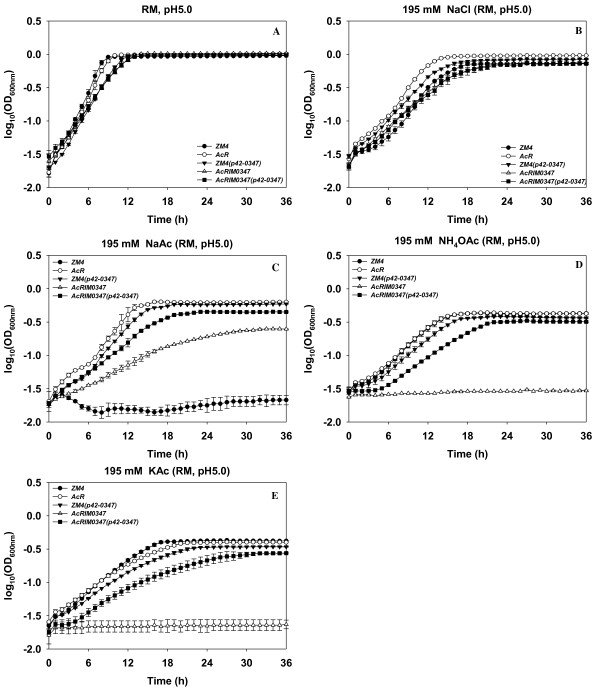
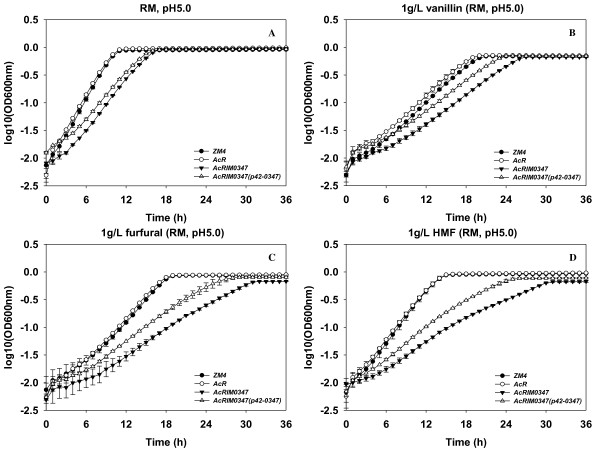
We generated a Z. mobilis hfq insertion mutant AcRIM0347 in an acetate tolerant strain (AcR) background and investigated its role in model lignocellulosic pretreatment inhibitors including acetate, vanillin, furfural and hydroxymethylfurfural (HMF). Saccharomyces cerevisiae Lsm protein (Hfq homologue) mutants and Lsm protein overexpression strains were also assayed for their inhibitor phenotypes. Our results indicated that all the pretreatment inhibitors tested in this study had a detrimental effect on both Z. mobilis and S. cerevisiae, and vanillin had the most inhibitory effect followed by furfural and then HMF for both Z. mobilis and S. cerevisiae. AcRIM0347 was more sensitive than the parental strain to the inhibitors and had an increased lag phase duration and/or slower growth depending upon the conditions. The hfq mutation in AcRIM0347 was complemented partially by trans-acting hfq gene expression. We also assayed growth phenotypes for S. cerevisiae Lsm protein mutant and overexpression phenotypes. Lsm1, 6, and 7 mutants showed reduced tolerance to acetate and other pretreatment inhibitors. S. cerevisiae Lsm protein overexpression strains showed increased acetate and HMF resistance as compared to the wild-type, while the overexpression strains showed greater inhibition under vanillin stress conditions.
We have shown the utility of the pKNOCK suicide plasmid for mutant construction in Z. mobilis, and constructed a Gateway compatible expression plasmid for use in Z. mobilis for the first time. We have also used genetics to show Z. mobilis Hfq and S. cerevisiae Lsm proteins play important roles in resisting multiple, important industrially relevant inhibitors. The conserved nature of this global regulator offers the potential to apply insights from these fundamental studies for further industrial strain development.
运动发酵单胞菌能够近乎理论地生产乙醇,且其重组菌株是候选的工业微生物。迄今为止,很少有研究从基因水平上研究其对各种应激的反应。Hfq 是细菌 Sm 样家族 RNA 结合蛋白的保守成员,协调多种反应,包括多种应激反应。在之前的一项研究中,我们观察到运动发酵单胞菌 ZM4 基因 ZMO0347 在厌氧、静止期的表达高于需氧、静止期的表达。
我们在耐乙酸菌株(AcR)背景下生成了运动发酵单胞菌 hfq 插入突变株 AcRIM0347,并研究了其在模型木质纤维素预处理抑制剂(包括乙酸、香草醛、糠醛和羟甲基糠醛(HMF))中的作用。酿酒酵母 Lsm 蛋白(Hfq 同源物)突变体和 Lsm 蛋白过表达菌株也进行了抑制剂表型分析。我们的结果表明,本研究中测试的所有预处理抑制剂对运动发酵单胞菌和酿酒酵母都有不利影响,香草醛对两者的抑制作用最大,其次是糠醛,然后是 HMF。与亲本菌株相比,AcRIM0347 对抑制剂更敏感,根据条件的不同,其滞后期延长和/或生长速度减慢。AcRIM0347 中的 hfq 突变部分由反式作用 hfq 基因表达互补。我们还检测了酿酒酵母 Lsm 蛋白突变体的生长表型和过表达表型。Lsm1、6 和 7 突变体对乙酸和其他预处理抑制剂的耐受性降低。与野生型相比,酿酒酵母 Lsm 蛋白过表达菌株对乙酸和 HMF 的抗性增加,而在香草醛胁迫条件下,过表达菌株的抑制作用更大。
我们展示了 pKNOCK 自杀质粒在运动发酵单胞菌突变构建中的实用性,并首次构建了适用于运动发酵单胞菌的 Gateway 兼容表达质粒。我们还利用遗传学证明,运动发酵单胞菌 Hfq 和酿酒酵母 Lsm 蛋白在抵抗多种重要的工业相关抑制剂方面发挥着重要作用。这种全局调节剂的保守性为进一步的工业菌株开发提供了应用这些基础研究结果的潜力。