Wang Jing-Li, Wu Bo, Qin Han, You Yang, Liu Song, Shui Zong-Xia, Tan Fu-Rong, Wang Yan-Wei, Zhu Qi-Li, Li Yan-Bin, Ruan Zhi-Yong, Ma Ke-Dong, Dai Li-Chun, Hu Guo-Quan, He Ming-Xiong
Key Laboratory of Development and Application of Rural Renewable Energy (Ministry of Agriculture), Biomass Energy Technology Research Centre, Biogas Institute of Ministry of Agriculture, Section 4-13, Renmin Nanlu, Chengdu, 610041, People's Republic of China.
Xinjiang Production and Construction Corps Key Laboratory of Protection and Utilization of Biological Resources, College of Life Sciences, Tarim University, Tarim Basin, Alaer City, 843300, People's Republic of China.
Microb Cell Fact. 2016 Jun 10;15(1):101. doi: 10.1186/s12934-016-0503-x.
The cell growth and ethanol yield of Zymomonas mobilis may be detrimentally affected by salt stress frequently present in some biomass-based fermentation systems, leading to a decrease in the rate of sugar conversion to ethanol or other bioproducts. To address this problem, improving the salt tolerance of Z. mobilis is a desirable way. However, limited progress has been made in development of Z. mobilis with higher salt tolerance for some technical challenges in the past decades. Recently, transposon insertion mutant system has been widely used as a novel genetic tool in many organisms to develop mutant strains. In this study, Tn5-based transposon insertion mutagenesis system firstly used for construction of higher salt tolerance strain in Z. mobilis.
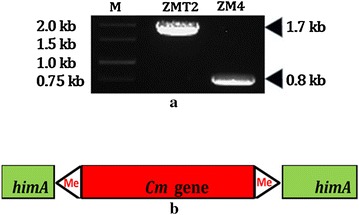
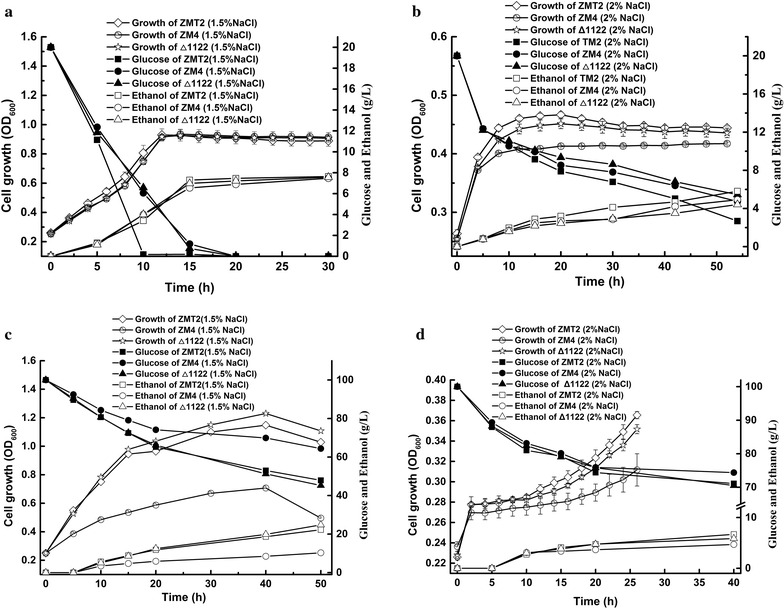
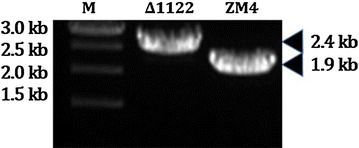
Approximately 200 Z. mobilis ZM4 mutants were generated by using Tn5-based transposon mutagenesis system. The mutant strain ZMT2 with improved salt tolerance phenotype was obtained by screening on RM agar plates with additional 1 % NaCl. Strain ZMT2 was confirmed to exhibit better fermentation performance under NaCl stress than wild type of strain ZM4. The transposon insertion was located in ZMO1122 (himA) by genome walking. Discruption of himA gene showed that himA may play an important role in response to salt tolerance in Z. mobils.
The mutant strain ZMT2 with a transposon insertion in himA gene of the genome showed obviously higher sugar conversion rate to ethonal under up to 2 % NaCl stress than did the wild ZM4 strain. Besides, ZMT2 exhibited shared fermentative capabilities with wild ZM4 strain under no or low NaCl stress. This report firstly showed that himA played a role in responding to NaCl stress. Furthermore, the result indicated that Tn5-based transposon mutagenesis system was a feasible tool not only for genetic engineering in Z. mobilis strain improvement, but also in tapping resistent genes.
运动发酵单胞菌的细胞生长和乙醇产量可能会受到一些基于生物质的发酵系统中常见的盐胁迫的不利影响,导致糖转化为乙醇或其他生物产品的速率降低。为了解决这个问题,提高运动发酵单胞菌的耐盐性是一种理想的方法。然而,在过去几十年中,由于一些技术挑战,在开发具有更高耐盐性的运动发酵单胞菌方面进展有限。最近,转座子插入突变系统已被广泛用作许多生物体中的一种新型遗传工具来开发突变菌株。在本研究中,基于Tn5的转座子插入诱变系统首次用于构建运动发酵单胞菌的高耐盐菌株。
使用基于Tn5的转座子诱变系统产生了约200个运动发酵单胞菌ZM4突变体。通过在添加1% NaCl的RM琼脂平板上筛选获得了具有改善的耐盐表型的突变菌株ZMT2。证实菌株ZMT2在NaCl胁迫下比野生型菌株ZM4表现出更好的发酵性能。通过基因组步移确定转座子插入位于ZMO1122(himA)中。himA基因的破坏表明himA可能在运动发酵单胞菌对盐胁迫的响应中起重要作用。
基因组中himA基因插入转座子的突变菌株ZMT2在高达2% NaCl胁迫下向乙醇的糖转化率明显高于野生ZM4菌株。此外,在无或低NaCl胁迫下,ZMT2与野生ZM4菌株表现出共同的发酵能力。本报告首次表明himA在响应NaCl胁迫中起作用。此外,结果表明基于Tn5的转座子诱变系统不仅是运动发酵单胞菌菌株改良基因工程的可行工具,也是挖掘抗性基因的可行工具。