State Key Laboratory of Cognitive Neuroscience and Learning, Beijing Normal University, Beijing, China.
BMC Neurosci. 2010 May 7;11:60. doi: 10.1186/1471-2202-11-60.
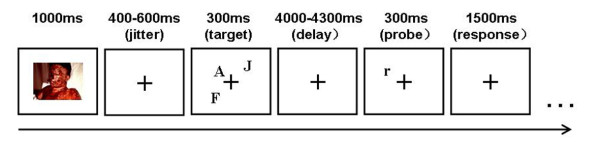
The effects of negative emotion on different processing periods in spatial and verbal working memory (WM) and the possible brain mechanism of the interaction between negative emotion and WM were explored using a high-time resolution event-related potential (ERP) technique and time-locked delayed matching-to-sample task (DMST).
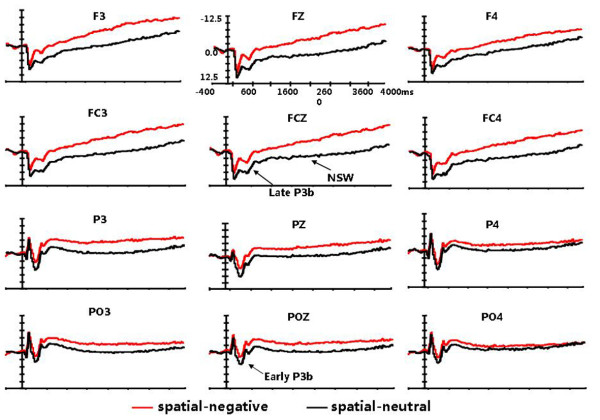
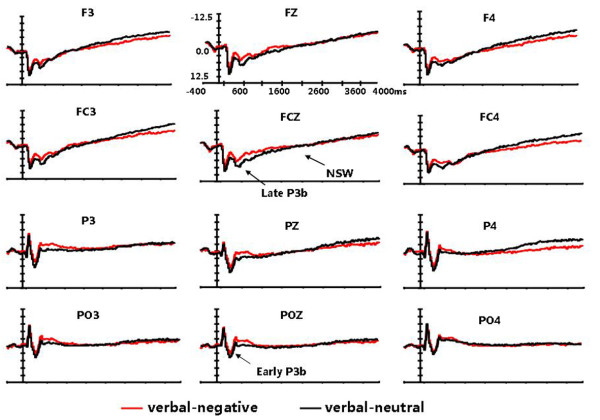
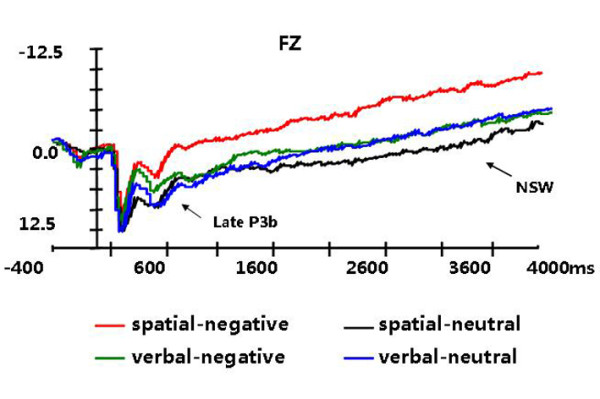
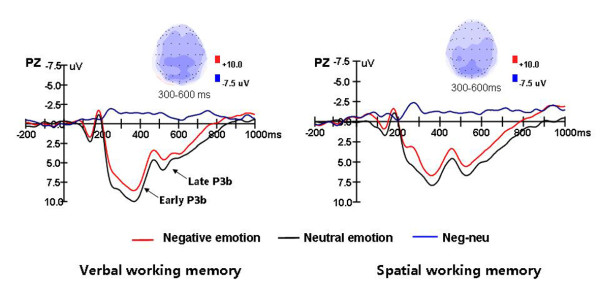
Early P3b and late P3b were reduced in the negative emotion condition for both the spatial and verbal tasks at encoding. At retention, the sustained negative slow wave (NSW) showed a significant interaction between emotional state and task type. Spatial trials in the negative emotion condition elicited a more negative deflection than they did in the neutral emotion condition. However, no such effect was observed for the verbal tasks. At retrieval, early P3b and late P3b were markedly more attenuated in the negative emotion condition than in the neutral emotion condition for both the spatial and verbal tasks.
The results indicate that the differential effects of negative emotion on spatial and verbal WM mainly take place during information maintenance processing, which implies that there is a systematic association between specific affects (e.g., negative emotion) and certain cognitive processes (e.g., spatial retention).
本研究采用高时间分辨率事件相关电位(ERP)技术和时锁延迟匹配样本任务(DMST),探讨了负性情绪对空间和言语工作记忆(WM)不同加工阶段的影响,以及负性情绪与 WM 相互作用的可能脑机制。
在空间和言语任务的编码阶段,负性情绪条件下的早期 P3b 和晚期 P3b 均减少。在保持阶段,负性慢波(NSW)的持续时间表现出情绪状态与任务类型之间的显著交互作用。在负性情绪条件下,空间任务诱发的负向偏转比中性情绪条件下更明显。然而,言语任务并未观察到这种效应。在提取阶段,无论是空间任务还是言语任务,负性情绪条件下的早期 P3b 和晚期 P3b 均比中性情绪条件下明显减弱。
结果表明,负性情绪对空间和言语 WM 的差异影响主要发生在信息维持加工阶段,这表明特定的情绪(如负性情绪)与特定的认知过程(如空间保持)之间存在系统的联系。