Department of Clinical Sciences in Malmö, Cardiovascular Epidemiology, Skåne University Hospital, Malmö, Sweden.
BMC Public Health. 2010 May 10;10:235. doi: 10.1186/1471-2458-10-235.
Although marital status and low occupation level has been associated with mortality, the relationship with case fatality rates (CFR) after a coronary event (CE) is unclear. This study explored whether incidence of CE and short-term CFR differ between groups defined in terms of marital status and occupation, and if this could be explained by biological and life-style risk factors.
Population-based cohort study of 33,224 subjects (67% men), aged 27 to 61 years, without history of myocardial infarction, who were enrolled between 1974 and 1992. Incidence of CE, and CFR (death during the first day or within 28 days after CE, including out-of-hospital deaths) was examined over a mean follow-up of 21 years.
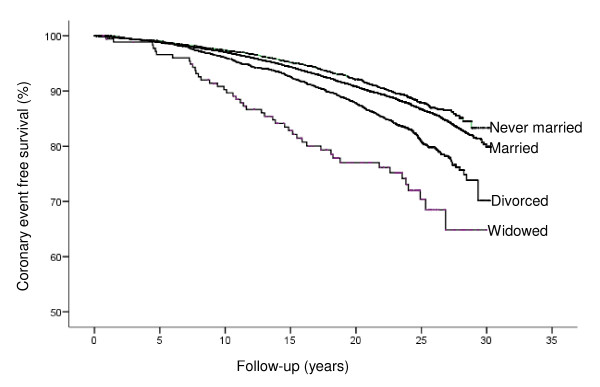
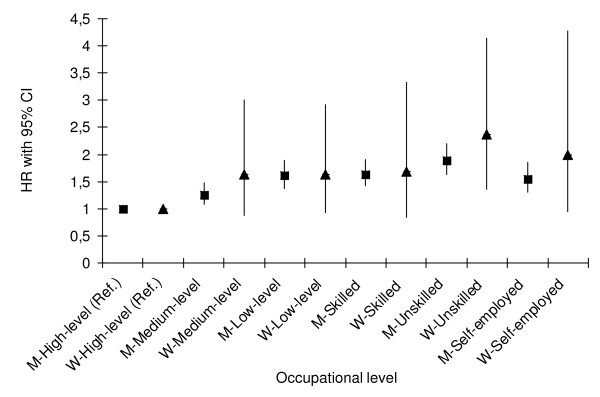
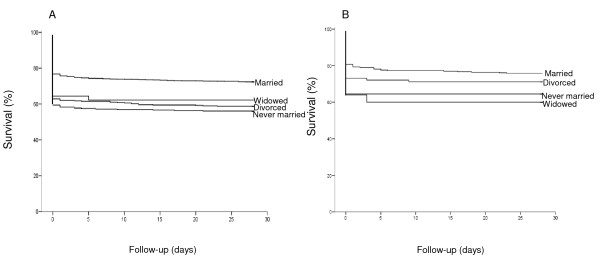
A total of 3,035 men (6.0 per 1000 person-years) and 507 women (2.4 per 1000) suffered a first CE during follow-up. CFR (during the 1st day) was 29% in men and 23% in women. After risk factor adjustments, unmarried status in men, but not in women, was significantly associated with increased risk of suffering a CE [hazard ratios (HR) 1.10, 95% CI: 0.97-1.24; 1.42: 1.27-1.58 and 1.77: 1.31-2.40 for never married, divorced and widowed, respectively, compared to married]. Unmarried status, in both gender, was also related with an increased CFR (1st day), taking potential confounders into account (odds ratio (OR) 2.14, 95% CI: 1.63-2.81; 1.91: 1.50-2.43 and 1.49: 0.77-2.89 for never married, divorced and widowed, respectively, compared to married men. Corresponding figures for women was 2.32: 0.93-5.81; 1.87: 1.04-3.36 and 2.74: 1.03-7.28. No differences in CFR (1st day) were observed between occupational groups in neither gender.
In this population-based Swedish cohort, short-term CFR was significantly related to unmarried status in men and women. This relationship was not explained by biological-, life-style factors or occupational level.
尽管婚姻状况和低职业水平与死亡率有关,但与冠心病事件(CE)后的病死率(CFR)的关系尚不清楚。本研究探讨了根据婚姻状况和职业定义的组别,CE 的发生率和短期 CFR 是否存在差异,以及这是否可以用生物学和生活方式的危险因素来解释。
这是一项基于人群的队列研究,共纳入 33224 名年龄在 27 至 61 岁之间、无心肌梗死病史的受试者(67%为男性),他们于 1974 年至 1992 年期间入组。在平均 21 年的随访期间,观察 CE 的发生率和 CFR(CE 后第 1 天或 28 天内死亡,包括院外死亡)。
共有 3035 名男性(每 1000 人年 6.0 例)和 507 名女性(每 1000 人年 2.4 例)在随访期间首次发生 CE。男性 CFR(第 1 天)为 29%,女性为 23%。在调整了危险因素后,男性未婚状态与 CE 风险增加显著相关(危险比[HR]1.10,95%可信区间:0.97-1.24;1.42:1.27-1.58 和 1.77:1.31-2.40,与已婚相比,分别为未婚、离婚和丧偶)。未婚状态,无论在男性还是女性,都与 CFR(第 1 天)升高有关,同时考虑了潜在的混杂因素(比值比[OR]2.14,95%可信区间:1.63-2.81;1.91:1.50-2.43 和 1.49:0.77-2.89,与已婚男性相比,分别为未婚、离婚和丧偶。对于女性,相应的数字分别为 2.32:0.93-5.81;1.87:1.04-3.36 和 2.74:1.03-7.28。在男性和女性中,职业组别之间的第 1 天 CFR 均无差异。
在这项基于瑞典人群的队列研究中,短期 CFR 与男性和女性的未婚状态显著相关。这种关系不能用生物学、生活方式因素或职业水平来解释。