The MRC Centre for Causal Analyses in Translational Epidemiology, University of Bristol, Oakfield House, Oakfield Grove, Bristol, UK.
Psychol Med. 2011 Feb;41(2):333-43. doi: 10.1017/S0033291710000814. Epub 2010 May 12.
Lower cognitive functioning in early childhood has been proposed as a risk factor for depression in later life but its association with depressive symptoms during adolescence has rarely been investigated. Our study examines the relationship between total intelligence quotient (IQ) score at age 8 years, and depressive symptoms at 11, 13, 14 and 17 years.
Study participants were 5250 children and adolescents from the Avon Longitudinal Study of Parents and their Children (ALSPAC), UK, for whom longitudinal data on depressive symptoms were available. IQ was assessed with the Wechsler Intelligence Scale for Children III, and self-reported depressive symptoms were measured with the Short Mood and Feelings Questionnaire (SMFQ).
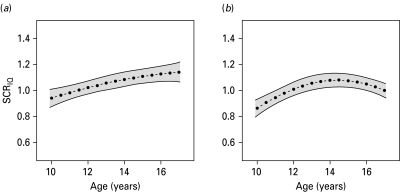
Multi-level analysis on continuous SMFQ scores showed that IQ at age 8 years was inversely associated with depressive symptoms at age 11 years, but the association changed direction by age 13 and 14 years (age-IQ interaction, p<0.0001; age squared-IQ interaction, p<0.0001) when a higher IQ score was associated with a higher risk of depressive symptoms. This change in IQ effect was also found in relation to pubertal stage (pubertal stage-IQ interaction, 0.00049<p=0.038). At age 17 years, however, sex-specific differences emerged (sex-age squared-IQ interaction, p=0.0075). Whilst the risk effect of higher childhood IQ scores for depressive symptoms declined in females, and some analyses even supported an inverse association by age 17 years, it persisted in males.
Our results suggest that the association between cognitive ability in childhood and depressive symptoms in adolescence varies according to age and/or pubertal stage.
儿童早期认知功能较低被认为是晚年患抑郁症的一个风险因素,但很少有研究调查其与青少年时期抑郁症状的关系。我们的研究考察了 8 岁时的总智商(IQ)得分与 11、13、14 和 17 岁时的抑郁症状之间的关系。
研究参与者是来自英国阿冯纵向研究父母及其子女(ALSPAC)的 5250 名儿童和青少年,他们有纵向的抑郁症状数据。智商采用韦氏儿童智力量表 III 进行评估,自我报告的抑郁症状采用短情绪和感觉问卷(SMFQ)进行测量。
对连续 SMFQ 评分的多水平分析表明,8 岁时的 IQ 与 11 岁时的抑郁症状呈负相关,但到 13 岁和 14 岁时,这种关系发生了变化(年龄-IQ 交互作用,p<0.0001;年龄平方-IQ 交互作用,p<0.0001),当较高的 IQ 得分与更高的抑郁症状风险相关时。在与青春期阶段有关的方面也发现了这种 IQ 效应的变化(青春期阶段-IQ 交互作用,0.00049<p=0.038)。然而,在 17 岁时,出现了性别特异性差异(性别-年龄平方-IQ 交互作用,p=0.0075)。虽然童年较高 IQ 分数对抑郁症状的风险效应在女性中下降,并且一些分析甚至支持到 17 岁时的反向关联,但在男性中仍然存在。
我们的研究结果表明,儿童期认知能力与青春期抑郁症状之间的关联随年龄和/或青春期阶段而变化。