Department of Oral Biology, School of Dental Medicine, State University of New York at Buffalo, Buffalo, NY 14214, USA.
Mol Microbiol. 2010 Jul;77(2):354-70. doi: 10.1111/j.1365-2958.2010.07210.x. Epub 2010 May 12.
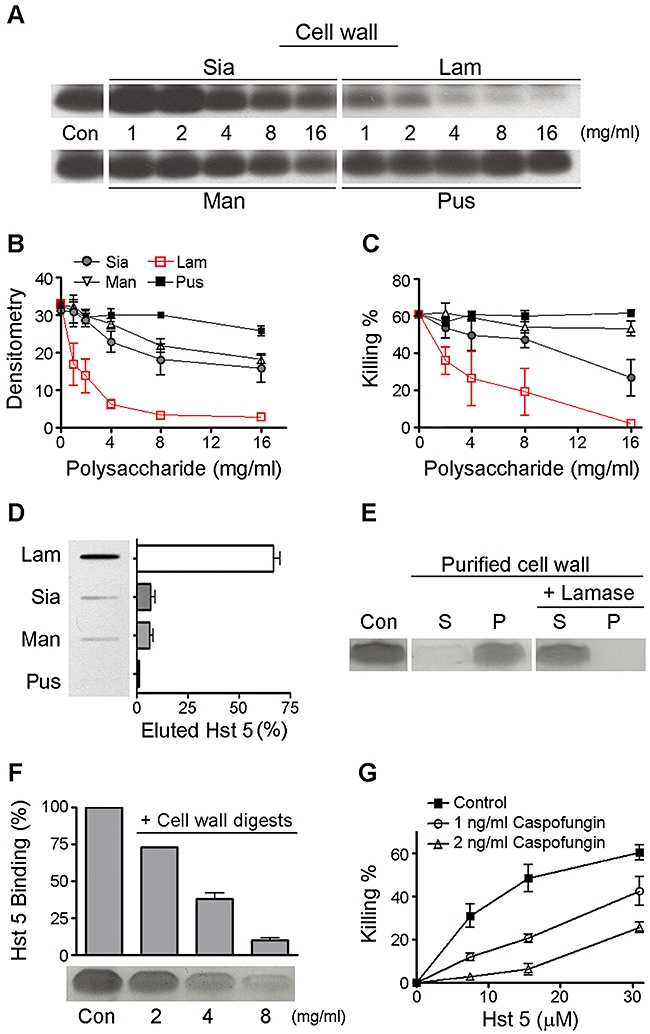
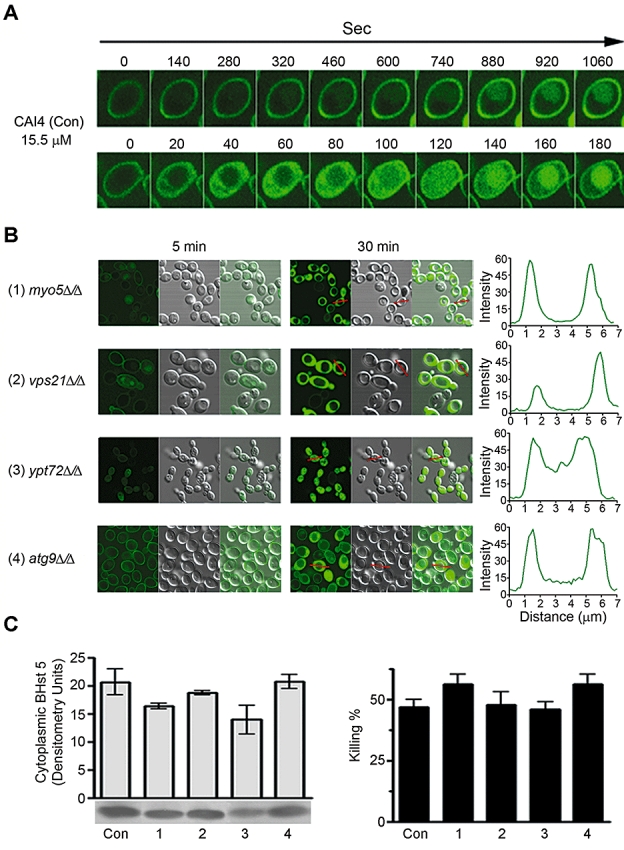
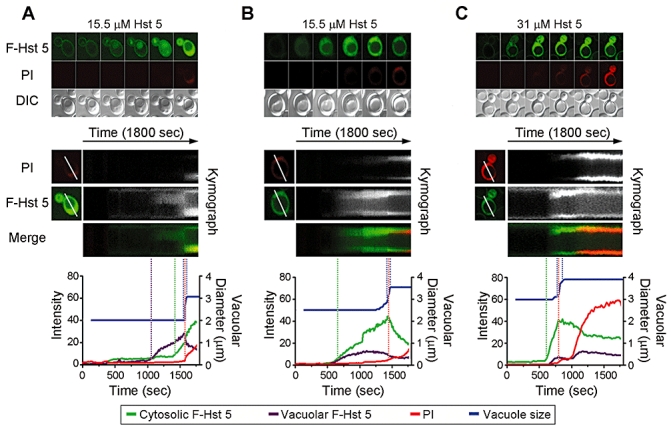
Salivary histatin 5 (Hst 5) is a cationic salivary protein with high fungicidal activity against Candida albicans. Binding to the cell wall followed by intracellular translocation is required for killing; however, specific binding components and critical toxic events are not understood. In this study, laminarin (beta-1,3-glucan) but not sialic acid, mannan or pustulan mediated Hst 5 binding to C. albicans, and was disassociated by 100 mM NaCl. Time-lapse confocal microscopy revealed a dose-dependent rate of cytosolic uptake of Hst 5 that invariably preceded propidium iodide (PI) entry, demonstrating that translocation itself does not disrupt membrane integrity. Cell toxicity was manifest by vacuolar expansion followed by PI entrance; however, loss of endocytotic vacuolar trafficking of Hst 5 did not reduce killing. Extracellular NaCl (100 mM), but not sorbitol, prevented vacuolar expansion and PI entry in cells already containing cytosolic Hst 5, thus showing a critical role for ionic balance in Hst 5 toxicity. Hst 5 uptake, but not cell wall binding, was blocked by pretreatment with azide or carbonyl cyanide m-chlorophenylhydrazone; however, 10% of de-energized cells had membrane disruption. Thus, Hst 5 is capable of heterogeneous intracellular entry routes, but only direct cytosolic translocation causes cell death as a result of ionic efflux.
唾液组蛋白 5(Hst5)是一种具有高杀真菌活性的阳离子唾液蛋白,可有效对抗白色念珠菌。该蛋白需要与细胞壁结合,随后发生细胞内转运才能发挥杀菌作用,但目前还不了解其具体的结合成分和关键毒性事件。在本研究中,发现昆布多糖(β-1,3-葡聚糖)而非唾液酸、甘露聚糖或普鲁兰可介导 Hst5 与白色念珠菌的结合,并且这种结合可被 100mM 氯化钠解离。延时共聚焦显微镜显示,Hst5 以剂量依赖性方式快速进入细胞质,而其进入细胞质的时间早于碘化丙啶(PI)的进入,这表明转运本身不会破坏细胞膜的完整性。细胞毒性表现为液泡扩张,随后 PI 进入细胞;然而,尽管 Hst5 的内吞液泡运输丧失,但并未降低其杀伤能力。细胞外 100mM 氯化钠(而非山梨醇)可阻止已含有细胞质内 Hst5 的细胞中液泡的扩张和 PI 的进入,表明离子平衡在 Hst5 毒性中起着关键作用。Hst5 的摄取,而非细胞壁结合,可被叠氮化物或羰基氰化物 m-氯苯腙预处理所阻断;然而,10%去极化的细胞出现了膜破裂。因此,Hst5 可通过多种非均相的细胞内进入途径,但只有直接的细胞质转运会导致离子外流,从而引发细胞死亡。