Department of Public Health, University of Otago, Box 7343 Wellington South 6242, New Zealand.
BMJ. 2010 May 21;340:c2424. doi: 10.1136/bmj.c2424.
To assess the risk of transmission of pandemic A/H1N1 2009 influenza (pandemic A/H1N1) from an infected high school group to other passengers on an airline flight and the effectiveness of screening and follow-up of exposed passengers.
Retrospective cohort investigation using a questionnaire administered to passengers and laboratory investigation of those with symptoms.
Auckland, New Zealand, with national and international follow-up of passengers.
Passengers seated in the rear section of a Boeing 747-400 long haul flight that arrived on 25 April 2009, including a group of 24 students and teachers and 97 (out of 102) other passengers in the same section of the plane who agreed to be interviewed.
Laboratory confirmed pandemic A/H1N1 infection in susceptible passengers within 3.2 days of arrival; sensitivity and specificity of influenza symptoms for confirmed infection; and completeness and timeliness of contact tracing.
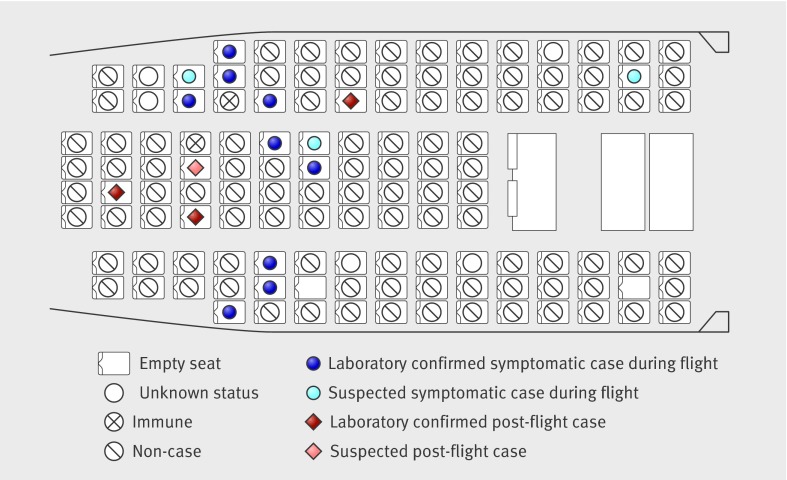
Nine members of the school group were laboratory confirmed cases of pandemic A/H1N1 infection and had symptoms during the flight. Two other passengers developed confirmed pandemic A/H1N1 infection, 12 and 48 hours after the flight. They reported no other potential sources of infection. Their seating was within two rows of infected passengers, implying a risk of infection of about 3.5% for the 57 passengers in those rows. All but one of the confirmed pandemic A/H1N1 infected travellers reported cough, but more complex definitions of influenza cases had relatively low sensitivity. Rigorous follow-up by public health workers located 93% of passengers, but only 52% were contacted within 72 hours of arrival.
A low but measurable risk of transmission of pandemic A/H1N1 exists during modern commercial air travel. This risk is concentrated close to infected passengers with symptoms. Follow-up and screening of exposed passengers is slow and difficult once they have left the airport.
评估感染大流行性 A/H1N1 流感(大流行性 A/H1N1)的高中生群体将病毒传播给航空公司航班上其他乘客的风险,以及对暴露乘客进行筛查和随访的效果。
使用问卷调查对乘客进行回顾性队列研究,并对有症状者进行实验室调查。
新西兰奥克兰,对乘客进行全国性和国际性随访。
2009 年 4 月 25 日抵达的一架波音 747-400 长途航班的后舱座位上的乘客,包括一组 24 名学生和教师,以及飞机同一舱位的 97 名(共 102 名)同意接受采访的其他乘客。
在抵达后 3.2 天内,易感乘客中实验室确认的大流行性 A/H1N1 感染;流感症状对确诊感染的敏感性和特异性;以及接触追踪的完整性和及时性。
学校群体中有 9 名成员实验室确诊为大流行性 A/H1N1 感染,并在飞行过程中出现症状。另外两名乘客在飞行后 12 小时和 48 小时分别确诊患有大流行性 A/H1N1 感染。他们报告没有其他潜在的感染源。他们的座位在受感染乘客的两个座位内,这意味着那些座位上的 57 名乘客感染的风险约为 3.5%。除一名旅行者外,所有确诊患有大流行性 A/H1N1 的旅行者均报告咳嗽,但更复杂的流感病例定义敏感性相对较低。公共卫生工作者进行了严格的随访,找到了 93%的乘客,但只有 52%的乘客在抵达后 72 小时内联系上。
在现代商业航空旅行中,存在可衡量的低水平大流行性 A/H1N1 传播风险。这种风险集中在有症状的受感染乘客附近。一旦乘客离开机场,对暴露乘客的随访和筛查就会缓慢而困难。