• 文献检索
  • 文档翻译
  • 深度研究
  • 学术资讯
  • Suppr Zotero 插件Zotero 插件
  • 邀请有礼
  • 套餐&价格
  • 历史记录
应用&插件
Suppr Zotero 插件Zotero 插件浏览器插件Mac 客户端Windows 客户端微信小程序
定价
高级版会员购买积分包购买API积分包
服务
文献检索文档翻译深度研究API 文档MCP 服务
关于我们
关于 Suppr公司介绍联系我们用户协议隐私条款
关注我们

Suppr 超能文献

核心技术专利:CN118964589B侵权必究
粤ICP备2023148730 号-1Suppr @ 2026

文献检索

告别复杂PubMed语法,用中文像聊天一样搜索,搜遍4000万医学文献。AI智能推荐,让科研检索更轻松。

立即免费搜索

文件翻译

保留排版,准确专业,支持PDF/Word/PPT等文件格式,支持 12+语言互译。

免费翻译文档

深度研究

AI帮你快速写综述,25分钟生成高质量综述,智能提取关键信息,辅助科研写作。

立即免费体验

急性物质使用及伤前物质滥用对入住创伤中心的成年创伤性脑损伤严重程度的影响。

Effects of acute substance use and pre-injury substance abuse on traumatic brain injury severity in adults admitted to a trauma centre.

作者信息

Andelic Nada, Jerstad Tone, Sigurdardottir Solrun, Schanke Anne-Kristine, Sandvik Leiv, Roe Cecilie

机构信息

Department of Physical Medicine and Rehabilitation, Oslo University Hospital, Ulleval, Norway.

出版信息

J Trauma Manag Outcomes. 2010 May 26;4:6. doi: 10.1186/1752-2897-4-6.

DOI:10.1186/1752-2897-4-6
PMID:20504353
原文链接:https://pmc.ncbi.nlm.nih.gov/articles/PMC2890596/
Abstract

BACKGROUND

The aims of this study were to describe the occurrence of substance use at the time of injury and pre-injury substance abuse in patients with moderate-to-severe traumatic brain injury (TBI). Effects of acute substance use and pre-injury substance abuse on TBI severity were also investigated.

METHODS

A prospective study of 111 patients, aged 16-55 years, injured from May 2005 to May 2007 and hospitalised at the Trauma Referral Centre in Eastern Norway with acute TBI (Glasgow Coma Scale 3-12). Based on structural brain damages shown on a computed tomography (CT) scan, TBI severity was defined by modified Marshall classification as less severe (score <3) and more severe (score >/=3). Clinical definition of substance use (alcohol and/or other psychoactive substances) was applied when hospital admission records reflected blood alcohol levels or a positive drug screen, or when a physician verified influence by examining the patient. Pre-injury substance abuse (alcohol and drug problems) was screened by using the CAGE questionnaire.

RESULTS

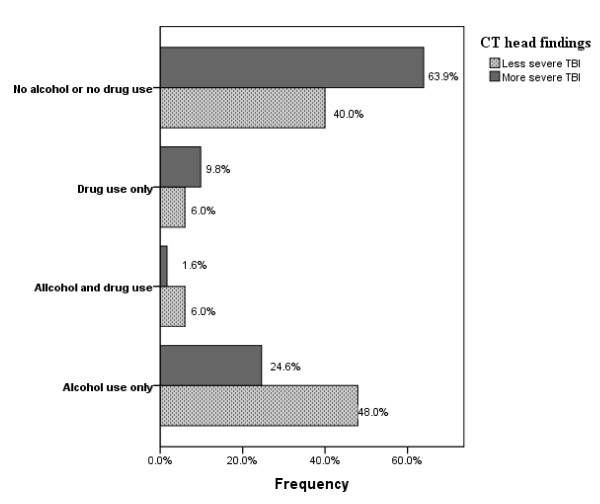
Forty-seven percent of patients were positive for substance use on admission to hospital. Significant pre-injury substance abuse was reported by 26% of patients. Substance use at the time of injury was more frequent in the less severe group (p = 0.01). The frequency of pre-injury substance abuse was higher in the more severe group (30% vs. 23%). In a logistic regression model, acute substance use at time of injury tended to decrease the probability of more severe intracranial injury, but the effect was not statistically significant after adjusting for age, gender, education, cause of injury and substance abuse, OR = 0.39; 95% CI 0.11-1.35, p = 0.14. Patients with positive screens for pre-injury substance abuse (CAGE >/=2) were more likely to have more severe TBI in the adjusted regression analyses, OR = 4.05; 95% CI 1.10-15.64, p = 0.04.

CONCLUSIONS

Acute substance use was more frequent in patients with less severe TBI caused by low-energy events such as falls, violence and sport accidents. Pre-injury substance abuse increased the probability of more severe TBI caused by high-energy trauma such as motor vehicle accidents and falls from higher levels. Preventive efforts to reduce substance consumption and abuse in at-risk populations are needed.

摘要

背景

本研究旨在描述中度至重度创伤性脑损伤(TBI)患者受伤时物质使用情况及伤前物质滥用情况。还调查了急性物质使用和伤前物质滥用对TBI严重程度的影响。

方法

对2005年5月至2007年5月期间受伤、年龄在16 - 55岁、因急性TBI(格拉斯哥昏迷量表评分为3 - 12分)入住挪威东部创伤转诊中心的111例患者进行前瞻性研究。根据计算机断层扫描(CT)显示的脑结构损伤,TBI严重程度通过改良马歇尔分类法定义为轻度(评分<3)和重度(评分≥3)。当入院记录显示血酒精水平或药物筛查呈阳性,或医生通过检查患者证实有影响时,采用物质使用(酒精和/或其他精神活性物质)的临床定义。使用CAGE问卷筛查伤前物质滥用(酒精和药物问题)。

结果

47%的患者入院时物质使用呈阳性。26%的患者报告有明显的伤前物质滥用。轻度组受伤时物质使用更为频繁(p = 0.01)。重度组伤前物质滥用频率更高(30%对23%)。在逻辑回归模型中,受伤时急性物质使用倾向于降低重度颅内损伤的概率,但在调整年龄、性别、教育程度、损伤原因和物质滥用后,该效应无统计学意义,OR = 0.39;95% CI 0.11 - 1.35,p = 0.14。在调整后的回归分析中,伤前物质滥用筛查呈阳性(CAGE≥2)的患者更有可能患有重度TBI,OR = 4.05;95% CI 1.10 - 15.64,p = 0.04。

结论

在因跌倒、暴力和体育事故等低能量事件导致的轻度TBI患者中,急性物质使用更为频繁。伤前物质滥用增加了因机动车事故和高处坠落等高能量创伤导致重度TBI的可能性。需要对高危人群采取预防措施以减少物质消费和滥用。
https://cdn.ncbi.nlm.nih.gov/pmc/blobs/4964/2890596/5fc3eeda8516/1752-2897-4-6-1.jpg

相似文献

1
Effects of acute substance use and pre-injury substance abuse on traumatic brain injury severity in adults admitted to a trauma centre.急性物质使用及伤前物质滥用对入住创伤中心的成年创伤性脑损伤严重程度的影响。
J Trauma Manag Outcomes. 2010 May 26;4:6. doi: 10.1186/1752-2897-4-6.
2
Moderate and severe traumatic brain injury: effect of blood alcohol concentration on Glasgow Coma Scale score and relation to computed tomography findings.中度和重度创伤性脑损伤:血液酒精浓度对格拉斯哥昏迷量表评分的影响及其与计算机断层扫描结果的关系。
J Neurosurg. 2015 Jan;122(1):211-8. doi: 10.3171/2014.9.JNS14322.
3
The impact of pre-injury anticoagulation therapy in the older adult patient experiencing a traumatic brain injury: A systematic review.伤前抗凝治疗对老年创伤性脑损伤患者的影响:一项系统综述。
JBI Libr Syst Rev. 2012;10(58):4610-4621. doi: 10.11124/jbisrir-2012-429.
4
The burden of traumatic brain injury from low-energy falls among patients from 18 countries in the CENTER-TBI Registry: A comparative cohort study.来自 CENTER-TBI 登记处的 18 个国家的患者中,低能量坠落导致的创伤性脑损伤负担:一项比较队列研究。
PLoS Med. 2021 Sep 14;18(9):e1003761. doi: 10.1371/journal.pmed.1003761. eCollection 2021 Sep.
5
Impact of Glasgow Coma Scale score and pupil parameters on mortality rate and outcome in pediatric and adult severe traumatic brain injury: a retrospective, multicenter cohort study.格拉斯哥昏迷评分和瞳孔参数对儿童和成人严重创伤性脑损伤患者死亡率和预后的影响:一项回顾性、多中心队列研究。
J Neurosurg. 2017 Mar;126(3):760-767. doi: 10.3171/2016.1.JNS152385. Epub 2016 Apr 1.
6
Intramural Healthcare Consumption and Costs After Traumatic Brain Injury: A Collaborative European NeuroTrauma Effectiveness Research in Traumatic Brain Injury (CENTER-TBI) Study.创伤性脑损伤后的院内医疗保健消费和成本:一项协作性的欧洲神经创伤有效性研究创伤性脑损伤(CENTER-TBI)研究。
J Neurotrauma. 2023 Oct;40(19-20):2126-2145. doi: 10.1089/neu.2022.0429. Epub 2023 Jun 28.
7
Patients with severe traumatic brain injury transferred to a Level I or II trauma center: United States, 2007 to 2009.2007 年至 2009 年期间,严重创伤性脑损伤患者转送至一级或二级创伤中心:美国。
J Trauma Acute Care Surg. 2012 Dec;73(6):1491-9. doi: 10.1097/TA.0b013e3182782675.
8
Traumatic brain injuries in older adults-6 years of data for one UK trauma centre: retrospective analysis of prospectively collected data.老年人创伤性脑损伤——英国一家创伤中心6年的数据:对前瞻性收集数据的回顾性分析
Emerg Med J. 2017 Aug;34(8):509-516. doi: 10.1136/emermed-2016-206506. Epub 2017 Jan 4.
9
Ability of Fibrin Monomers to Predict Progressive Hemorrhagic Injury in Patients with Severe Traumatic Brain Injury.纤维蛋白单体预测严重创伤性脑损伤患者进行性出血性损伤的能力。
Neurocrit Care. 2020 Aug;33(1):182-195. doi: 10.1007/s12028-019-00882-6.
10
[Home falls in infants before walking acquisition].[婴儿在学会走路之前的家庭跌倒情况]
Arch Pediatr. 2013 May;20(5):484-91. doi: 10.1016/j.arcped.2013.02.071. Epub 2013 Apr 4.

引用本文的文献

1
Digital Toxicology Teleconsultation for Adult Poisoning Cases in Saudi Hospitals: A Nationwide Study.沙特医院成人中毒病例的数字毒理学远程会诊:一项全国性研究。
Healthcare (Basel). 2025 Feb 21;13(5):474. doi: 10.3390/healthcare13050474.
2
Delirium in Neurocritical Care: Uncovering Undisclosed Psychotropic Substance and Medication Use and Stress Exposure by Hair Analysis.神经重症监护中的谵妄:通过毛发分析揭示未公开的精神药物使用、药物使用及压力暴露情况。
Neurocrit Care. 2025 Feb;42(1):164-174. doi: 10.1007/s12028-024-02052-9. Epub 2024 Jul 16.
3
Opioid-related polysubstance use and its effect on mortality and health resource utilization among trauma patients.

本文引用的文献

1
Comparisons of the Outcome Prediction Performance of Injury Severity Scoring Tools Using the Abbreviated Injury Scale 90 Update 98 (AIS 98) and 2005 Update 2008 (AIS 2008).使用简明损伤定级标准90版更新98版(AIS 98)和2005版更新2008版(AIS 2008)的损伤严重度评分工具的结果预测性能比较
Ann Adv Automot Med. 2011;55:255-65.
2
Traumatic brain injury and substance abuse: A review and analysis of the literature.创伤性脑损伤与物质滥用:文献回顾与分析。
Neuropsychol Rehabil. 2003 Jan-Mar;13(1-2):165-88. doi: 10.1080/09602010244000336.
3
Post-concussion symptoms after traumatic brain injury at 3 and 12 months post-injury: a prospective study.
阿片类药物相关的多物质使用及其对创伤患者死亡率和卫生资源利用的影响。
Inj Epidemiol. 2023 Oct 23;10(1):54. doi: 10.1186/s40621-023-00459-0.
4
Association Between Lifetime Sexual Violence and Recent Traumatic Brain Injury Among Adults: 2017 Connecticut Behavioral Risk Factor Surveillance System.成年人一生中遭受的性暴力与近期创伤性脑损伤之间的关联:2017年康涅狄格州行为危险因素监测系统
J Interpers Violence. 2024 Mar;39(5-6):1351-1367. doi: 10.1177/08862605231203962. Epub 2023 Oct 7.
5
Substance use and adolescent injuries: a multi-country analysis of the association and mediating effect of interpersonal violence among 122,945 in-school paediatric populations in 29 countries.物质使用与青少年伤害:29 个国家 122945 名在校儿科人群中人际暴力的相关性及其中介作用的多国分析。
Front Public Health. 2023 Jul 20;11:1193711. doi: 10.3389/fpubh.2023.1193711. eCollection 2023.
6
Comparability of (Post-Concussion) Symptoms across Time in Individuals after Traumatic Brain Injury: Results from the CENTER-TBI Study.创伤性脑损伤后个体(脑震荡后)症状随时间的可比性:CENTER-TBI研究结果
J Clin Med. 2022 Jul 14;11(14):4090. doi: 10.3390/jcm11144090.
7
In the Aftermath of Acute Hospitalization for Traumatic Brain Injury: Factors Associated with the Direct Pathway into Specialized Rehabilitation.创伤性脑损伤急性住院治疗后:与直接进入专科康复治疗途径相关的因素
J Clin Med. 2021 Aug 14;10(16):3577. doi: 10.3390/jcm10163577.
8
Use of Medical Cannabis to Treat Traumatic Brain Injury.医用大麻治疗创伤性脑损伤。
J Neurotrauma. 2021 Jul 15;38(14):1904-1917. doi: 10.1089/neu.2020.7148. Epub 2021 Jan 25.
9
Sex, Drugs, and TBI: The Role of Sex in Substance Abuse Related to Traumatic Brain Injuries.性别、药物与创伤性脑损伤:性别在与创伤性脑损伤相关的药物滥用中的作用
Front Neurol. 2020 Oct 19;11:546775. doi: 10.3389/fneur.2020.546775. eCollection 2020.
10
Characteristics of traumatic brain injury patients with abnormal neuroimaging in Southeast Norway.挪威东南部神经影像学异常的创伤性脑损伤患者的特征
Inj Epidemiol. 2020 Sep 1;7(1):45. doi: 10.1186/s40621-020-00269-8.
创伤性脑损伤后3个月和12个月时的脑震荡后症状:一项前瞻性研究。
Brain Inj. 2009 Jun;23(6):489-97. doi: 10.1080/02699050902926309.
4
The impact of substance abuse on mortality in patients with severe traumatic brain injury.药物滥用对重度创伤性脑损伤患者死亡率的影响。
J Trauma. 2008 Sep;65(3):674-7. doi: 10.1097/TA.0b013e31817db0a5.
5
Prevalence of alcohol and drugs among Norwegian motor vehicle drivers: a roadside survey.挪威机动车驾驶员中酒精和药物的流行情况:一项路边调查。
Accid Anal Prev. 2008 Sep;40(5):1765-72. doi: 10.1016/j.aap.2008.06.015. Epub 2008 Jul 18.
6
Moderate and severe traumatic brain injury in adults.成人中度和重度创伤性脑损伤
Lancet Neurol. 2008 Aug;7(8):728-41. doi: 10.1016/S1474-4422(08)70164-9.
7
Incidence of hospital-treated traumatic brain injury in the Oslo population.奥斯陆人群中医院收治的创伤性脑损伤发病率。
Neuroepidemiology. 2008;30(2):120-8. doi: 10.1159/000120025. Epub 2008 Mar 11.
8
Alcohol-related adverse consequences: cross-cultural variations in attribution process among young adults.与酒精相关的不良后果:年轻人归因过程中的跨文化差异
Eur J Public Health. 2008 Aug;18(4):386-91. doi: 10.1093/eurpub/ckn007. Epub 2008 Feb 19.
9
Alcohol and drug use following traumatic brain injury: a prospective study.创伤性脑损伤后的酒精和药物使用:一项前瞻性研究。
Brain Inj. 2007 Dec;21(13-14):1385-92. doi: 10.1080/02699050701796960.
10
G*Power 3: a flexible statistical power analysis program for the social, behavioral, and biomedical sciences.G*Power 3:一款适用于社会科学、行为科学和生物医学科学的灵活的统计功效分析程序。
Behav Res Methods. 2007 May;39(2):175-91. doi: 10.3758/bf03193146.