Logan David J, Carpenter Anne E
Imaging Platform, The Broad Institute of MIT and Harvard, Cambridge, MA, USA.
J Biomol Screen. 2010 Aug;15(7):840-6. doi: 10.1177/1087057110370895. Epub 2010 Jun 1.
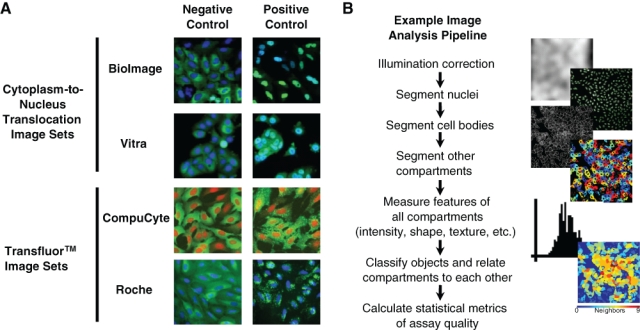
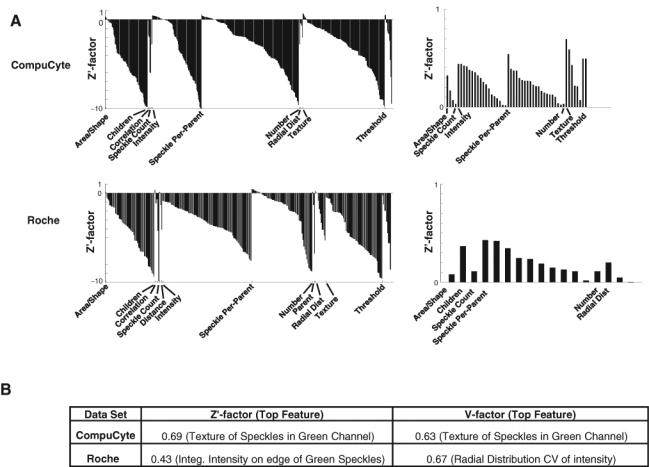
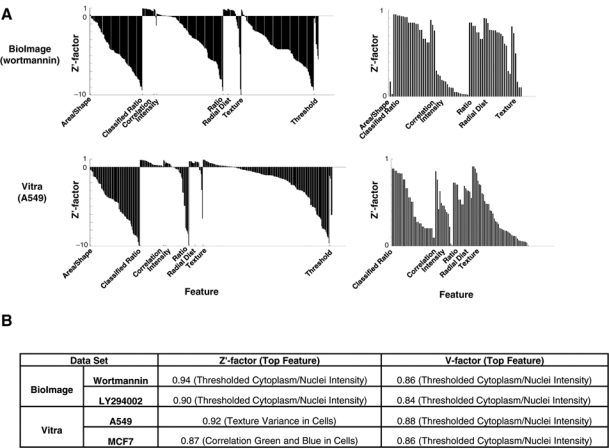
The typical "design" approach to image-based assay development involves choosing measurements that are likely to correlate with the phenotype of interest, based on the researcher's intuition and knowledge of image analysis. An alternate "screening" approach is to measure a large number of cellular features and systematically test each feature to identify those that are best able to distinguish positive and negative controls while taking precautions to avoid overfitting the available data. The cell measurement software the authors previously developed, CellProfiler, makes both approaches straightforward, easing the process of assay development. Here, they demonstrate the use of the screening approach to image assay development to select the best measures for scoring publicly available image sets of 2 cytoplasm-to-nucleus translocation assays and 2 Transfluor assays. The authors present the resulting assay quality measures as a baseline for future algorithm comparisons, and all software, methods, and images they present are freely available.
基于图像的分析方法开发的典型“设计”方法是,根据研究人员对图像分析的直觉和知识,选择可能与感兴趣的表型相关的测量方法。另一种“筛选”方法是测量大量细胞特征,并系统地测试每个特征,以识别那些最能区分阳性和阴性对照的特征,同时采取预防措施以避免过度拟合现有数据。作者之前开发的细胞测量软件CellProfiler,使这两种方法都变得简单直接,简化了分析方法的开发过程。在这里,他们展示了使用筛选方法进行图像分析开发,以选择对公开可用的2种细胞质到细胞核转位分析和2种Transfluor分析的图像集进行评分的最佳测量方法。作者将所得的分析质量测量结果作为未来算法比较的基线,并且他们展示的所有软件、方法和图像都是免费可用的。