Mueller Andreas, Candrian Gian, Kropotov Juri D, Ponomarev Valery A, Baschera Gian-Marco
Brain and Trauma Foundation Grisons, Poststrasse 22, 7000 Chur, Switzerland.
Institute of the Human Brain of Russian Academy of Sciences, ul. Acad. Pavlova 9, 197376 St. Petersburg, Russian Federation.
Nonlinear Biomed Phys. 2010 Jun 3;4 Suppl 1(Suppl 1):S1. doi: 10.1186/1753-4631-4-S1-S1.
In the context of sensory and cognitive-processing deficits in ADHD patients, there is considerable evidence of altered event related potentials (ERP). Most of the studies, however, were done on ADHD children. Using the independent component analysis (ICA) method, ERPs can be decomposed into functionally different components. Using the classification method of support vector machine, this study investigated whether features of independent ERP components can be used for discrimination of ADHD adults from healthy subjects.
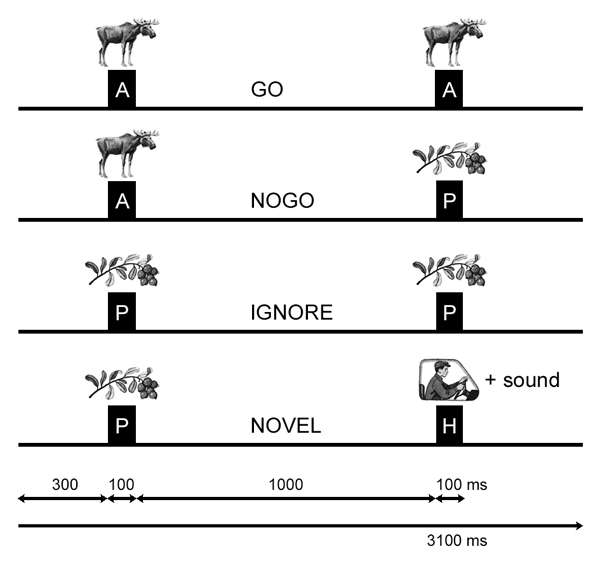
Two groups of age- and sex-matched adults (74 ADHD, 74 controls) performed a visual two stimulus GO/NOGO task. ERP responses were decomposed into independent components by means of ICA. A feature selection algorithm defined a set of independent component features which was entered into a support vector machine.
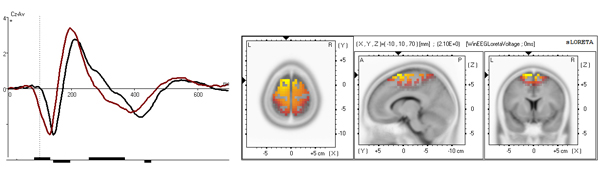
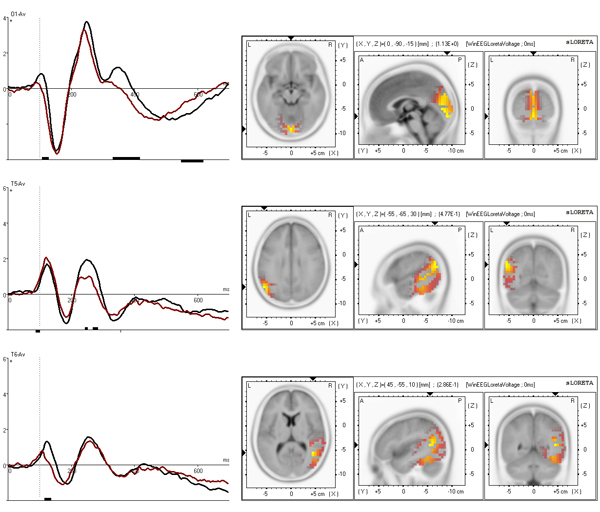
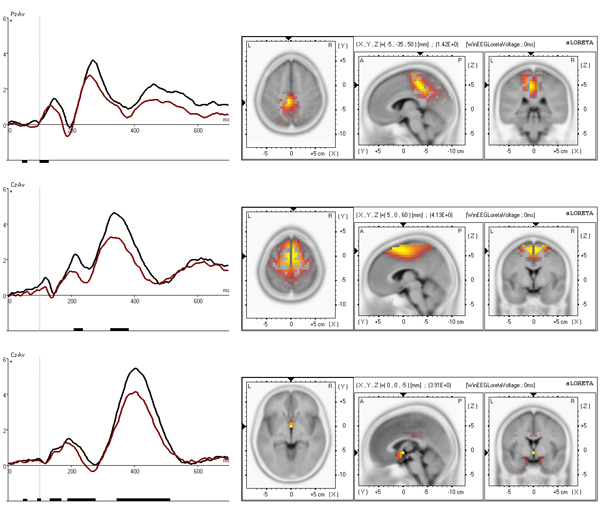
The feature set consisted of five latency measures in specific time windows, which were collected from four different independent components. The independent components involved were a novelty component, a sensory related and two executive function related components. Using a 10-fold cross-validation approach, classification accuracy was 92%.
This study was a first attempt to classify ADHD adults by means of support vector machine which indicates that classification by means of non-linear methods is feasible in the context of clinical groups. Further, independent ERP components have been shown to provide features that can be used for characterizing clinical populations.
在注意缺陷多动障碍(ADHD)患者存在感觉和认知加工缺陷的情况下,有大量证据表明其事件相关电位(ERP)发生了改变。然而,大多数研究是针对ADHD儿童进行的。使用独立成分分析(ICA)方法,ERP可分解为功能不同的成分。本研究采用支持向量机分类方法,调查独立ERP成分的特征是否可用于区分ADHD成人与健康受试者。
两组年龄和性别匹配的成年人(74例ADHD患者,74例对照)进行视觉双刺激GO/NOGO任务。通过ICA将ERP反应分解为独立成分。一种特征选择算法定义了一组独立成分特征,并将其输入支持向量机。
特征集由特定时间窗口内的五个潜伏期测量值组成,这些测量值从四个不同的独立成分中收集。涉及的独立成分包括一个新奇成分、一个感觉相关成分和两个执行功能相关成分。采用10折交叉验证方法,分类准确率为92%。
本研究首次尝试通过支持向量机对ADHD成人进行分类,这表明在临床群体中使用非线性方法进行分类是可行的。此外,已证明独立ERP成分可提供用于表征临床群体的特征。