Institute of Basic Medical Sciences, National Cheng Kung University, Tainan, Taiwan, Republic of China.
PLoS One. 2010 May 27;5(5):e10844. doi: 10.1371/journal.pone.0010844.
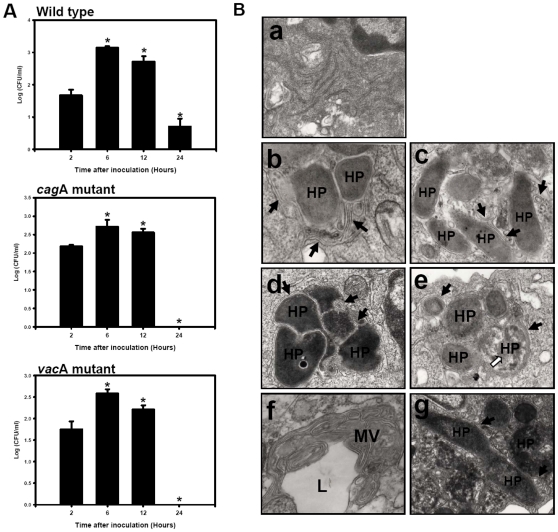
Helicobacter pylori, a human pathogen associated with chronic gastritis, peptic ulcer and gastric malignancies, is generally viewed as an extracellular microorganism. Here, we show that H. pylori replicates in murine bone marrow derived-dendritic cells (BMDCs) within autophagosomes.
METHODOLOGY/PRINCIPAL FINDINGS: A 10-fold increase of CFU is found between 2 h and 6 h p.i. in H. pylori-infected BMDCs. Autophagy is induced around the bacterium and participates at late time points of infection for the clearance of intracellular H. pylori. As a consequence of infection, LC3, LAMP1 and MHC class II molecules are retained within the H. pylori-containing vacuoles and export of MHC class II molecules to cell surface is blocked. However, formalin-fixed H. pylori still maintain this inhibitory activity in BMDC derived from wild type mice, but not in from either TLR4 or TLR2-deficient mice, suggesting the involvement of H. pylori-LPS in this process. TNF-alpha, IL-6 and IL-10 expression was also modulated upon infection showing a TLR2-specific dependent IL-10 secretion. No IL-12 was detected favoring the hypothesis of a down modulation of DC functions during H. pylori infection. Furthermore, antigen-specific T cells proliferation was also impaired upon infection.
CONCLUSIONS/SIGNIFICANCE: H. pylori can infect and replicate in BMDCs and thereby affects DC-mediated immune responses. The implication of this new finding is discussed for the biological life cycle of H. pylori in the host.
幽门螺杆菌是一种与慢性胃炎、消化性溃疡和胃癌相关的人类病原体,通常被认为是一种细胞外微生物。在这里,我们表明幽门螺杆菌在自噬体中复制在鼠骨髓来源的树突状细胞(BMDC)中。
方法/主要发现:在感染幽门螺杆菌的 BMDC 中,在 2 小时至 6 小时之间 CFU 增加了 10 倍。自噬在细菌周围被诱导,并在感染的后期阶段参与清除细胞内的幽门螺杆菌。作为感染的结果,LC3、LAMP1 和 MHC II 类分子保留在含有幽门螺杆菌的空泡内,并且 MHC II 类分子的细胞表面输出被阻断。然而,福尔马林固定的幽门螺杆菌在来自野生型小鼠的 BMDC 中仍然保持这种抑制活性,但在 TLR4 或 TLR2 缺陷型小鼠的 BMDC 中则不然,这表明幽门螺杆菌-LPS 参与了这一过程。感染后还调节了 TNF-α、IL-6 和 IL-10 的表达,显示 TLR2 特异性依赖的 IL-10 分泌。未检测到 IL-12,有利于在幽门螺杆菌感染期间下调 DC 功能的假说。此外,感染后抗原特异性 T 细胞增殖也受到损害。
结论/意义:幽门螺杆菌可以感染和复制在 BMDC 中,从而影响 DC 介导的免疫反应。这一新发现的意义将为幽门螺杆菌在宿主中的生物学生命周期进行讨论。