Institute of Membrane & Systems Biology, Faculty of Biological Sciences, University of Leeds, Leeds, LS2 9JT, UK.
BMC Musculoskelet Disord. 2010 Jun 4;11:111. doi: 10.1186/1471-2474-11-111.
Calcium-permeable channels are known to have roles in many mammalian cell types but the expression and contribution of such ion channels in synovial cells is mostly unknown. The objective of this study was to investigate the potential relevance of Transient Receptor Potential Melastatin 3 (TRPM3) channel to fibroblast-like synoviocytes (FLSs) of patients with rheumatoid arthritis.
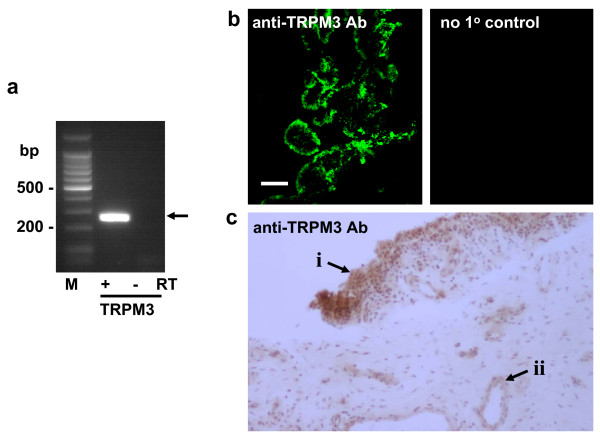
The study used RT-PCR and immunofluorescence to detect mRNA and protein. Intracellular calcium measurement detected channel activity in a FLS cell-line and primary cultures of FLSs from patients with rheumatoid arthritis. Enzyme-linked immunosorbent assays measured hyaluronan.
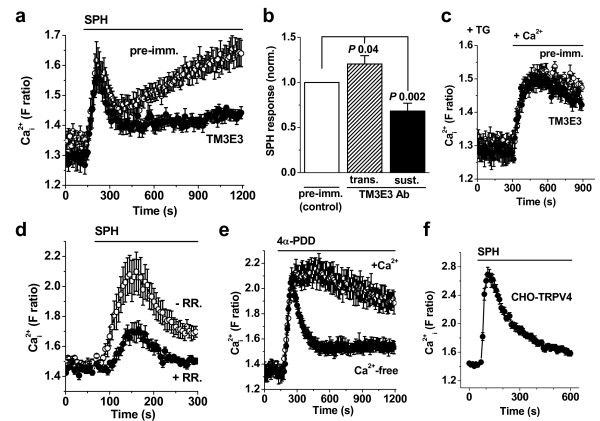
Endogenous expression of TRPM3 was detected. Previously reported stimulators of TRPM3 sphingosine and pregnenolone sulphate evoked sustained elevation of intracellular calcium in FLSs. The FLS cell-line showed an initial transient response to sphingosine which may be explained by TRPV4 channels but was not observed in FLSs from patients. Blocking antibody targeted to TRPM3 inhibited sustained sphingosine and pregnenolone sulphate responses. Secretion of hyaluronan, which contributes adversely in rheumatoid arthritis, was suppressed by pregnenolone sulphate in FLSs from patients and the effect was blocked by anti-TRPM3 antibody.
The data suggest that FLSs of patients with rheumatoid arthritis express TRPM3-containing ion channels that couple negatively to hyaluronan secretion and can be stimulated by pharmacological concentrations of pregnenolone sulphate.
已知钙通透性通道在许多哺乳动物细胞类型中具有作用,但滑膜细胞中这种离子通道的表达和作用大多未知。本研究的目的是研究瞬时受体电位 melastatin 3(TRPM3)通道在类风湿关节炎患者成纤维样滑膜细胞(FLS)中的潜在相关性。
本研究使用 RT-PCR 和免疫荧光检测 mRNA 和蛋白。在成纤维样滑膜细胞系和类风湿关节炎患者的成纤维样滑膜细胞原代培养物中,通过细胞内钙测量检测通道活性。酶联免疫吸附测定法测量透明质酸。
检测到内源性 TRPM3 的表达。先前报道的 TRPM3 激动剂神经鞘氨醇和孕烯醇酮硫酸盐可诱发 FLSs 中细胞内钙的持续升高。成纤维样滑膜细胞系对神经鞘氨醇表现出初始的短暂反应,这可能是由 TRPV4 通道解释的,但在患者的成纤维样滑膜细胞中未观察到。针对 TRPM3 的阻断抗体抑制了神经鞘氨醇和孕烯醇酮硫酸盐的持续反应。透明质酸的分泌在类风湿关节炎中产生不利影响,孕烯醇酮硫酸盐可抑制患者成纤维样滑膜细胞中透明质酸的分泌,而抗 TRPM3 抗体可阻断该作用。
数据表明,类风湿关节炎患者的 FLSs 表达含有 TRPM3 的离子通道,该通道与透明质酸分泌呈负相关,并且可以被药理学浓度的孕烯醇酮硫酸盐刺激。