Suppr超能文献

环丙沙星和其他氟喹诺酮类抗生素的眼部光毒性的检测和预防。

Detection and prevention of ocular phototoxicity of ciprofloxacin and other fluoroquinolone antibiotics.

机构信息

Laboratory of Toxicology and Pharmacology, National Institute of Environmental Health Sciences, NIH, Research Triangle Park, NC, USA.

出版信息

Photochem Photobiol. 2010 Jul-Aug;86(4):798-805. doi: 10.1111/j.1751-1097.2010.00755.x. Epub 2010 Jun 1.

Abstract

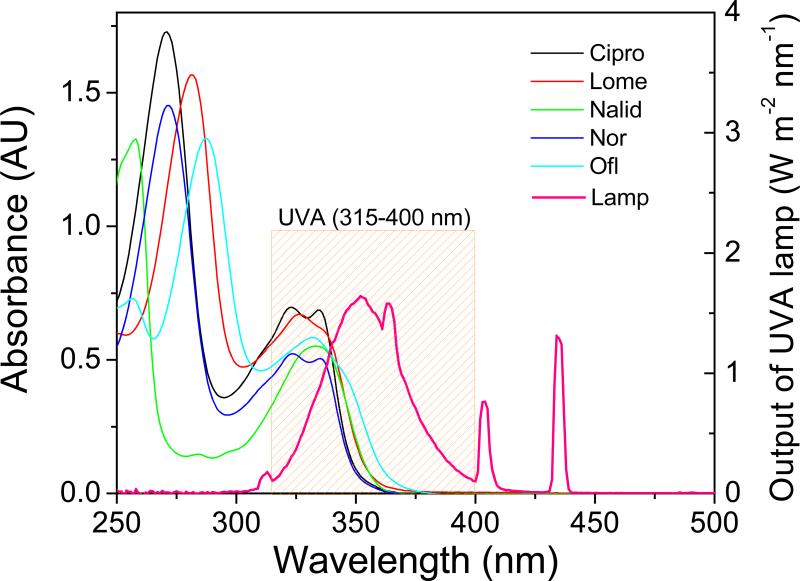
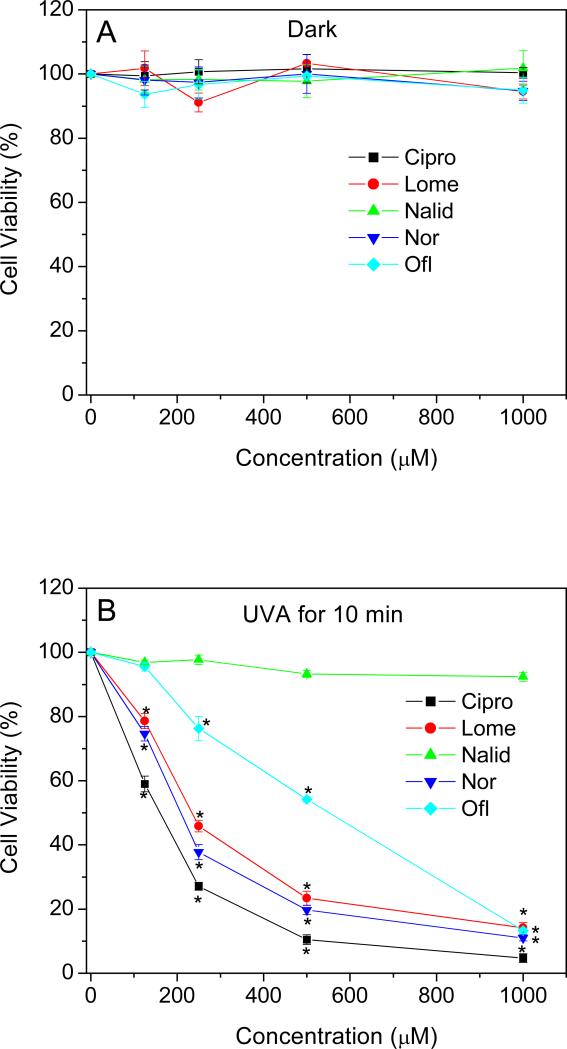
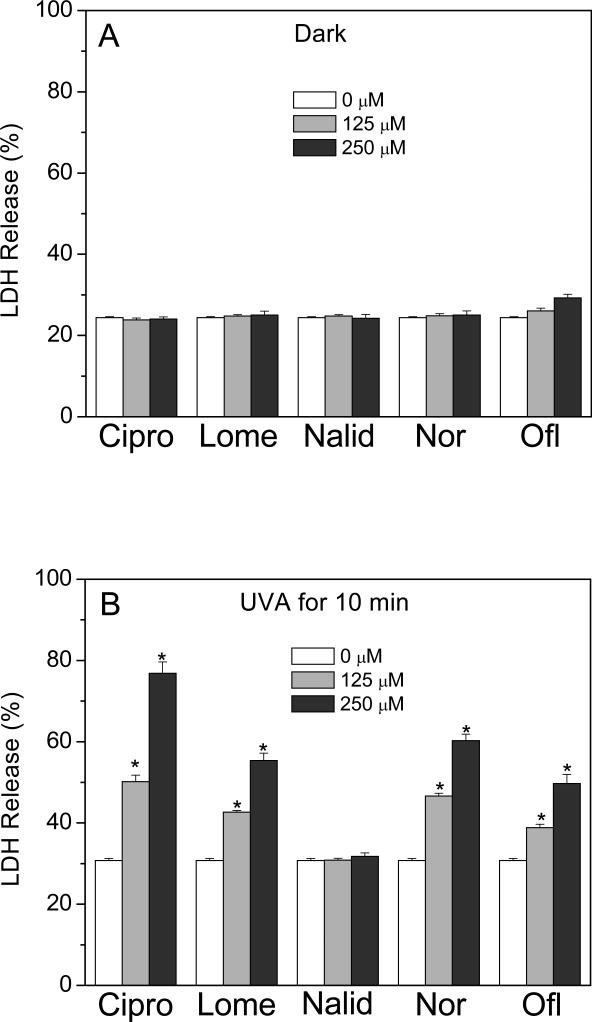
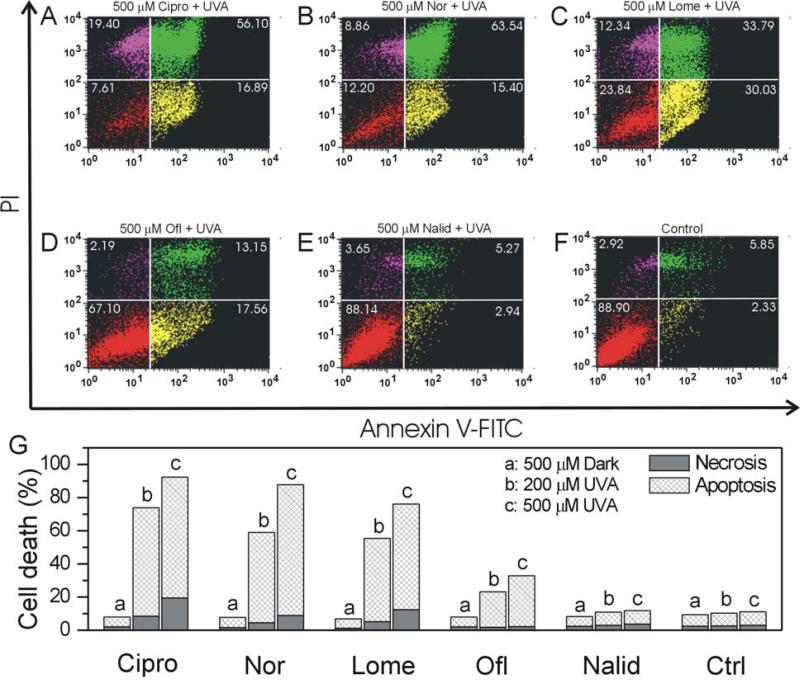
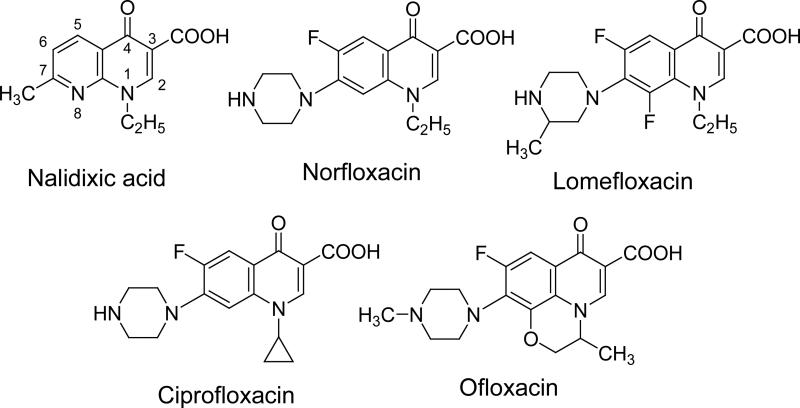
Fluoroquinolone (FLQ) drugs are a potent family of antibiotics used to treat infections including ocular infections. To determine if these antibiotics may be phototoxic to the eye, we exposed human lens epithelial cells to 0.125-1 mm FLQs (ciprofloxacin [Cipro], lomefloxacin [Lome], norfloxacin [Nor] and ofloxacin [Ofl]), the precursor quinolone nalidixic acid (Nalid) and UVA radiation (2.5 J cm(-2)). Based on fluorescence confocal microscopy, FLQs are diffused throughout the cytoplasm and preferentially located in the lysosomes of lens epithelial cells. Neither FLQ exposure alone nor UVA exposure alone reduced cell viability. However, with exposure to UVA radiation the FLQs studied (Cipro, Nor, Lome and Ofl) induced a phototoxic reaction that included necrosis, apoptosis, loss of cell viability as measured by MTS, and membrane damage as determined by the lactate dehydrogenase assay. Both Nalid and all FLQs studied (Cipro, Nor, Lome and Ofl) photopolymerized the lens protein alpha-crystallin. Phototoxic damage to lens epithelial cells and/or alpha-crystallin will lead to a loss of transparency of the human lens. However, if precautions are taken to filter all UV radiation from the eye while taking these antibiotics, eye damage may be prevented.

摘要

氟喹诺酮(FLQ)类药物是一类强效抗生素,用于治疗包括眼部感染在内的感染。为了确定这些抗生素是否对眼睛具有光毒性,我们将人晶状体上皮细胞暴露于 0.125-1mm 的 FLQ 药物(环丙沙星[Cipro]、洛美沙星[Lome]、诺氟沙星[Nor]和氧氟沙星[Ofl])、前体喹诺酮萘啶酸(Nalid)和 UVA 辐射(2.5J/cm(-2))下。基于荧光共聚焦显微镜,FLQ 药物遍布细胞质,并且优先位于晶状体上皮细胞的溶酶体中。单独暴露于 FLQ 药物或 UVA 辐射均不会降低细胞活力。然而,在暴露于 UVA 辐射下,所研究的 FLQ 药物(Cipro、Nor、Lome 和 Ofl)会引起光毒性反应,包括坏死、凋亡、细胞活力丧失(通过 MTS 测量)以及通过乳酸脱氢酶测定确定的膜损伤。Nalid 和所研究的所有 FLQ 药物(Cipro、Nor、Lome 和 Ofl)都能使晶状体蛋白α-晶体蛋白光聚合。晶状体上皮细胞和/或α-晶体蛋白的光毒性损伤会导致人晶状体的透明度丧失。然而,如果在服用这些抗生素时采取措施过滤眼睛的所有紫外线辐射,则可能预防眼部损伤。
相似文献

2
Phototoxicity in human lens epithelial cells promoted by St. John's Wort.贯叶连翘引发人晶状体上皮细胞的光毒性。
Photochem Photobiol. 2004 Nov-Dec;80(3):583-6. doi: 10.1562/0031-8655(2004)080<0583:PIHLEC>2.0.CO;2.
3
Phototoxicity and cytotoxicity of fullerol in human lens epithelial cells.富勒醇对人晶状体上皮细胞的光毒性和细胞毒性
Toxicol Appl Pharmacol. 2008 Apr 1;228(1):49-58. doi: 10.1016/j.taap.2007.12.010. Epub 2007 Dec 15.
5
Damage to mitochondria of cultured human skin fibroblasts photosensitized by fluoroquinolones.
J Photochem Photobiol B. 2000 Oct;58(1):20-5. doi: 10.1016/s1011-1344(00)00101-9.
8
Quinolone antibiotic photodynamic production of 8-oxo-7, 8-dihydro-2'-deoxyguanosine in cultured liver epithelial cells.
Photochem Photobiol. 1997 Jun;65(6):990-6. doi: 10.1111/j.1751-1097.1997.tb07959.x.

引用本文的文献

1
The effects of exposure to solar radiation on human health.太阳辐射对人类健康的影响。
Photochem Photobiol Sci. 2023 May;22(5):1011-1047. doi: 10.1007/s43630-023-00375-8. Epub 2023 Mar 1.

本文引用的文献

1
Theory of transparency of the eye.眼的透明度理论
Appl Opt. 1971 Mar 1;10(3):459-73. doi: 10.1364/AO.10.000459.
5
Ocular toxicity of fluoroquinolones.氟喹诺酮类药物的眼部毒性。
Clin Exp Ophthalmol. 2007 Aug;35(6):566-77. doi: 10.1111/j.1442-9071.2007.01552.x.
7
Phototoxicity in human lens epithelial cells promoted by St. John's Wort.贯叶连翘引发人晶状体上皮细胞的光毒性。
Photochem Photobiol. 2004 Nov-Dec;80(3):583-6. doi: 10.1562/0031-8655(2004)080<0583:PIHLEC>2.0.CO;2.
9
Ophthalmic ultraviolet action spectra.眼科紫外线作用光谱。
Am J Ophthalmol. 1956 Jun;41(6):969-75. doi: 10.1016/0002-9394(56)91044-3.
10
Fas-mediated apoptosis in human lens epithelial cells of cataracts associated with diabetic retinopathy.
Med Electron Microsc. 2002 Dec;35(4):234-41. doi: 10.1007/s007950200027.

文献检索

告别复杂PubMed语法,用中文像聊天一样搜索,搜遍4000万医学文献。AI智能推荐,让科研检索更轻松。

立即免费搜索

文件翻译

保留排版,准确专业,支持PDF/Word/PPT等文件格式,支持 12+语言互译。

免费翻译文档

深度研究

AI帮你快速写综述,25分钟生成高质量综述,智能提取关键信息,辅助科研写作。

立即免费体验