Department of Neurology, University Hospital of Valencia, Valencia, Spain.
BMC Neurol. 2010 Jun 8;10:39. doi: 10.1186/1471-2377-10-39.
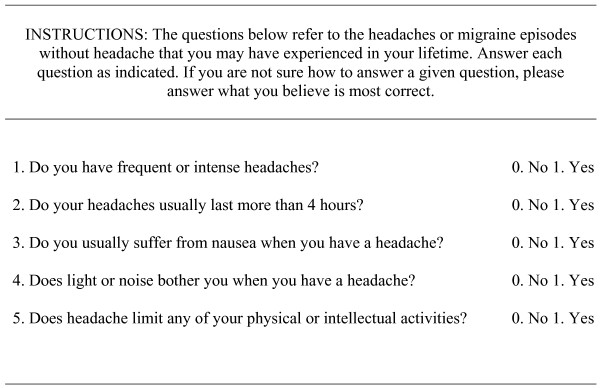
PC plays an important role in early diagnosis of health disorders, particularly migraine, due to the financial impact of this disease for the society and its impact on patients' quality of life. The aim of the study was to validate the self-administered MS-Q questionnaire for detection of hidden migraine in the field of primary care (PC), and to explore its use in this setting.
Cross-sectional, observational, and multicentre study in subjects above 18 years of age patients attending PC centers (regardless of the reason for consultation). A MS-Q score > or = 4 was considered possible migraine. Level of agreement with IHS criteria clinical diagnosis (kappa coefficient), and instrument's validity properties: sensitivity, specificity, positive (PPV) and negative (NPV) predictive values were determined. The ability of the instrument to identify possible new cases of migraine was calculated, as well as the ratio of hidden disease compared to the ratio obtained by IHS criteria.
A total of 9,670 patients were included [48.9 +/- 17.2 years (mean +/- SD); 61.9% women], from 410 PC centers representative of the whole national territory. The clinical prevalence of migraine according to the IHS criteria was 24.7%, and 20.4% according to MS-Q: Kappa index of agreement 0.82 (p < 0.05). MS-Q sensitivity was 0.82 (95% CI, 0.81-0.84), specificity 0.97 (95% CI, 0.98-0.99), PPV 0.95 (95% CI, 0.94 - 0.96), and NPV 0.94 (95% CI, 0.93-0.95). No statistically significant differences were found in the percentages of patients with de novo and hidden migraine identified by MS-Q and by IHS criteria: 5.7% vs. 6.1% and 26.6% vs. 24.1%, respectively.
The results of the present study confirm the usefulness of the MS-Q questionnaire for the early detection and assessment of migraine in PC settings, and its ability to detect hidden migraine.
PC 在健康障碍的早期诊断中起着重要作用,尤其是偏头痛,因为这种疾病对社会的经济影响及其对患者生活质量的影响。本研究的目的是验证自我管理的 MS-Q 问卷在初级保健(PC)领域中用于检测隐匿性偏头痛的有效性,并探讨其在该领域的应用。
横断面、观察性和多中心研究,纳入年龄在 18 岁以上的 PC 中心就诊患者(无论就诊原因如何)。MS-Q 得分为>或= 4 被认为是可能的偏头痛。采用 IHS 标准临床诊断的一致性(kappa 系数)和仪器的有效性特征:灵敏度、特异性、阳性(PPV)和阴性(NPV)预测值进行测定。还计算了仪器识别可能新的偏头痛病例的能力,以及与 IHS 标准获得的隐匿性疾病的比值。
共纳入 9670 例患者[48.9 +/- 17.2 岁(均值 +/- 标准差);61.9%为女性],来自代表全国范围的 410 个 PC 中心。根据 IHS 标准,偏头痛的临床患病率为 24.7%,根据 MS-Q 为 20.4%:一致性的 Kappa 指数为 0.82(p < 0.05)。MS-Q 的灵敏度为 0.82(95%置信区间,0.81-0.84),特异性为 0.97(95%置信区间,0.98-0.99),PPV 为 0.95(95%置信区间,0.94-0.96),NPV 为 0.94(95%置信区间,0.93-0.95)。用 MS-Q 和 IHS 标准识别的新发和隐匿性偏头痛患者的百分比无统计学差异:5.7% vs. 6.1%和 26.6% vs. 24.1%。
本研究结果证实了 MS-Q 问卷在 PC 环境中用于早期检测和评估偏头痛的有效性,以及其检测隐匿性偏头痛的能力。