Psychology, School for Social Sciences, University of Westminster, London, UK.
KITE-Toronto Rehabilitation Institute, University Health Network, Toronto, Canada.
Exp Brain Res. 2023 May;241(5):1381-1391. doi: 10.1007/s00221-023-06603-y. Epub 2023 Apr 5.
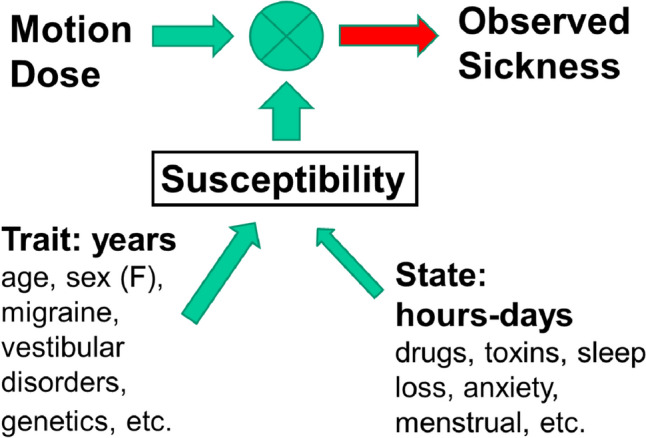
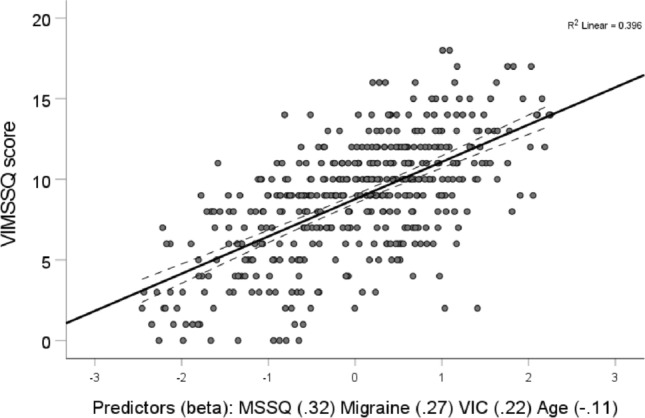
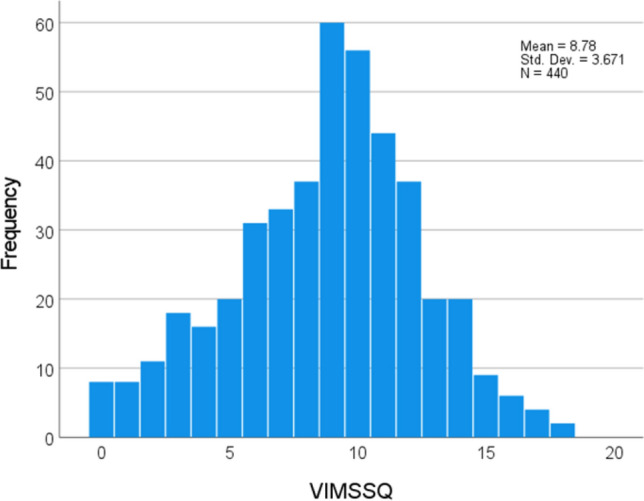
The widespread use of visual technologies such as Virtual Reality increases the risk of visually induced motion sickness (VIMS). Previously, the 6-item short version of the Visually Induced Motion Sickness Susceptibility Questionnaire (VIMSSQ short form) has been validated for predicting individual variation in VIMS. The aim of the current study was to investigate how the susceptibility to VIMS is correlated with other relevant factors in the general population. A total of 440 participants (201 M, 239F), mean age 33.6 (SD 14.8) years, completed an anonymous online survey of various questionnaires including the VIMSSQ, Motion Sickness Susceptibility Questionnaire (MSSQ), Vertigo in City questionnaire (VIC), Migraine (scale), Social & Work Impact of Dizziness (SWID), Syncope (faintness), and Personality ('Big Five' TIPI). The VIMSSQ correlated positively with the MSSQ (r = 0.50), VIC (r = 0.45), Migraine (r = 0.44), SWID (r = 0.28), and Syncope (r = 0.15). The most efficient Multiple Linear Regression model for the VIMSSQ included the predictors MSSQ, Migraine, VIC, and Age and explained 40% of the variance. Factor analysis of strongest correlates with VIMSSQ revealed a single factor loading with VIMSSQ, MSSQ, VIC, Migraine, SWID, and Syncope, suggesting a common latent variable of sensitivity. The set of predictors for the VIMSSQ in the general population has similarity with those often observed in patients with vestibular disorders. Based on these correlational results, we suggest the existence of continuum of underlying risk factors for sensitivity, from healthy population to patients with extreme visual vertigo and perhaps Persistent Postural-Perceptual Dizziness.
虚拟现实等视觉技术的广泛应用增加了视觉诱发运动病(VIMS)的风险。此前,视觉诱发运动病易感性问卷(VIMSSQ 短版)的 6 项简短版本已被验证可预测 VIMS 的个体差异。本研究的目的是调查 VIMS 的易感性与一般人群中其他相关因素的相关性。共有 440 名参与者(201 名男性,239 名女性),平均年龄 33.6(SD 14.8)岁,完成了一项匿名在线调查,调查内容包括 VIMSSQ、运动病易感性问卷(MSSQ)、城市眩晕问卷(VIC)、偏头痛(量表)、头晕对社会和工作的影响(SWID)、晕厥(昏厥)和人格(“五大”TIPI)。VIMSSQ 与 MSSQ(r=0.50)、VIC(r=0.45)、偏头痛(r=0.44)、SWID(r=0.28)和晕厥(r=0.15)呈正相关。VIMSSQ 的最佳多元线性回归模型包括 MSSQ、偏头痛、VIC 和年龄预测因子,解释了 40%的方差。与 VIMSSQ 相关性最强的因素分析显示,一个因素与 VIMSSQ、MSSQ、VIC、偏头痛、SWID 和晕厥的负荷量相同,表明存在一个共同的敏感性潜在变量。一般人群中 VIMSSQ 的预测因子集与前庭障碍患者中常见的预测因子集相似。基于这些相关性结果,我们认为存在敏感性的潜在风险因素连续体,从健康人群到有极端视觉眩晕的患者,甚至可能是持续性姿势感知性头晕。