Division of Geriatric Medicine, Department of Internal Medicine, Keio University School of Medicine, 35 Shinanomachi, Shinjuku-ku, Tokyo 160-8582, Japan.
BMC Geriatr. 2010 Jun 9;10:35. doi: 10.1186/1471-2318-10-35.
With the rapid worldwide increase in the oldest old population, considerable concern has arisen about the social and economic burden of diseases and disability in this age group. Understanding of multidimensional structure of health and its life-course trajectory is an essential prerequisite for effective health care delivery. Therefore, we organized an interdisciplinary research team consisting of geriatricians, dentists, psychologists, sociologists, and epidemiologists to conduct a longitudinal observational study.
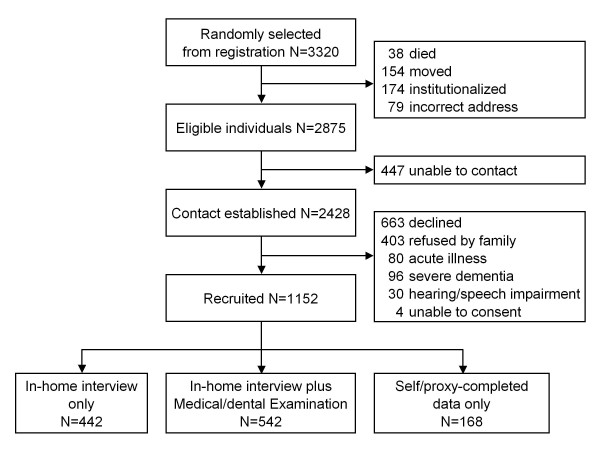
METHODS/DESIGN: For the Tokyo Oldest Old Survey on Total Health (TOOTH) study, a random sample of inhabitants of the city of Tokyo, aged 85 years or older, was drawn from the basic city registry. The baseline comprehensive assessment consists of an in-home interview, a self-administered questionnaire, and a medical/dental examination. To perform a wide variety of biomedical measurements, including carotid ultrasonography and a detailed dental examination, participants were invited to our study center at Keio University Hospital. For those who were not able to visit the study center, we provided the option of a home-based examination, in which participants were simultaneously visited by a geriatrician and a dentist. Of 2875 eligible individuals, a total of 1152 people were recruited, of which 542 completed both the in-home interview and the medical/dental examination, with 442 completed the in-home interview only, and another 168 completed self or proxy-administered data collection only. Carotid ultrasonography was completed in 458 subjects, which was 99.6% of the clinic visitors (n = 460). Masticatory assessment using a colour-changeable chewing gum was completed in 421 subjects, a 91.5% of the clinic visitors.
Our results demonstrated the feasibility of a new comprehensive study that incorporated non-invasive measurements of subclinical diseases and a detailed dental examination aiming at community-dwelling individuals aged 85 years or older. The bimodal recruitment strategy is critically important to capture a broad range of health profiles among the oldest old. Results form the TOOTH study will help develop new models of health promotion, which are expected to contribute to an improvement in lifelong health and well-being.
随着全球最年长人口的迅速增加,人们对该年龄段疾病和残疾的社会和经济负担产生了极大的关注。了解健康的多维结构及其生命轨迹是有效提供医疗保健的必要前提。因此,我们组织了一个由老年医学专家、牙医、心理学家、社会学家和流行病学家组成的跨学科研究团队,开展一项纵向观察研究。
方法/设计:为了进行东京最年长老年人全面健康调查(TOOTH)研究,我们从东京市的基本城市登记册中抽取了 85 岁或以上的居民作为随机样本。基线综合评估包括家庭访谈、自我管理问卷和医疗/牙科检查。为了进行广泛的生物医学测量,包括颈动脉超声检查和详细的牙科检查,参与者被邀请到庆应义塾大学医院的研究中心。对于那些无法前往研究中心的人,我们提供了家庭检查的选择,在这种情况下,由一名老年医学专家和一名牙医同时对参与者进行检查。在 2875 名符合条件的人中,共有 1152 人被招募,其中 542 人完成了家庭访谈和医疗/牙科检查,442 人仅完成了家庭访谈,另外 168 人仅完成了自我或代理数据收集。有 458 名参与者完成了颈动脉超声检查,占诊所访问者(n=460)的 99.6%。有 421 名参与者完成了使用变色口香糖进行咀嚼评估,占诊所访问者的 91.5%。
我们的研究结果表明,一种新的综合研究是可行的,该研究结合了亚临床疾病的非侵入性测量和详细的牙科检查,旨在针对 85 岁或以上的社区居民。双模式招募策略对于捕捉最年长老年人的广泛健康状况至关重要。TOOTH 研究的结果将有助于开发新的健康促进模式,有望改善终生健康和幸福感。