Université de Toulouse, ENVT, INRA, UMR Xénobiotiques, France.
Cancer Prev Res (Phila). 2010 Jul;3(7):852-64. doi: 10.1158/1940-6207.CAPR-09-0160. Epub 2010 Jun 8.
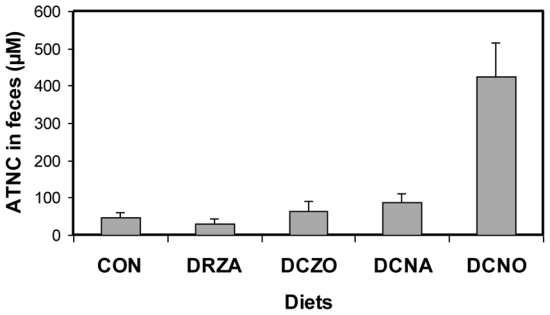
Processed meat intake is associated with colorectal cancer risk, but no experimental study supports the epidemiologic evidence. To study the effect of meat processing on carcinogenesis promotion, we first did a 14-day study with 16 models of cured meat. Studied factors, in a 2 x 2 x 2 x 2 design, were muscle color (a proxy for heme level), processing temperature, added nitrite, and packaging. Fischer 344 rats were fed these 16 diets, and we evaluated fecal and urinary fat oxidation and cytotoxicity, three biomarkers of heme-induced carcinogenesis promotion. A principal component analysis allowed for selection of four cured meats for inclusion into a promotion study. These selected diets were given for 100 days to rats pretreated with 1,2-dimethylhydrazine. Colons were scored for preneoplastic lesions: aberrant crypt foci (ACF) and mucin-depleted foci (MDF). Cured meat diets significantly increased the number of ACF/colon compared with a no-meat control diet (P = 0.002). Only the cooked nitrite-treated and oxidized high-heme meat significantly increased the fecal level of apparent total N-nitroso compounds (ATNC) and the number of MDF per colon compared with the no-meat control diet (P < 0.05). This nitrite-treated and oxidized cured meat specifically increased the MDF number compared with similar nonnitrite-treated meat (P = 0.03) and with similar nonoxidized meat (P = 0.004). Thus, a model cured meat, similar to ham stored aerobically, increased the number of preneoplastic lesions, which suggests colon carcinogenesis promotion. Nitrite treatment and oxidation increased this promoting effect, which was linked with increased fecal ATNC level. This study could lead to process modifications to make nonpromoting processed meat.
加工肉类的摄入与结直肠癌风险相关,但尚无实验研究支持这些流行病学证据。为了研究肉类加工对致癌作用促进的影响,我们首先进行了一项为期 14 天的研究,使用 16 种腌制肉模型。研究因素采用 2 x 2 x 2 x 2 设计,包括肌肉颜色(血红素水平的替代指标)、加工温度、添加的亚硝酸盐和包装。我们用这些 16 种饮食喂养 Fischer 344 大鼠,并评估粪便和尿液脂肪氧化和细胞毒性这三种血红素诱导的致癌作用促进生物标志物。主成分分析用于选择四种腌制肉进行促进研究。这些选定的饮食在给予大鼠 1,2-二甲基肼预处理 100 天后给予。对结肠进行前肿瘤病变评分:异常隐窝病灶(ACF)和粘蛋白耗竭病灶(MDF)。与无肉对照饮食相比,腌制肉饮食显著增加了 ACF/结肠的数量(P = 0.002)。只有经过烹饪的亚硝酸盐处理和氧化的高血红素肉与无肉对照饮食相比,显著增加了粪便中总 N-亚硝基化合物(ATNC)的水平和每结肠 MDF 的数量(P < 0.05)。与类似的无亚硝酸盐处理的肉相比(P = 0.03)和类似的非氧化肉相比(P = 0.004),这种经过亚硝酸盐处理和氧化的腌制肉特别增加了 MDF 的数量。因此,类似于有氧储存的火腿的模型腌制肉增加了前肿瘤病变的数量,这表明结肠致癌作用促进。亚硝酸盐处理和氧化增加了这种促进作用,这与粪便中 ATNC 水平的增加有关。这项研究可能会导致加工过程的改变,以生产非促进性的加工肉类。