National Centre for Epidemiology and Population Health, The Australian National University, Canberra, ACT, 0200, Australia.
BMC Public Health. 2010 Jun 11;10:331. doi: 10.1186/1471-2458-10-331.
Vitamin D supplementation for fracture prevention is widespread despite conflicting interpretation of relevant randomised controlled trial (RCT) evidence. This study summarises quantitatively the current evidence from RCTs and observational studies regarding vitamin D, parathyroid hormone (PTH) and hip fracture risk.
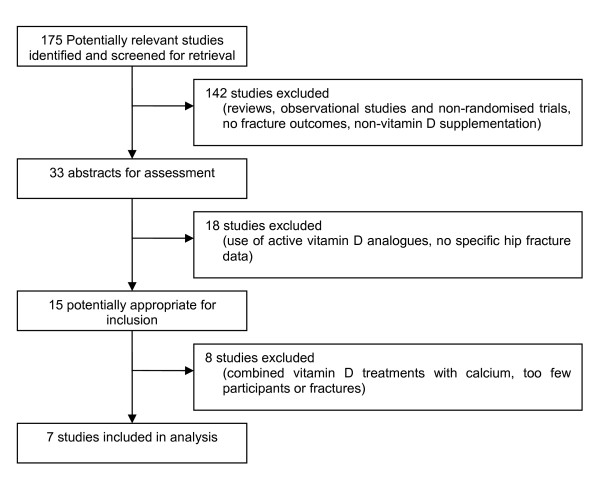
We undertook separate meta-analyses of RCTs examining vitamin D supplementation and hip fracture, and observational studies of serum vitamin D status (25-hydroxyvitamin D (25(OH)D) level), PTH and hip fracture. Results from RCTs were combined using the reported hazard ratios/relative risks (RR). Results from case-control studies were combined using the ratio of 25(OH)D and PTH measurements of hip fracture cases compared with controls. Original published studies of vitamin D, PTH and hip fracture were identified through PubMed and Web of Science databases, searches of reference lists and forward citations of key papers.
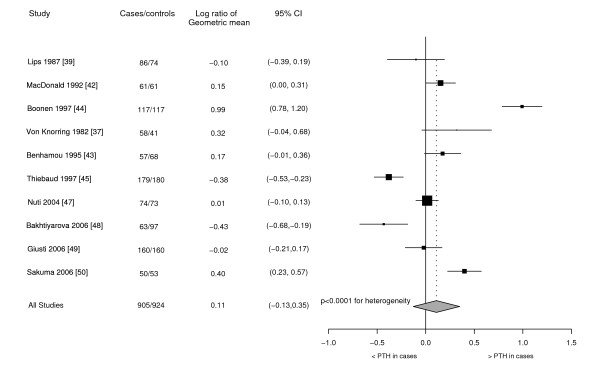
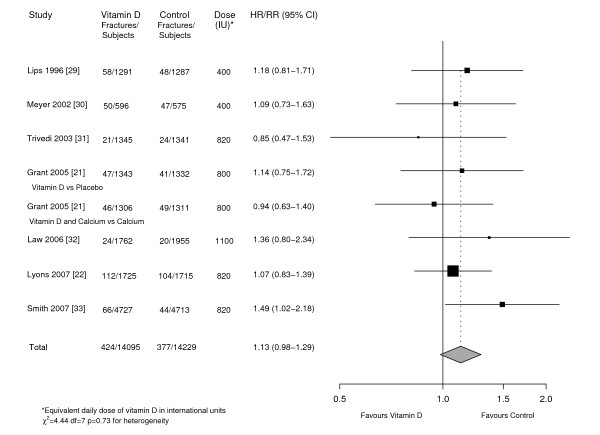
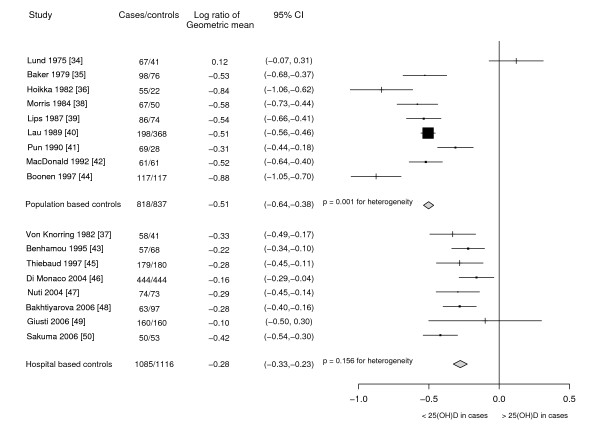
The seven eligible RCTs identified showed no significant difference in hip fracture risk in those randomised to cholecalciferol or ergocalciferol supplementation versus placebo/control (RR = 1.13[95%CI 0.98-1.29]; 801 cases), with no significant difference between trials of <800 IU/day and > or = 800 IU/day. The 17 identified case-control studies found 33% lower serum 25(OH)D levels in cases compared to controls, based on 1903 cases. This difference was significantly greater in studies with population-based compared to hospital-based controls (chi(2)(1) (heterogeneity) = 51.02, p < 0.001) and significant heterogeneity was present overall (chi(2)(16) (heterogeneity) = 137.9, p < 0.001). Serum PTH levels in hip fracture cases did not differ significantly from controls, based on ten case-control studies with 905 cases (chi(2)(9) (heterogeneity) = 149.68, p < 0.001).
Neither higher nor lower dose vitamin D supplementation prevented hip fracture. Randomised and observational data on vitamin D and hip fracture appear to differ. The reason for this is unclear; one possible explanation is uncontrolled confounding in observational studies. Post-fracture PTH levels are unrelated to hip fracture risk.
尽管相关随机对照试验(RCT)证据存在相互矛盾的解释,但维生素 D 补充剂用于预防骨折的做法仍十分普遍。本研究定量总结了当前关于维生素 D、甲状旁腺激素(PTH)与髋部骨折风险的 RCT 和观察性研究证据。
我们分别对维生素 D 补充剂与髋部骨折的 RCT 以及血清维生素 D 状态(25-羟维生素 D(25[OH]D)水平)、PTH 与髋部骨折的观察性研究进行了荟萃分析。使用报告的风险比/相对风险(RR)对 RCT 的结果进行合并。使用病例对照研究中髋部骨折病例与对照组的 25(OH)D 和 PTH 测量值比值对结果进行合并。通过 PubMed 和 Web of Science 数据库、参考文献列表搜索和关键论文的追溯引文,确定了有关维生素 D、PTH 和髋部骨折的原始研究。
纳入的 7 项 RCT 研究表明,与安慰剂/对照组相比,接受胆钙化醇或麦角钙化醇补充剂治疗的患者髋部骨折风险无显著差异(RR=1.13[95%CI 0.98-1.29];801 例病例),每日 800IU 以下和 800IU 以上的试验之间也无显著差异。纳入的 17 项病例对照研究发现,基于 1903 例病例,髋部骨折病例的血清 25(OH)D 水平比对照组低 33%。与基于人群的对照组相比,基于医院的对照组的这一差异更大(卡方(1)(异质性)=51.02,p<0.001),且总体存在显著的异质性(卡方(16)(异质性)=137.9,p<0.001)。基于 10 项包含 905 例病例的病例对照研究,髋部骨折病例的血清 PTH 水平与对照组无显著差异(卡方(9)(异质性)=149.68,p<0.001)。
较高或较低剂量的维生素 D 补充剂均不能预防髋部骨折。关于维生素 D 和髋部骨折的随机和观察性数据似乎存在差异。造成这种情况的原因尚不清楚;一种可能的解释是观察性研究中存在未得到控制的混杂因素。骨折后 PTH 水平与髋部骨折风险无关。