Institut Pierre Richet, BP 47 Abidjan, Côte d'Ivoire.
Malar J. 2010 Jun 16;9:167. doi: 10.1186/1475-2875-9-167.
The spread of pyrethroid resistance in Anopheles gambiae s.s. is a critical issue for malaria vector control based on the use of insecticide-treated nets. Carbamates and organophosphates insecticides are regarded as alternatives or supplements to pyrethroids used in nets treatment. It is, therefore, essential to investigate on the susceptibility of pyrethroid resistant populations of An. gambiae s.s. to these alternative products.
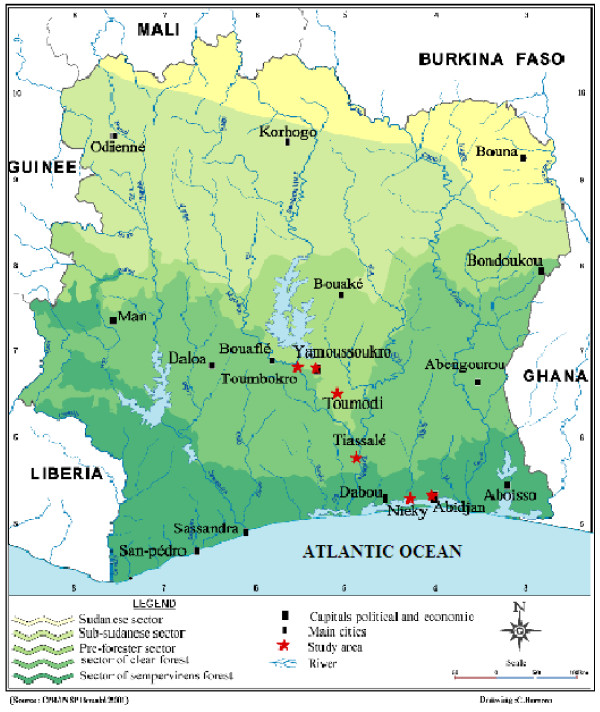
In September 2004, a cross sectional survey was conducted in six localities in Côte d'Ivoire: Toumbokro, Yamoussoukro, Toumodi in the Southern Guinea savannah, Tiassalé in semi-deciduous forest, then Nieky and Abidjan in evergreen forest area. An. gambiae populations from these localities were previously reported to be highly resistant to pyrethroids insecticides. Anopheline larvae were collected from the field and reared to adults. Resistance/susceptibility to carbamates (0.4% carbosulfan, 0.1% propoxur) and organophosphates (0.4% chlorpyrifos-methyl, 1% fenitrothion) was assessed using WHO bioassay test kits for adult mosquitoes. Then, PCR assays were run to determine the molecular forms (M) and (S), as well as phenotypes for insensitive acetylcholinesterase (AChE1) due to G119S mutation.
Bioassays showed carbamates (carbosulfan and propoxur) resistance in all tested populations of An. gambiae s.s. In addition, two out of the six tested populations (Toumodi and Tiassalé) were also resistant to organophosphates (mortality rates ranged from 29.5% to 93.3%). The M-form was predominant in tested samples (91.8%). M and S molecular forms were sympatric at two localities but no M/S hybrids were detected. The highest proportion of S-form (7.9% of An. gambiae identified) was in sample from Toumbokro, in the southern Guinea savannah. The G119S mutation was found in both M and S molecular forms with frequency from 30.9 to 35.2%.
This study revealed a wide distribution of insensitive acetylcholinesterase due to the G119S mutation in both M and S molecular forms of the populations of An. gambiae s.s. tested. The low cross-resistance between carbamates and organophosphates highly suggests involvement of other resistance mechanisms such as metabolic detoxification or F290V mutation.
在以经杀虫剂处理过的蚊帐为基础的疟疾媒介控制中,按蚊属冈比亚按蚊对拟除虫菊酯的抗药性传播是一个关键问题。氨基甲酸酯类和有机磷类杀虫剂被认为是替代或补充用于网处理的拟除虫菊酯的选择。因此,有必要调查对拟除虫菊酯产生抗药性的按蚊属冈比亚按蚊种群对这些替代产品的敏感性。
2004 年 9 月,在科特迪瓦的六个地区进行了横断面调查:图姆博克罗、亚穆苏克罗、南部几内亚稀树草原的图莫迪、半落叶林的蒂萨莱、尼凯和常绿林地区的阿比让。此前报道称,这些地区的按蚊种群对拟除虫菊酯类杀虫剂具有高度抗药性。从现场采集按蚊幼虫并饲养成成虫。使用世界卫生组织的成蚊生物测定试剂盒评估对氨基甲酸酯类(0.4% 涕灭威、0.1% 残杀威)和有机磷类(0.4% 毒死蜱-甲基、1% 杀螟硫磷)的抗药性/敏感性。然后,运行 PCR 检测以确定分子形式(M 和 S)以及由于 G119S 突变导致的不敏感乙酰胆碱酯酶(AChE1)的表型。
生物测定表明,所有测试的按蚊属冈比亚按蚊种群对氨基甲酸酯类(涕灭威和残杀威)均有抗药性。此外,在测试的 6 个种群中有 2 个种群(图莫迪和蒂萨莱)也对有机磷类(死亡率在 29.5%至 93.3%之间)有抗药性。测试样本中主要是 M 形式(占 91.8%)。在两个地点同时存在 M 和 S 分子形式,但未检测到 M/S 杂种。在来自南部几内亚稀树草原的图姆博克罗的样本中,S 形式的比例最高(占鉴定的按蚊属冈比亚按蚊的 7.9%)。在 M 和 S 分子形式中均发现了 G119S 突变,频率为 30.9%至 35.2%。
本研究显示,在所测试的按蚊属冈比亚按蚊种群的 M 和 S 分子形式中,由于 G119S 突变导致不敏感乙酰胆碱酯酶广泛分布。氨基甲酸酯类和有机磷类之间的低交叉抗药性高度表明存在其他抗性机制,如代谢解毒或 F290V 突变。