National Cancer Institute, Bethesda, Maryland 20852, USA.
Am J Epidemiol. 2010 Jul 1;172(1):81-93. doi: 10.1093/aje/kwq120. Epub 2010 Jun 18.
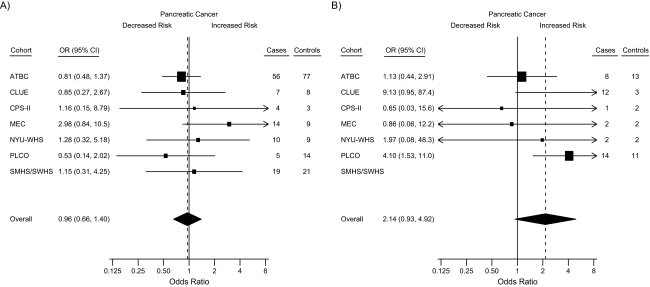
Results from epidemiologic studies examining pancreatic cancer risk and vitamin D intake or 25-hydroxyvitamin D (25(OH)D) concentrations (the best indicator of vitamin D derived from diet and sun) have been inconsistent. Therefore, the authors conducted a pooled nested case-control study of participants from 8 cohorts within the Cohort Consortium Vitamin D Pooling Project of Rarer Cancers (VDPP) (1974-2006) to evaluate whether prediagnostic circulating 25(OH)D concentrations were associated with the development of pancreatic cancer. In total, 952 incident pancreatic adenocarcinoma cases occurred among participants (median follow-up, 6.5 years). Controls (n = 1,333) were matched to each case by cohort, age, sex, race/ethnicity, date of blood draw, and follow-up time. Conditional logistic regression analysis was used to calculate smoking-, body mass index-, and diabetes-adjusted odds ratios and 95% confidence intervals for pancreatic cancer. Clinically relevant 25(OH)D cutpoints were compared with a referent category of 50-<75 nmol/L. No significant associations were observed for participants with lower 25(OH)D status. However, a high 25(OH)D concentration (> or =100 nmol/L) was associated with a statistically significant 2-fold increase in pancreatic cancer risk overall (odds ratio = 2.12, 95% confidence interval: 1.23, 3.64). Given this result, recommendations to increase vitamin D concentrations in healthy persons for the prevention of cancer should be carefully considered.
来自流行病学研究的结果检查了胰腺癌风险与维生素 D 摄入或 25-羟维生素 D(25(OH)D)浓度(来自饮食和阳光的维生素 D 的最佳指标)之间的关系,但结果并不一致。因此,作者对 Cohort Consortium Vitamin D Pooling Project of Rarer Cancers(VDPP)中的 8 个队列的参与者进行了一项嵌套病例对照研究(1974-2006 年),以评估预诊断时循环 25(OH)D 浓度是否与胰腺癌的发展有关。共有 952 例新发胰腺腺癌病例发生在参与者中(中位随访时间为 6.5 年)。对照组(n=1333)按队列、年龄、性别、种族/民族、采血日期和随访时间与每个病例相匹配。使用条件逻辑回归分析计算胰腺癌的调整后比值比和 95%置信区间。与 50-<75nmol/L 的参考类别相比,比较了临床相关的 25(OH)D 切点。对于 25(OH)D 状态较低的参与者,未观察到显著关联。然而,高 25(OH)D 浓度(>或=100nmol/L)与总体胰腺癌风险增加 2 倍具有统计学意义(比值比=2.12,95%置信区间:1.23,3.64)。鉴于这一结果,对于通过增加健康人群的维生素 D 浓度来预防癌症的建议应谨慎考虑。