Zemel A, Rehfeldt F, Brown A E X, Discher D E, Safran S A
Institute of Dental Sciences, Faculty of Dental Medicine, and the Fritz Haber Center for Molecular Dynamics, the Hebrew University-Hadassah Medical Center, Jerusalem, 91120, Israel.
Nat Phys. 2010 Jun 1;6(6):468-473. doi: 10.1038/nphys1613.
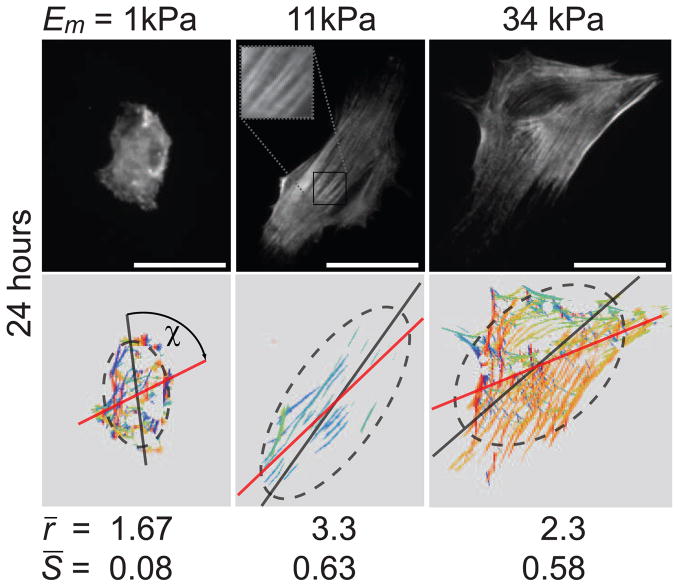
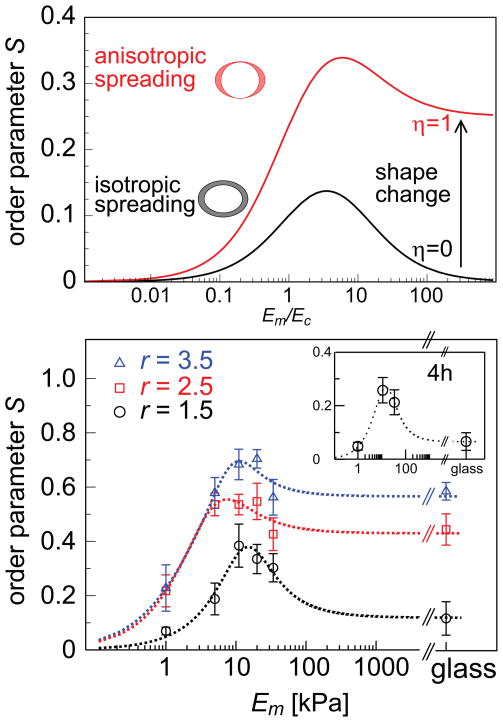
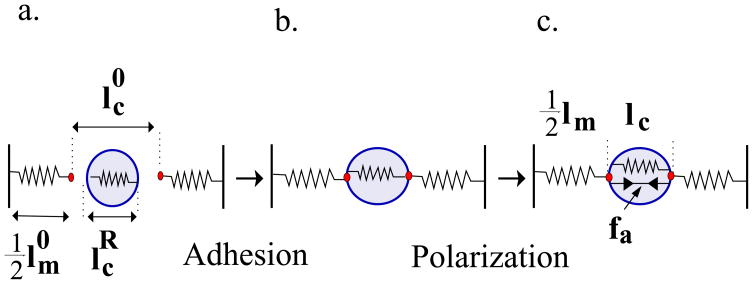
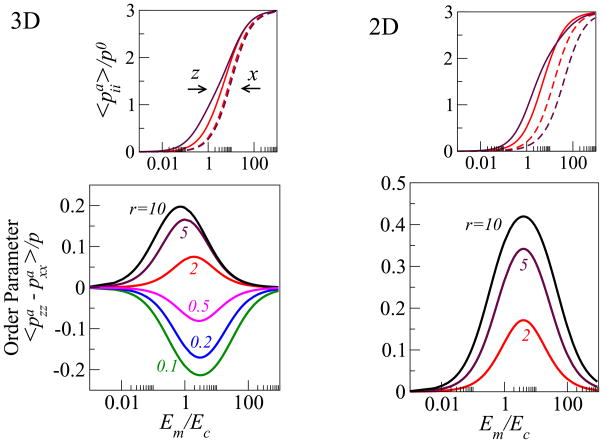
The shape and differentiation of human mesenchymal stem cells is especially sensitive to the rigidity of their environment; the physical mechanisms involved are unknown. A theoretical model and experiments demonstrate here that the polarization/alignment of stress-fibers within stem cells is a non-monotonic function of matrix rigidity. We treat the cell as an active elastic inclusion in a surrounding matrix whose polarizability, unlike dead matter, depends on the feedback of cellular forces that develop in response to matrix stresses. The theory correctly predicts the monotonic increase of the cellular forces with the matrix rigidity and the alignment of stress-fibers parallel to the long axis of cells. We show that the anisotropy of this alignment depends non-monotonically on matrix rigidity and demonstrate it experimentally by quantifying the orientational distribution of stress-fibers in stem cells. These findings offer a first physical insight for the dependence of stem cell differentiation on tissue elasticity.
人类间充质干细胞的形状和分化对其所处环境的硬度尤为敏感;其中涉及的物理机制尚不清楚。本文的一个理论模型和实验表明,干细胞内应力纤维的极化/排列是基质硬度的非单调函数。我们将细胞视为周围基质中的一个活性弹性内含物,与无生命物质不同,其极化率取决于细胞因基质应力而产生的力的反馈。该理论正确地预测了细胞力随基质硬度的单调增加以及应力纤维与细胞长轴平行的排列。我们表明,这种排列的各向异性非单调地取决于基质硬度,并通过量化干细胞中应力纤维的取向分布进行了实验验证。这些发现为干细胞分化对组织弹性的依赖性提供了首个物理层面的见解。