Redwood Center for Theoretical Neuroscience, University of California Berkeley, CA, USA.
Front Neurosci. 2010 May 15;4:53. doi: 10.3389/neuro.01.010.2010. eCollection 2010.
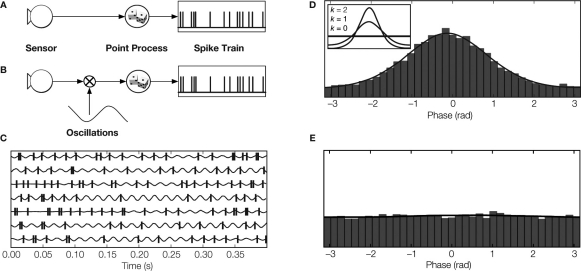
Neuronal oscillations appear throughout the nervous system, in structures as diverse as the cerebral cortex, hippocampus, subcortical nuclei and sense organs. Whether neural rhythms contribute to normal function, are merely epiphenomena, or even interfere with physiological processing are topics of vigorous debate. Sensory pathways are ideal for investigation of oscillatory activity because their inputs can be defined. Thus, we will focus on sensory systems as we ask how neural oscillations arise and how they might encode information about the stimulus. We will highlight recent work in the early visual pathway that shows how oscillations can multiplex different types of signals to increase the amount of information that spike trains encode and transmit. Last, we will describe oscillation-based models of visual processing and explore how they might guide further research.
神经元的振荡活动出现在神经系统的各个部位,从大脑皮层、海马体、皮质下核团到感觉器官都有涉及。神经节律是否有助于正常功能,仅仅是一种副现象,还是甚至干扰生理处理,这些都是激烈争论的话题。感觉通路是研究振荡活动的理想选择,因为它们的输入可以被定义。因此,当我们问到神经振荡是如何产生的,以及它们如何编码关于刺激的信息时,我们将重点关注感觉系统。我们将强调早期视觉通路中的最新工作,展示振荡如何复用不同类型的信号,以增加尖峰序列编码和传输的信息量。最后,我们将描述基于振荡的视觉处理模型,并探讨它们如何指导进一步的研究。