
抗菌选择压力和次要因素对日本产肉动物源大肠杆菌中抗菌药物耐药性流行的作用
Role of antimicrobial selective pressure and secondary factors on antimicrobial resistance prevalence in Escherichia coli from food-producing animals in Japan.
作者信息
Harada Kazuki, Asai Tetsuo
机构信息
National Veterinary Assay Laboratory, Ministry of Agriculture, Forestry and Fisheries, 1-15-1 Tokura, Kokubunji, Tokyo 185-8511, Japan.
出版信息
J Biomed Biotechnol. 2010;2010:180682. doi: 10.1155/2010/180682. Epub 2010 Jun 2.
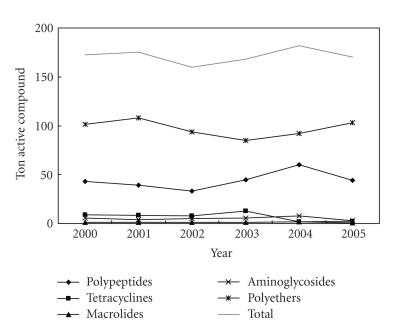
The use of antimicrobial agents in the veterinary field affects the emergence, prevalence, and dissemination of antimicrobial resistance in bacteria isolated from food-producing animals. To control the emergence, prevalence, and dissemination of antimicrobial resistance, it is necessary to implement appropriate actions based on scientific evidence. In Japan, the Japanese Veterinary Antimicrobial Resistance Monitoring System (JVARM) was established in 1999 to monitor the antimicrobial susceptibility of foodborne and commensal bacteria from food-producing animals. The JVARM showed that the emergence and prevalence of resistant Escherichia coli were likely linked to the therapeutic antimicrobial use in food-producing animals through not only direct selection of the corresponding resistance but also indirect selections via cross-resistance and coresistance. In addition, relevant factors such as host animals and bacterial properties might affect the occurrence and prevalence of antimicrobial-resistant E. coli under the selective pressure from antimicrobial usage. This paper reviews the trends in antimicrobial resistance in E. coli and consumption of antimicrobials agents in Japan and introduces the relationship between antimicrobial usage and prevalence of antimicrobial-resistant bacteria, from food-producing animals under the JVARM program. In this paper, we will provide the underlying information about the significant factors that can help control antimicrobial resistance in bacteria in veterinary medicine.
兽医学领域中抗菌剂的使用会影响从食用动物分离出的细菌中抗菌药物耐药性的出现、流行和传播。为了控制抗菌药物耐药性的出现、流行和传播,有必要根据科学证据采取适当行动。在日本,1999年建立了日本兽医抗菌药物耐药性监测系统(JVARM),以监测来自食用动物的食源细菌和共生细菌的抗菌药敏性。JVARM表明,耐药大肠杆菌的出现和流行可能与食用动物的治疗性抗菌剂使用有关,这不仅是通过直接选择相应的耐药性,还通过交叉耐药性和共耐药性的间接选择。此外,在抗菌剂使用的选择压力下,宿主动物和细菌特性等相关因素可能会影响抗菌耐药性大肠杆菌的发生和流行。本文回顾了日本大肠杆菌抗菌药物耐药性的趋势以及抗菌剂的消费情况,并介绍了JVARM计划下食用动物抗菌剂使用与抗菌耐药细菌流行之间的关系。在本文中,我们将提供有关有助于控制兽医学中细菌抗菌药物耐药性的重要因素的基础信息。



 Zotero 插件