Mudenda Steward, Malama Sydney, Munyeme Musso, Matafwali Scott Kaba, Kapila Penjaninge, Katemangwe Patrick, Mainda Geoffrey, Mukubesa Andrew Nalishuwa, Hadunka Mwendalubi Albert, Muma John Bwalya
Department of Pharmacy, School of Health Sciences, University of Zambia, Lusaka, Zambia.
Department of Disease Control, School of Veterinary Medicine, University of Zambia, Lusaka, Zambia.
JAC Antimicrob Resist. 2023 May 22;5(3):dlad060. doi: 10.1093/jacamr/dlad060. eCollection 2023 Jun.
Antimicrobial resistance (AMR) has been deepening in the layer poultry sector in Zambia partly due to the inappropriate use of antimicrobials. (), a commensal and zoonotic bacterium, can potentially be a source of AMR.
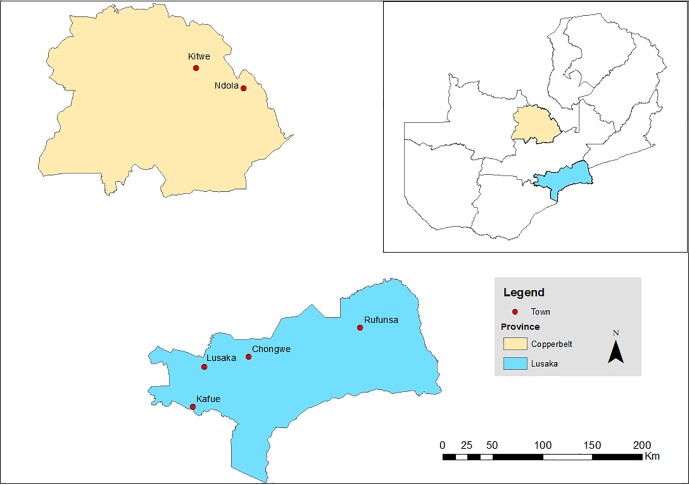
This study assessed the phenotypic AMR profiles of isolated from the apparent health-laying hens in Lusaka and Copperbelt provinces of Zambia.
A cross-sectional study was conducted between September 2020 and April 2021 in which 365 cloacal swabs were collected from 77-layer farms based in Lusaka and Copperbelt provinces of Zambia. isolation and identification were done using cultural and biochemical properties and confirmed using the 16S rRNA gene sequencing. Antimicrobial susceptibility testing (AST) was done using the Kirby-Bauer disc-diffusion method. Data analysis was done using WHONET 2020 and Stata v.16.1.
Of the 365 samples, was isolated from 92.9% ( = 339). The AMR was detected in 96.5% (= 327) of the isolates, of which 64.6% (= 219) were multidrug-resistant (MDR). was highly resistant to tetracycline (54.6%) and ampicillin (54%) but showed low resistance to meropenem (0.9%), ceftazidime (6.2%) and chloramphenicol (8.8%).
This study found a high prevalence of resistant to some commonly used antibiotics in poultry, which is a public health concern because of the potential contamination of eggs and layers of chicken meat that enter the food chain. Urgent attention is needed, including strengthening antimicrobial stewardship and surveillance programmes in layer poultry production in Zambia.
赞比亚蛋鸡养殖部门的抗菌药物耐药性(AMR)不断加剧,部分原因是抗菌药物使用不当。[细菌名称]作为一种共生和人畜共患病原体,可能是AMR的一个来源。
本研究评估了从赞比亚卢萨卡省和铜带省表面健康的产蛋母鸡中分离出的[细菌名称]的表型AMR谱。
于2020年9月至2021年4月进行了一项横断面研究,从赞比亚卢萨卡省和铜带省的77个蛋鸡养殖场采集了365份泄殖腔拭子。通过培养和生化特性进行[细菌名称]的分离和鉴定,并使用16S rRNA基因测序进行确认。采用 Kirby-Bauer 纸片扩散法进行抗菌药物敏感性试验(AST)。使用WHONET 2020和Stata v.16.1进行数据分析。
在365份样本中,92.9%(n = 339)分离出了[细菌名称]。在96.5%(n = 327)的分离株中检测到AMR,其中64.6%(n = 219)为多重耐药(MDR)。[细菌名称]对四环素(54.6%)和氨苄西林(54%)高度耐药,但对美罗培南(0.9%)、头孢他啶(6.2%)和氯霉素(8.8%)耐药性较低。
本研究发现家禽中对一些常用抗生素耐药的[细菌名称]感染率很高,这是一个公共卫生问题,因为进入食物链的鸡蛋和鸡肉可能受到污染。需要紧急关注,包括加强赞比亚蛋鸡生产中的抗菌药物管理和监测计划。