Division of Nephrology and Hypertension, Cincinnati Children's Hospital Medical Center, University of Cincinnati College of Medicine, Cincinnati, OH, 45229-3039, USA.
Am J Kidney Dis. 2010 Oct;56(4):632-42. doi: 10.1053/j.ajkd.2010.04.014.
Serum creatinine is a delayed marker of acute kidney injury (AKI). Our purpose is to discover and validate novel early urinary biomarkers of AKI after cardiac surgery.
Diagnostic test study.
SETTING & PARTICIPANTS: Children undergoing cardiopulmonary bypass surgery. The test set included 15 participants with AKI and 15 matched controls (median age, 1.5 year) of 45 participants without AKI. The validation set included 365 children (median age, 1.9 year).
Biomarkers identified using proteomic profiling: α(1)-microglobulin, α(1)-acid glycoprotein, and albumin.
AKI, defined as ≥50% increase in serum creatinine level from baseline within 3 days of surgery.
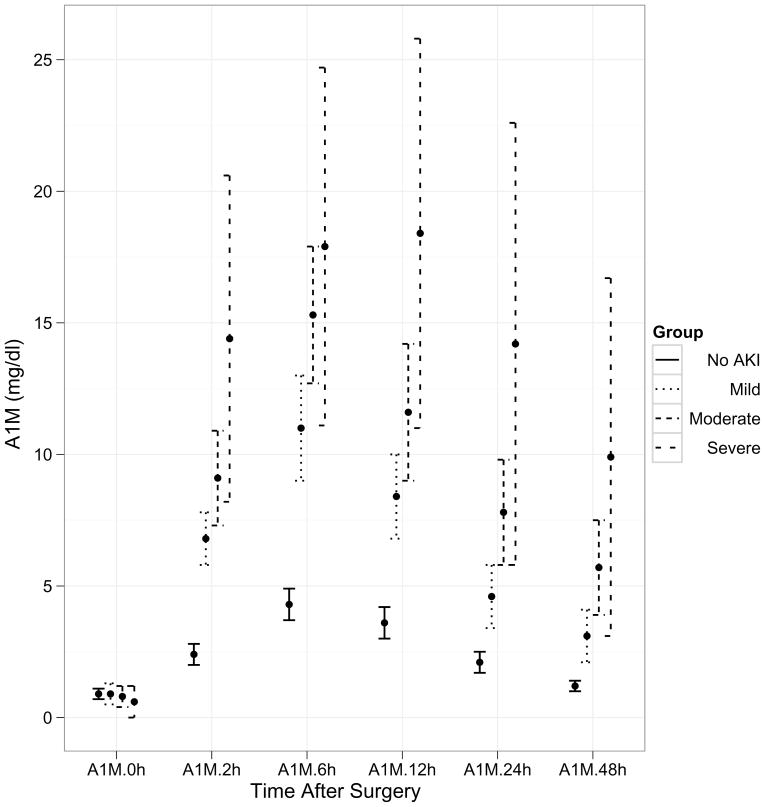
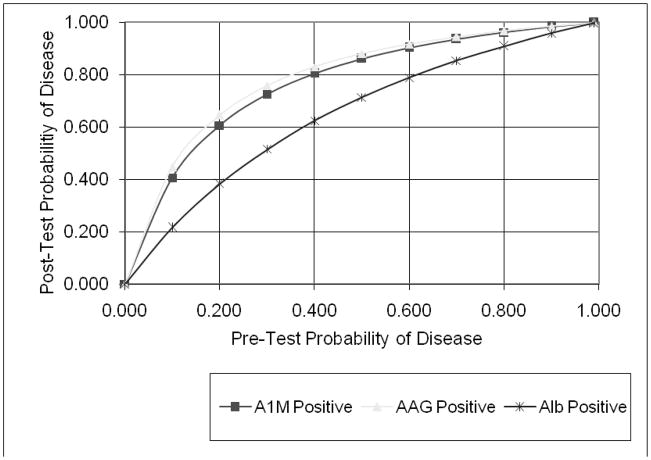
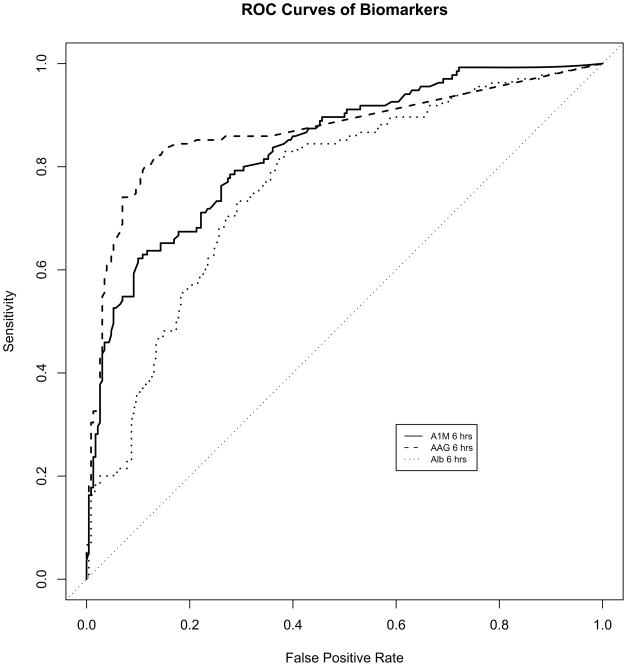
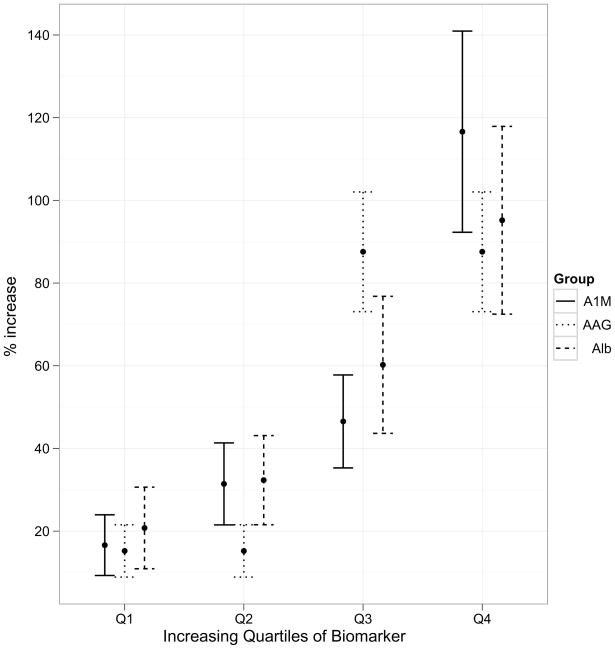
Proteomic profiling using surface-enhanced laser desorption/ionization time-of-flight mass spectrometry (SELDI-TOF MS) showed 3 protein peaks that appeared consistently within 2 hours in children who developed AKI after cardiopulmonary bypass surgery. The proteins were identified as α(1)-microglobulin, α(1)-acid glycoprotein, and albumin. Using clinical assays, results were confirmed in a test set and validated in an independent prospective cohort. In the validation set, 135 (37%) developed AKI, in whom there was a progressive increase in urinary biomarker concentrations with severity of AKI. Areas under the curve for urinary α(1)-microglobulin, α(1)-acid glycoprotein, and albumin at 6 hours after cardiac surgery were 0.84 (95% CI, 0.79-0.89), 0.87 (95% CI, 0.83-0.91), and 0.76 (95% CI, 0.71-0.81), respectively. Participants with increasing quartiles of biomarkers showed increasing lengths of hospital stays and durations of AKI (P < 0.001).
Single-center study of children with normal kidney function at recruitment. The SELDI-TOF MS technique has limited sensitivity for the detection of proteins greater than the 20-kDa range.
Urinary α(1)-microglobulin, α(1)-acid glycoprotein, and albumin represent early, accurate, inexpensive, and widely available biomarkers of AKI after cardiac surgery. They also offer prognostic information about the duration of AKI and length of hospitalization after cardiac surgery.
血清肌酐是急性肾损伤(AKI)的延迟标志物。我们的目的是发现并验证心脏手术后 AKI 的新型早期尿生物标志物。
诊断测试研究。
接受心肺旁路手术的儿童。测试集包括 15 名 AKI 患者和 45 名无 AKI 患者中 15 名匹配的对照组(中位年龄 1.5 岁)。验证集包括 365 名儿童(中位年龄 1.9 岁)。
使用蛋白质组学分析鉴定的生物标志物:α(1)-微球蛋白、α(1)-酸性糖蛋白和白蛋白。
AKI,定义为手术后 3 天内血清肌酐水平从基线升高≥50%。
使用表面增强激光解吸/离子化时间飞行质谱法(SELDI-TOF MS)进行蛋白质组学分析显示,3 个蛋白峰在接受心肺旁路手术后发生 AKI 的儿童中,在 2 小时内持续出现。这些蛋白质被鉴定为α(1)-微球蛋白、α(1)-酸性糖蛋白和白蛋白。使用临床检测,在测试集中得到了证实,并在独立的前瞻性队列中得到了验证。在验证集中,135 名(37%)儿童发生 AKI,其尿生物标志物浓度随 AKI 严重程度逐渐增加。心脏手术后 6 小时时,尿α(1)-微球蛋白、α(1)-酸性糖蛋白和白蛋白的曲线下面积分别为 0.84(95%CI,0.79-0.89)、0.87(95%CI,0.83-0.91)和 0.76(95%CI,0.71-0.81)。生物标志物四分位递增的参与者住院时间和 AKI 持续时间均延长(P<0.001)。
招募时儿童肾功能正常的单中心研究。SELDI-TOF MS 技术对检测大于 20 kDa 范围的蛋白质的灵敏度有限。
尿α(1)-微球蛋白、α(1)-酸性糖蛋白和白蛋白是心脏手术后 AKI 的早期、准确、廉价和广泛可用的生物标志物。它们还提供了关于心脏手术后 AKI 持续时间和住院时间的预后信息。