• 文献检索
  • 文档翻译
  • 深度研究
  • 学术资讯
  • Suppr Zotero 插件Zotero 插件
  • 邀请有礼
  • 套餐&价格
  • 历史记录
应用&插件
Suppr Zotero 插件Zotero 插件浏览器插件Mac 客户端Windows 客户端微信小程序
定价
高级版会员购买积分包购买API积分包
服务
文献检索文档翻译深度研究API 文档MCP 服务
关于我们
关于 Suppr公司介绍联系我们用户协议隐私条款
关注我们

Suppr 超能文献

核心技术专利:CN118964589B侵权必究
粤ICP备2023148730 号-1Suppr @ 2026

文献检索

告别复杂PubMed语法,用中文像聊天一样搜索,搜遍4000万医学文献。AI智能推荐,让科研检索更轻松。

立即免费搜索

文件翻译

保留排版,准确专业,支持PDF/Word/PPT等文件格式,支持 12+语言互译。

免费翻译文档

深度研究

AI帮你快速写综述,25分钟生成高质量综述,智能提取关键信息,辅助科研写作。

立即免费体验

尿液能准确反映循环中的异黄酮,并确定大豆干预期间的依从性。

Urine accurately reflects circulating isoflavonoids and ascertains compliance during soy intervention.

机构信息

Cancer Research Center of Hawaii, 1236 Lauhala Street, Honolulu, HI 96813, USA.

出版信息

Cancer Epidemiol Biomarkers Prev. 2010 Jul;19(7):1775-83. doi: 10.1158/1055-9965.EPI-10-0116.

DOI:10.1158/1055-9965.EPI-10-0116
PMID:20615889
原文链接:https://pmc.ncbi.nlm.nih.gov/articles/PMC2950801/
Abstract

BACKGROUND

Isoflavonoids (IFL) may protect against chronic diseases, including cancer. IFL exposure is traditionally measured from plasma (PL), but the reliability of urine is uncertain. We assessed whether IFL excretion in overnight urine (OU) or spot urine (SU) reliably reflects IFLs in PL and the usefulness of the three matrices to determine soy intake compliance.

METHODS

In a randomized, double-blind, placebo-controlled soy intervention trial with 350 postmenopausal women, IFLs (daidzein, genistein, glycitein, equol, O-desmethylangolensin, dihydrodaidzein, dihydrogenistein) were analyzed by liquid chromatography/mass spectrometry in OU, SU, and PL collected at baseline and every 6 months over 2.5 years.

RESULTS

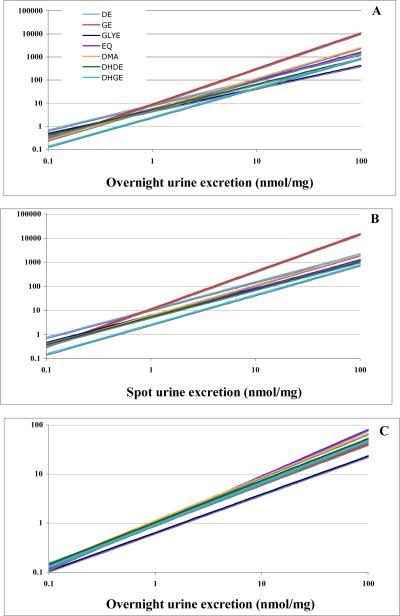
High between-subject intraclass correlations between all three matrices (median, 0.94) and high between-subject Pearson correlations (median r(OU-PL) = 0.80; median r(SU-PL) = 0.80; median r(OU-SU) = 0.92) allowed the development of equations to predict IFL values from any of the three matrices. Equations developed from a randomly selected 87% of all available data were valid because high correlations were found on the residual 13% of data between equation-generated and measured IFL values (median r(OU-PL) = 0.86; median r(SU-PL) = 0.78; median r(OU-SU) = 0.84); median absolute IFL differences for OU-PL, SU-PL, and OU-SU were 8.8 nmol/L, 10.3 nmol/L, and 0.28 nmol/mg, respectively. All three matrices showed highly significant IFL differences between the placebo and soy intervention group at study end (P < 0.0001) and highly significant correlations between IFL values and counted soy doses in the intervention group.

CONCLUSIONS

OU and SU IFL excretion reflect circulating PL IFL levels in healthy postmenopausal women accurately.

IMPACT

Noninvasively-collected urine can be used to reliably determine systemic IFL exposure and soy intake compliance.

摘要

背景

异黄酮(IFL)可能对包括癌症在内的慢性疾病具有保护作用。IFL 的暴露传统上是从血浆(PL)中测量的,但尿液的可靠性尚不确定。我们评估了 overnight urine(OU)或 spot urine(SU)中 IFL 的排泄是否能可靠地反映 PL 中的 IFL,以及这三种基质在确定大豆摄入量依从性方面的有用性。

方法

在一项针对 350 名绝经后妇女的随机、双盲、安慰剂对照的大豆干预试验中,在基线时以及 2.5 年内每 6 个月采集 OU、SU 和 PL,并使用液相色谱/质谱法分析 IFL(大豆苷、染料木素、黄豆苷元、黄豆黄素、O-去甲安哥拉紫檀素、二氢大豆苷、二氢染料木素)。

结果

三种基质之间的受试者内组内相关系数均较高(中位数,0.94),受试者内 Pearson 相关系数也较高(中位数 r(OU-PL)=0.80;中位数 r(SU-PL)=0.80;中位数 r(OU-SU)=0.92),这允许我们开发从任何三种基质预测 IFL 值的方程。从所有可用数据中随机选择的 87%的数据中开发的方程是有效的,因为在剩余的 13%的数据中,方程生成的和测量的 IFL 值之间存在高度相关性(中位数 r(OU-PL)=0.86;中位数 r(SU-PL)=0.78;中位数 r(OU-SU)=0.84);OU-PL、SU-PL 和 OU-SU 的 IFL 差异中位数分别为 8.8 nmol/L、10.3 nmol/L 和 0.28 nmol/mg。在研究结束时,所有三种基质在安慰剂和大豆干预组之间均显示出 IFL 差异具有统计学意义(P<0.0001),并且在干预组中 IFL 值与计数的大豆剂量之间存在高度显著的相关性。

结论

健康绝经后妇女的 OU 和 SU 中 IFL 的排泄能准确反映循环 PL 中的 IFL 水平。

意义

非侵入性采集的尿液可用于可靠地确定系统性 IFL 暴露和大豆摄入量的依从性。
https://cdn.ncbi.nlm.nih.gov/pmc/blobs/b802/2950801/afaa28a8910e/nihms-202344-f0001.jpg

相似文献

1
Urine accurately reflects circulating isoflavonoids and ascertains compliance during soy intervention.尿液能准确反映循环中的异黄酮,并确定大豆干预期间的依从性。
Cancer Epidemiol Biomarkers Prev. 2010 Jul;19(7):1775-83. doi: 10.1158/1055-9965.EPI-10-0116.
2
Associations between urine excretion of isoflavonoids and cognition in postmenopausal women in the Women's Isoflavone Soy Health clinical trial.绝经后妇女尿液中异黄酮排泄与认知能力的关系——大豆异黄酮健康临床试验。
J Am Geriatr Soc. 2014 Apr;62(4):629-35. doi: 10.1111/jgs.12752. Epub 2014 Mar 11.
3
Urinary isoflavones are increased in adults, but decreased in children, consuming soy when on oral antibiotic therapy.在口服抗生素治疗期间食用大豆时,成人尿中异黄酮水平会升高,而儿童尿中异黄酮水平会降低。
Nutr Cancer. 2008;60(5):627-35. doi: 10.1080/01635580802065310.
4
Usual dietary consumption of soy foods and its correlation with the excretion rate of isoflavonoids in overnight urine samples among Chinese women in Shanghai.上海中国女性日常大豆食品摄入量及其与夜间尿液样本中异黄酮排泄率的相关性。
Nutr Cancer. 1999;33(1):82-7. doi: 10.1080/01635589909514752.
5
Determinants for urinary and plasma isoflavones in humans after soy intake.大豆摄入后人体尿液和血浆中异黄酮的决定因素。
Nutr Cancer. 2004;50(2):141-54. doi: 10.1207/s15327914nc5002_3.
6
Isoflavonoid levels in spot urine are associated with frequency of dietary soy intake in a population-based sample of middle-aged and older Chinese in Singapore.在新加坡一个基于人群的中老年华人样本中,随机尿样中的异黄酮水平与膳食大豆摄入量的频率相关。
Cancer Epidemiol Biomarkers Prev. 1998 Feb;7(2):135-40.
7
Oral antibiotics decrease urinary isoflavonoid excretion in children after soy consumption.口服抗生素会降低儿童食用大豆后尿液中异黄酮的排泄量。
Nutr Cancer. 2008;60(1):14-22. doi: 10.1080/01635580701586747.
8
Absorption, distribution, metabolism, and excretion of isoflavonoids after soy intake.大豆摄入后异黄酮的吸收、分布、代谢和排泄。
Arch Biochem Biophys. 2014 Oct 1;559:24-8. doi: 10.1016/j.abb.2014.06.007. Epub 2014 Jun 16.
9
The effects of soy protein containing phytoestrogens on menopausal symptoms in postmenopausal women.含植物雌激素的大豆蛋白对绝经后女性更年期症状的影响。
Climacteric. 2000 Sep;3(3):161-7. doi: 10.1080/13697130008500108.
10
Dietary seaweed modifies estrogen and phytoestrogen metabolism in healthy postmenopausal women.食用海藻可改变健康绝经后女性的雌激素和植物雌激素代谢。
J Nutr. 2009 May;139(5):939-44. doi: 10.3945/jn.108.100834. Epub 2009 Mar 25.

引用本文的文献

1
Urinary Equol and Equol-Predicting Microbial Species Are Favorably Associated With Cardiometabolic Risk Markers in Chinese Adults.中国成年人尿液中的雌马酚及其预测微生物种与心血管代谢风险标志物呈正相关。
J Am Heart Assoc. 2024 Jul 2;13(13):e034126. doi: 10.1161/JAHA.123.034126. Epub 2024 Jun 27.
2
From the gut to the brain: the long journey of phenolic compounds with neurocognitive effects.从肠道到大脑:具有神经认知效应的酚类化合物的漫长旅程。
Nutr Rev. 2025 Feb 1;83(2):e533-e546. doi: 10.1093/nutrit/nuae034.
3
Prediagnostic Level of Dietary and Urinary Isoflavonoids in Relation to Risk of Liver Cancer in Shanghai, China.

本文引用的文献

1
Phytoestrogenic isoflavonoids in epidemiologic and clinical research.植物雌激素异黄酮在流行病学和临床研究中的作用。
Drug Test Anal. 2009 Jan;1(1):14-21. doi: 10.1002/dta.12.
2
Urinary phytoestrogen excretion and prostate cancer risk: a nested case-control study in the Multiethnic Cohort.尿中植物雌激素排泄与前列腺癌风险:多民族队列中的一项巢式病例对照研究。
Br J Cancer. 2009 Jul 7;101(1):185-91. doi: 10.1038/sj.bjc.6605137. Epub 2009 Jun 16.
3
Childhood soy intake and breast cancer risk in Asian American women.亚裔美国女性儿童期大豆摄入量与乳腺癌风险
膳食和尿内异黄酮水平与中国上海肝癌发病风险的关系。
Cancer Epidemiol Biomarkers Prev. 2019 Oct;28(10):1712-1719. doi: 10.1158/1055-9965.EPI-18-1075. Epub 2019 Aug 6.
4
Urinary equol, but not daidzein and genistein, was inversely associated with the risk of type 2 diabetes in Chinese adults.尿中_EQUOL_,而非_大豆苷元和染料木黄酮_,与中国成年人 2 型糖尿病风险呈负相关。
Eur J Nutr. 2020 Mar;59(2):719-728. doi: 10.1007/s00394-019-01939-0. Epub 2019 Apr 5.
5
Biomarkers of legume intake in human intervention and observational studies: a systematic review.人体干预和观察性研究中豆类摄入量的生物标志物:一项系统综述。
Genes Nutr. 2018 Sep 10;13:25. doi: 10.1186/s12263-018-0614-6. eCollection 2018.
6
Soy Food Intake and Biomarkers of Breast Cancer Risk: Possible Difference in Asian Women?大豆食品摄入量与乳腺癌风险生物标志物:亚洲女性是否存在潜在差异?
Nutr Cancer. 2017 Jan;69(1):146-153. doi: 10.1080/01635581.2017.1250924. Epub 2016 Dec 5.
7
Urine phyto-oestrogen metabolites are not significantly associated with risk of type 2 diabetes: the Singapore Chinese health study.尿中植物雌激素代谢产物与2型糖尿病风险无显著关联:新加坡华人健康研究。
Br J Nutr. 2016 May;115(9):1607-15. doi: 10.1017/S0007114516000581. Epub 2016 Mar 7.
8
Isoflavone pharmacokinetics and metabolism after consumption of a standardized soy and soy-almond bread in men with asymptomatic prostate cancer.无症状前列腺癌男性食用标准化大豆和大豆杏仁面包后的异黄酮药代动力学及代谢情况。
Cancer Prev Res (Phila). 2015 Nov;8(11):1045-54. doi: 10.1158/1940-6207.CAPR-14-0465. Epub 2015 Aug 14.
9
Association of estrogen measurements in serum and urine of premenopausal women.绝经前女性血清和尿液中雌激素测量值的相关性
Biomark Med. 2015;9(5):417-24. doi: 10.2217/bmm.15.10.
10
Soy provides modest benefits on endothelial function without affecting inflammatory biomarkers in adults at cardiometabolic risk.大豆对处于心脏代谢风险中的成年人的内皮功能有适度益处,且不影响炎症生物标志物。
Mol Nutr Food Res. 2015 Feb;59(2):323-33. doi: 10.1002/mnfr.201400270. Epub 2014 Dec 5.
Cancer Epidemiol Biomarkers Prev. 2009 Apr;18(4):1050-9. doi: 10.1158/1055-9965.EPI-08-0405. Epub 2009 Mar 24.
4
Intraclass correlations: uses in assessing rater reliability.组内相关系数:在评估评分者可靠性中的应用。
Psychol Bull. 1979 Mar;86(2):420-8. doi: 10.1037//0033-2909.86.2.420.
5
Urinary isoflavones are increased in adults, but decreased in children, consuming soy when on oral antibiotic therapy.在口服抗生素治疗期间食用大豆时,成人尿中异黄酮水平会升高,而儿童尿中异黄酮水平会降低。
Nutr Cancer. 2008;60(5):627-35. doi: 10.1080/01635580802065310.
6
Isoflavones in children and adults consuming soy.食用大豆的儿童和成人中的异黄酮。
Arch Biochem Biophys. 2008 Aug 15;476(2):161-70. doi: 10.1016/j.abb.2008.02.009. Epub 2008 Feb 14.
7
The relation of soy intake and isoflavone levels in nipple aspirate fluid.大豆摄入量与乳头抽吸液中异黄酮水平的关系。
Eur J Cancer Prev. 2008 Feb;17(1):67-70. doi: 10.1097/CEJ.0b013e3281108101.
8
Adolescent dietary phytoestrogen intake and breast cancer risk (Canada).青少年膳食中植物雌激素的摄入量与乳腺癌风险(加拿大)。
Cancer Causes Control. 2006 Dec;17(10):1253-61. doi: 10.1007/s10552-006-0062-2.
9
Isoflavones in breastfed infants after mothers consume soy.母亲食用大豆后母乳喂养婴儿体内的异黄酮。
Am J Clin Nutr. 2006 Aug;84(2):406-13. doi: 10.1093/ajcn/84.1.406.
10
Metabolic phenotype of isoflavones differ among female rats, pigs, monkeys, and women.
J Nutr. 2006 May;136(5):1215-21. doi: 10.1093/jn/136.5.1215.