Cancer Research Center of Hawai'i, Natural Products and Cancer Biology Program, Honolulu, HI 96813, USA.
Drug Test Anal. 2009 Jan;1(1):14-21. doi: 10.1002/dta.12.
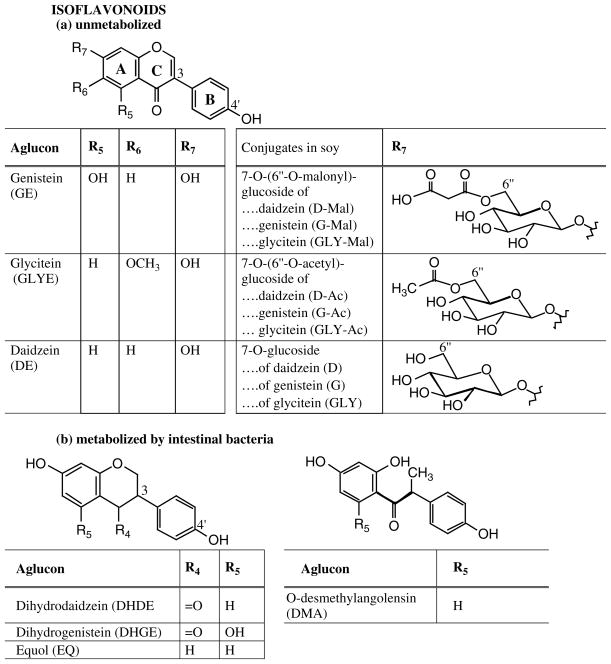
Isoflavones (IFLs) are natural products to which humans have been traditionally exposed predominantly through soy foods; more recently humans are also exposed to them through soy protein addition to processed foods or through supplements. They are structurally similar to steroidal estrogens and can exert estrogenic or antiestrogenic effects depending on their concentrations and on the tissue considered. These properties qualify IFLs to be classified as phytoestrogens and are believed to account for many of the biological effects observed for soy and/or IFL exposure including benefits for bone and heart health or prevention of menopausal symptoms and certain types of cancer. In order to evaluate the function of IFLs, alone or when exposure happens through soy intake, pharmacokinetics and bioavailability are critical issues to be considered in epidemiologic and clinical research. For this purpose precise, accurate, robust, fast, and affordable techniques for IFL analyses are required.
异黄酮(IFLs)是天然产物,人类主要通过食用大豆食品来摄入;最近,人们也通过在加工食品中添加大豆蛋白或通过补充剂来摄入 IFLs。它们的结构与甾体雌激素相似,并根据其浓度和所考虑的组织,发挥雌激素或抗雌激素作用。这些特性使 IFLs 有资格被归类为植物雌激素,并被认为是许多观察到的与大豆和/或 IFL 暴露相关的生物学效应的原因,包括对骨骼和心脏健康的益处、预防更年期症状和某些类型的癌症。为了评估 IFLs 的功能,无论是单独存在还是通过大豆摄入,药代动力学和生物利用度是在流行病学和临床研究中需要考虑的关键问题。为此,需要精确、准确、稳健、快速且经济实惠的 IFL 分析技术。