Division of AIDS, Korea Centers for Disease Control and Prevention, Seoul, Korea.
BMC Public Health. 2010 Jul 13;10:411. doi: 10.1186/1471-2458-10-411.
The number of Koreans diagnosed with human immunodeficiency virus (HIV) infections is increasing annually; however, CD4+ T-cell counts at diagnosis have decreased. The purpose of the present study was to identify clinical and epidemiologic associations with low CD4+ T-cell counts at the time of HIV diagnosis in a Korean population.
Data from 2,299 HIV-infected individuals with initial CD4+ T-cell counts measured within 6 months of HIV diagnosis and reason for HIV testing were recorded and measured from 2000 to 2007. Data were selected from the database of the Korea Centers for Disease Control and Prevention. Late diagnosis was defined by CD4+ T-cell counts <200 cells/mm3. Reasons for HIV testing were analyzed using logistic regression including epidemiologic variables.
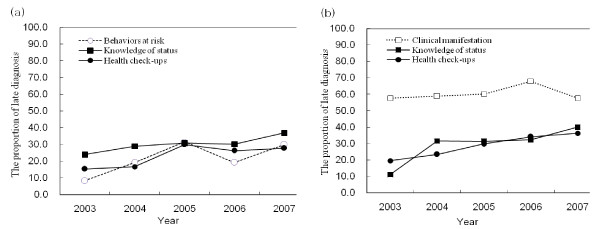
A total of 858 individuals (37.3%) were included in the late diagnosis group. Individuals with a late diagnosis were older, exposed through heterosexual contact, and demonstrated clinical manifestations of acquired immunodeficiency syndrome (AIDS). The primary reason for HIV testing was a routine health check-up (41%) followed by clinical manifestations (31%) of AIDS. The proportion of individuals with a late diagnosis was higher in individuals tested due to clinical symptoms in public health centers (adjusted odds ratio [AOR], 17.3; 95% CI, 1.7-175) and hospitals (AOR, 4.9; 95% CI, 3.4-7.2) compared to general health check-up. Late diagnosis annually increased in individuals diagnosed by voluntary testing both in public health centers (PHCs, P = 0.017) and in hospitals (P = 0.063). Routine testing due to risky behaviors resulted in earlier detection than testing secondary to health check-ups, although this difference was not statistically significant (AOR, 0.7; P = 0.187). Individuals identified as part of hospital health check-ups more frequently had a late diagnosis (P = 0.001)
HIV infection was primarily detected by voluntary testing with identification in PHCs and by testing due to clinical symptoms in hospitals. However, early detection was not influenced by either voluntary testing or general health check-up. It is important to encourage voluntary testing for early detection to decrease the prevalence of HIV infection and AIDS progression.
韩国每年诊断出的人类免疫缺陷病毒(HIV)感染者人数正在增加,但诊断时的 CD4+T 细胞计数却有所下降。本研究的目的是确定韩国人群 HIV 诊断时 CD4+T 细胞计数较低的临床和流行病学关联。
从 2000 年至 2007 年,记录了 2299 名 HIV 感染患者的初始 CD4+T 细胞计数,这些患者在 HIV 诊断后 6 个月内进行了测量,并记录了他们接受 HIV 检测的原因。数据取自韩国疾病控制与预防中心的数据库。CD4+T 细胞计数<200 个细胞/mm3 被定义为晚期诊断。使用包括流行病学变量的逻辑回归分析 HIV 检测的原因。
共有 858 人(37.3%)被纳入晚期诊断组。晚期诊断组的患者年龄较大,通过异性接触感染,并且表现出获得性免疫缺陷综合征(AIDS)的临床症状。HIV 检测的主要原因是常规健康检查(41%),其次是 AIDS 的临床症状(31%)。在公共卫生中心(调整后的优势比 [AOR],17.3;95%置信区间 [CI],1.7-175)和医院(AOR,4.9;95%CI,3.4-7.2)因临床症状就诊的患者中,晚期诊断的比例较高,与常规健康检查相比。在公共卫生中心(PHC)和医院接受自愿检测的患者中,每年的晚期诊断率均有所增加(PHC:P=0.017;医院:P=0.063)。由于危险行为进行常规检测比因健康检查进行检测更早发现感染,但这一差异无统计学意义(AOR,0.7;P=0.187)。作为医院健康检查的一部分而被发现的患者更常出现晚期诊断(P=0.001)。
HIV 感染主要通过自愿检测(在 PHC 中发现)和医院因临床症状进行的检测发现。然而,早期检测不受自愿检测或常规健康检查的影响。鼓励自愿检测以早期发现,从而降低 HIV 感染和 AIDS 进展的发生率,这一点非常重要。