Vandenborne K, McCully K, Kakihira H, Prammer M, Bolinger L, Detre J A, De Meirlier K, Walter G, Chance B, Leigh J S
Department of Biochemistry and Biophysics, University of Pennsylvania, Philadelphia 19104.
Proc Natl Acad Sci U S A. 1991 Jul 1;88(13):5714-8. doi: 10.1073/pnas.88.13.5714.
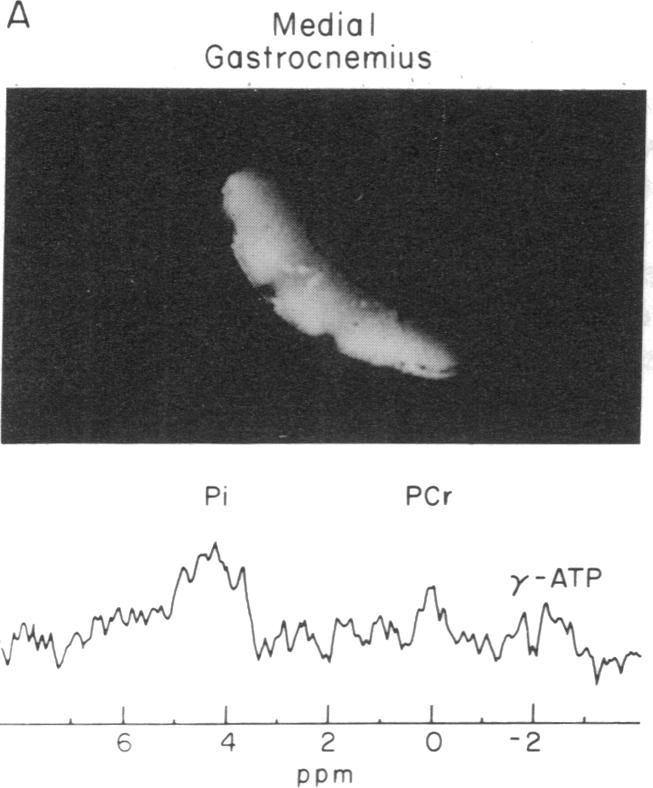
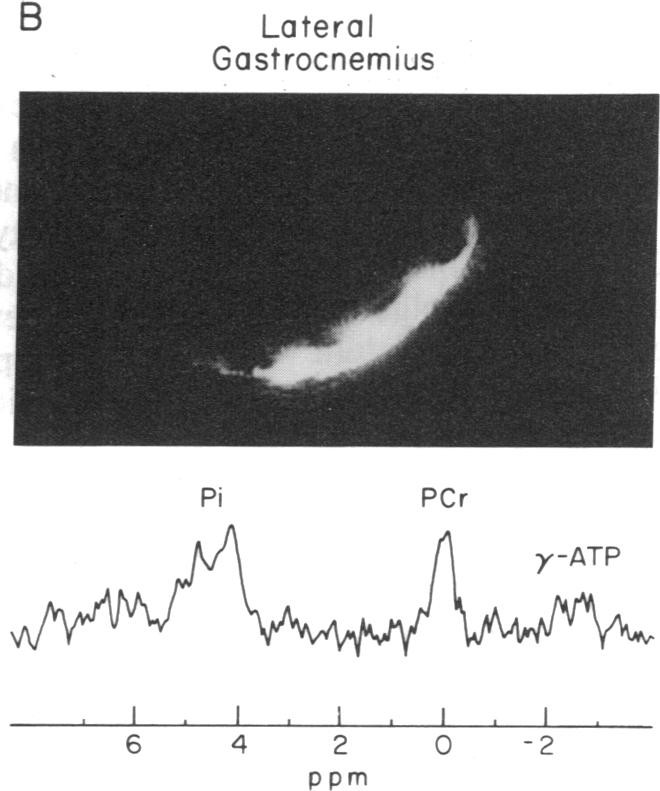
Human skeletal muscle is composed of various muscle fiber types. We hypothesized that differences in metabolism between fiber types could be detected noninvasively with 31P nuclear magnetic resonance spectroscopy during maximal exercise. This assumes that during maximal exercise all fiber types are recruited and all vary in the amount of acidosis. The calf muscles of seven subjects were studied. Two different coils were applied: an 11-cm-diameter surface coil and a five-segment meander coil. The meander coil was used to localize the 31P signal to either the medial or the lateral gastrocnemius. Maximal exercise, consisting of rapid plantar flexions, resulted in an 83.7% +/- 7.8% decrease of the phosphocreatine pool and an 8-fold increase of the inorganic phosphate (Pi) pool. At rest the Pi pool was observed as a single resonance (pH 7.0). Toward the end of the first minute of exercise, three subjects showed three distinct Pi peaks. During the second minute of exercise the pH values stabilized at 7.12 +/- 0.12, 6.63 +/- 0.15, and 6.27 +/- 0.23. The same pattern was seen when the signal was collected from the medial or lateral gastrocnemius. In four subjects only two distinct Pi peaks were observed. The Pi peaks had differing relative areas in different subjects, but they were reproducible in each individual. This method allowed us to study the appearance and disappearance of the different Pi peaks, together with the changes in pH. Because multiple Pi peaks were seen in single muscles they most likely identify different muscle fiber types.
人类骨骼肌由多种肌纤维类型组成。我们假设在最大运动期间,通过31P核磁共振波谱可以无创检测纤维类型之间的代谢差异。这假定在最大运动期间,所有纤维类型均被募集,且酸中毒程度各不相同。对7名受试者的小腿肌肉进行了研究。使用了两种不同的线圈:一个直径11厘米的表面线圈和一个五段曲折线圈。曲折线圈用于将31P信号定位到内侧或外侧腓肠肌。由快速跖屈组成的最大运动导致磷酸肌酸池减少83.7%±7.8%,无机磷酸盐(Pi)池增加8倍。静息时,Pi池表现为单一共振(pH 7.0)。在运动的第一分钟结束时,三名受试者出现了三个不同的Pi峰。在运动的第二分钟,pH值稳定在7.12±0.12、6.63±0.15和6.27±0.23。从内侧或外侧腓肠肌收集信号时也观察到相同的模式。在四名受试者中,仅观察到两个不同的Pi峰。不同受试者的Pi峰相对面积不同,但在每个个体中都具有可重复性。这种方法使我们能够研究不同Pi峰的出现和消失以及pH值的变化。由于在单个肌肉中观察到多个Pi峰,它们很可能识别出不同的肌纤维类型。