Huang Shun Ping, Palla Suryanarayana, Ruzycki Philip, Varma Ross Arjun, Harter Theresa, Reddy G Bhanuprakesh, Petrash J Mark
Department of Ophthalmology & Visual Sciences, Washington University School of Medicine, St. Louis, MO 63110, USA.
J Ophthalmol. 2010;2010:521204. doi: 10.1155/2010/521204. Epub 2010 Jun 13.
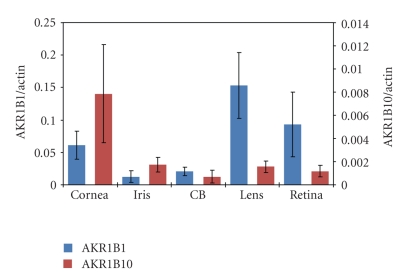
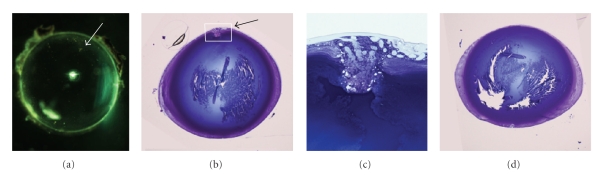
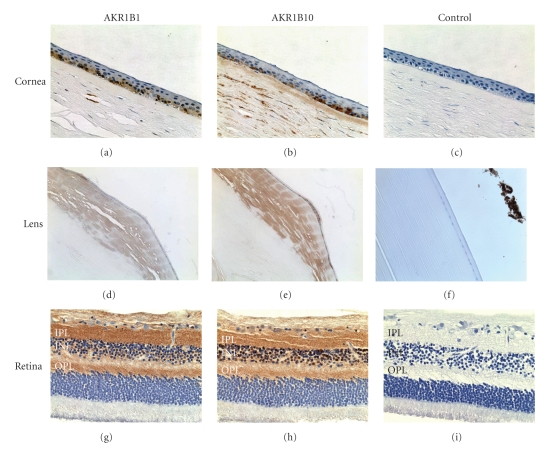
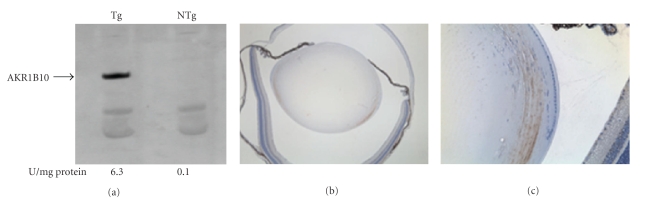
Aldose reductase (AKR1B1) is an NADPH-dependent aldo-keto reductase best known as the rate-limiting enzyme of the polyol pathway. Accelerated glucose metabolism through this pathway has been implicated in diabetic cataract and retinopathy. Some human tissues contain AKR1B1 as well as AKR1B10, a closely related member of the aldo-keto reductase gene superfamily. This opens the possibility that AKR1B10 may also contribute to diabetic complications. The goal of the current study was to characterize the expression profiles of AKR1B1 and AKR1B10 in the human eye. Using quantitative reverse transcriptase-PCR and immunohistochemical staining, we observed expression of both AKR genes in cornea, iris, ciliary body, lens, and retina. Expression of AKR1B1 was the highest in lens and retina, whereas AKR1B10 was the highest in cornea. Lenses from transgenic mice designed for overexpression of AKR1B10 were not significantly different from nontransgenic controls, although a significant number developed a focal defect in the anterior lens epithelium following 6 months of experimentally induced diabetes. However, lenses from AKR1B10 mice remained largely transparent following longterm diabetes. These results indicate that AKR1B1 and AKR1B10 may have different functional properties in the lens and suggest that AKR1B10 does not contribute to the pathogenesis of diabetic cataract in humans.
醛糖还原酶(AKR1B1)是一种依赖烟酰胺腺嘌呤二核苷酸磷酸(NADPH)的醛酮还原酶,作为多元醇途径的限速酶最为人所知。通过该途径加速的葡萄糖代谢与糖尿病性白内障和视网膜病变有关。一些人体组织含有AKR1B1以及醛酮还原酶基因超家族中密切相关的成员AKR1B10。这使得AKR1B10也可能导致糖尿病并发症成为可能。本研究的目的是描述AKR1B1和AKR1B10在人眼中的表达谱。使用定量逆转录聚合酶链反应(qRT-PCR)和免疫组织化学染色,我们观察到这两种AKR基因在角膜、虹膜、睫状体、晶状体和视网膜中均有表达。AKR1B1在晶状体和视网膜中的表达最高,而AKR1B10在角膜中的表达最高。设计用于过表达AKR1B10的转基因小鼠的晶状体与非转基因对照没有显著差异,尽管在实验性诱导糖尿病6个月后,相当数量的小鼠在前晶状体上皮出现了局灶性缺陷。然而,长期糖尿病后,AKR1B10小鼠的晶状体在很大程度上仍保持透明。这些结果表明,AKR1B1和AKR1B10在晶状体中可能具有不同的功能特性,并表明AKR1B10对人类糖尿病性白内障的发病机制没有贡献。