Department of Otolaryngology-Head and Neck Surgery, University of Iowa, Iowa City, Iowa, U.S.A.
Otol Neurotol. 2010 Sep;31(7):1041-8. doi: 10.1097/MAO.0b013e3181ec1d92.
To determine the extent to which electrically evoked compound action potential (ECAP) measurements were related with speech perception performance in implant users with a short electrode array and to investigate the relationship between ECAP measures and performance according to specific devices.
Prospective study.
Tertiary referral center.
Seventeen Hybrid cochlear implant users were tested in this study. Subjects were divided into 2 groups: 8 using the Nucleus Hybrid M and 9 using the Nucleus Hybrid RE. In addition, 21 Nucleus Freedom long electrode implant (CI24RE) users also were tested to compare with the results of the old device (CI24M).
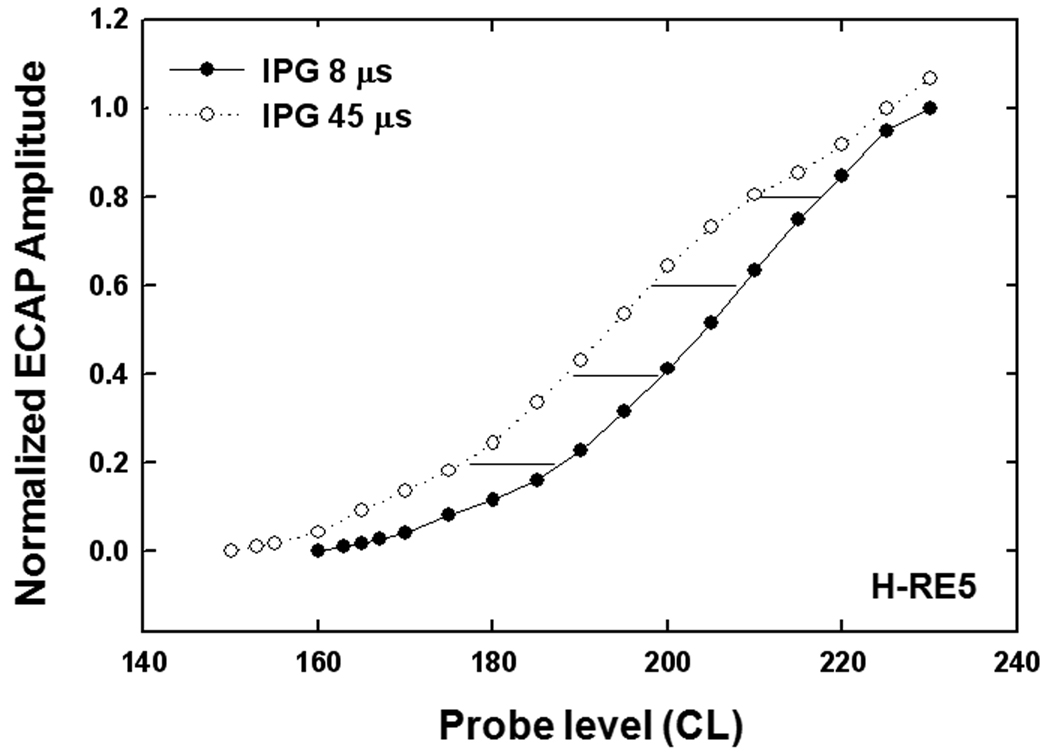
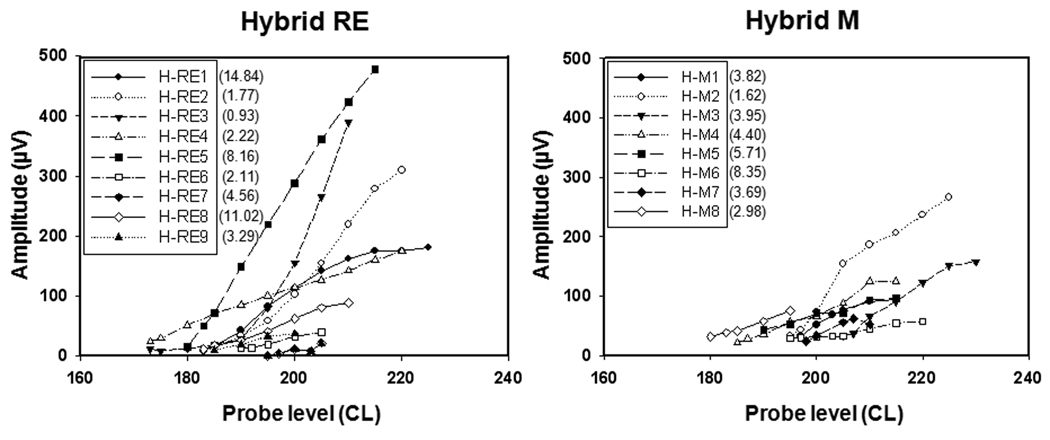
ECAP growth functions were recorded using either an interphase gap (IPG) of 8 or 45 mus. We then calculated the slope of the growth function and changes in sensitivity with IPG. For each subject, these measures were compared with performance on tests of word recognition.
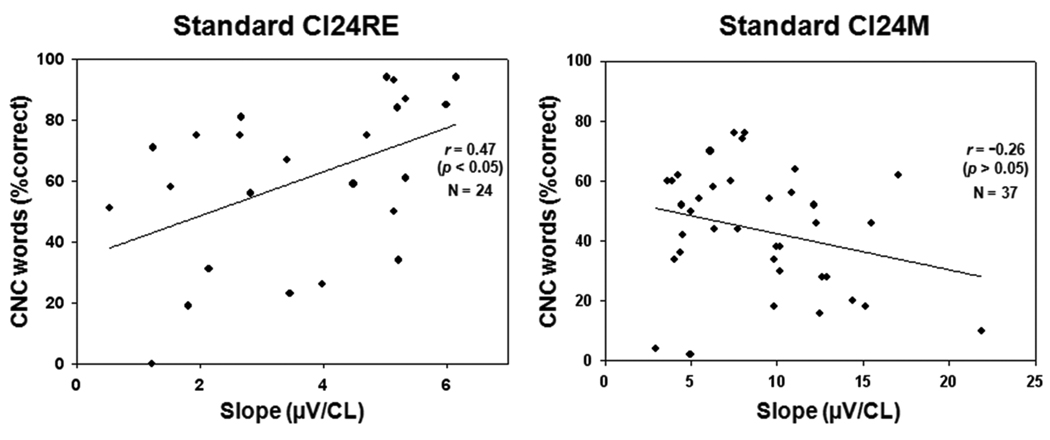
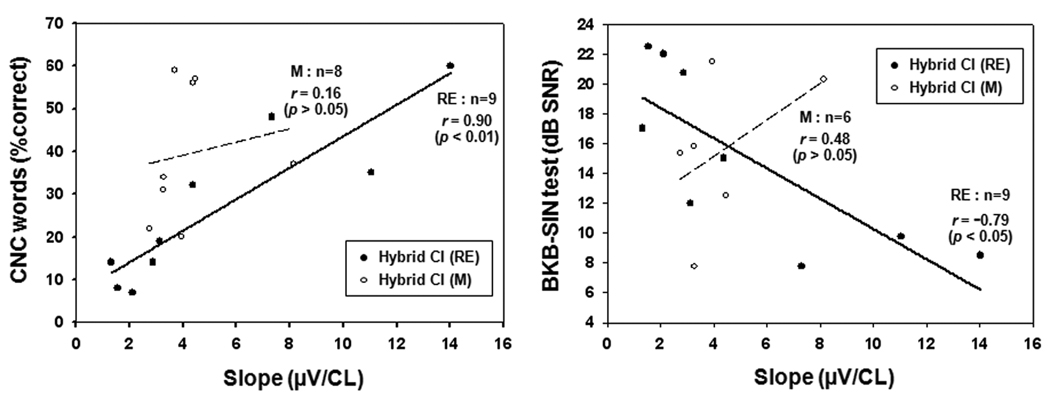
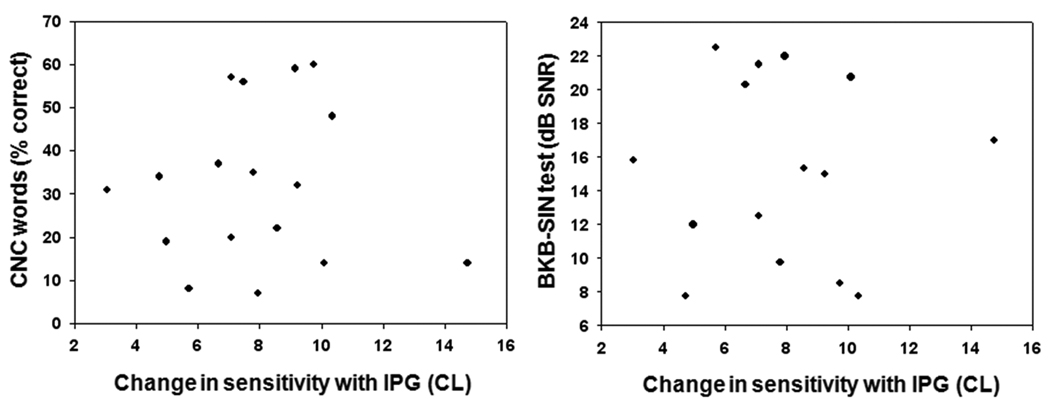
The changes in sensitivity using 2 IPGs showed no correlation with the results of word recognition test in Hybrid cochlear implant users. In contrast, relatively strong correlations have been found between the slope of ECAP growth functions and performance on word recognition test. Additionally, when we separate the results of Hybrid M and RE, the slopes of ECAP growth functions from only Hybrid RE CI recipients were significantly correlated with speech performance. The slopes of ECAP growth function in CI24RE users with long electrode also were significantly correlated with performance. However, comparing between 2 independent correlations in RE devices, correlation was higher in Hybrid RE group.
The results presented in this article support the view that slope of the ECAP growth can show significant correlation to performance with a cochlear implant. Furthermore, these results suggest that the strength of the correlation may be related to the specific device. These results suggest that ECAP measures may be useful in developing a test to predict outcomes with the implant.
确定短电极阵列人工耳蜗植入者中电诱发复合动作电位(ECAP)测量与言语感知性能的相关程度,并根据特定设备研究 ECAP 测量值与性能之间的关系。
前瞻性研究。
三级转诊中心。
本研究纳入了 17 名 Hybrid 人工耳蜗植入者。受试者分为 2 组:8 名使用 Nucleus Hybrid M,9 名使用 Nucleus Hybrid RE。此外,还对 21 名 Nucleus Freedom 长电极植入(CI24RE)使用者进行了测试,以与旧设备(CI24M)的结果进行比较。
使用 8 或 45 微秒的相间间隙(IPG)记录 ECAP 生长函数。然后,我们计算了生长函数的斜率和 IPG 变化时的灵敏度。对于每个受试者,将这些指标与单词识别测试的结果进行比较。
Hybrid 人工耳蜗植入者中,2 个 IPG 的灵敏度变化与单词识别测试结果无相关性。相比之下,ECAP 生长函数斜率与单词识别测试的相关性较强。此外,当我们将 Hybrid M 和 RE 的结果分开时,仅 Hybrid RE CI 受者的 ECAP 生长函数斜率与言语表现显著相关。长电极 CI24RE 使用者的 ECAP 生长函数斜率也与性能显著相关。然而,在 RE 设备中比较 2 个独立的相关性时,Hybrid RE 组的相关性更高。
本文的结果支持这样一种观点,即 ECAP 生长的斜率可以与人工耳蜗植入者的性能显著相关。此外,这些结果表明,相关性的强度可能与特定设备有关。这些结果表明,ECAP 测量值可能有助于开发一种预测植入物效果的测试。