Section of Orthopaedics, Department of Surgical Sciences, Uppsala University, [corrected] Uppsala, Sweden.
PLoS One. 2010 Jul 13;5(7):e11555. doi: 10.1371/journal.pone.0011555.
Vitamin D is not only important for bone health but can also affect the development of several non-bone diseases. The definition of vitamin D insufficiency by serum levels of 25-hydroxyvitamin D depends on the clinical outcome but might also be a consequence of analytical methods used for the definition. Although numerous 25-hydroxyvitamin D assays are available, their comparability is uncertain. We therefore aim to investigate the precision, accuracy and clinical consequences of differences in performance between three common commercially available assays.
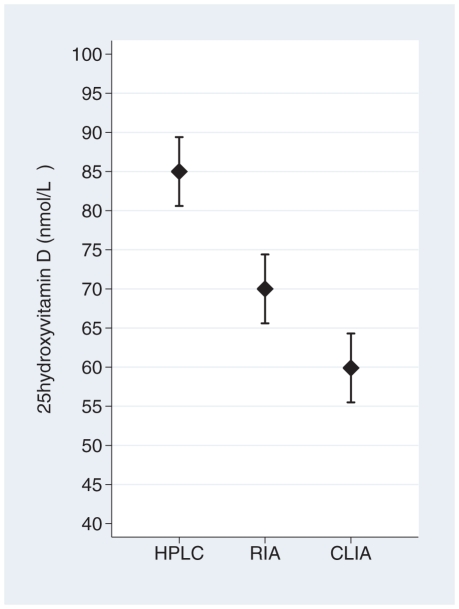
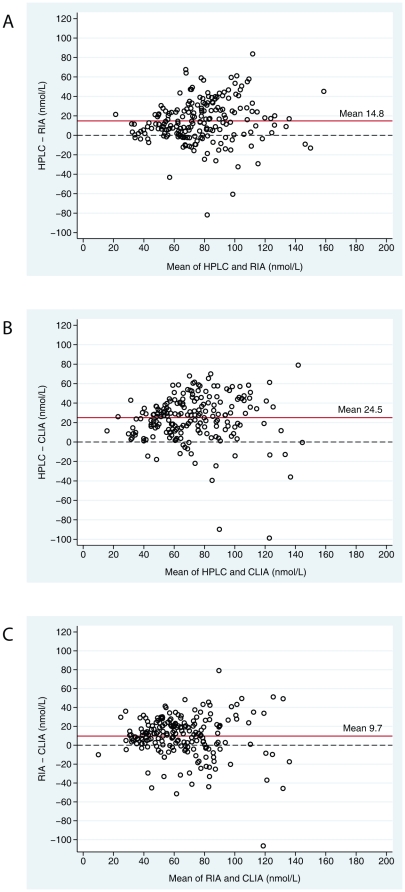
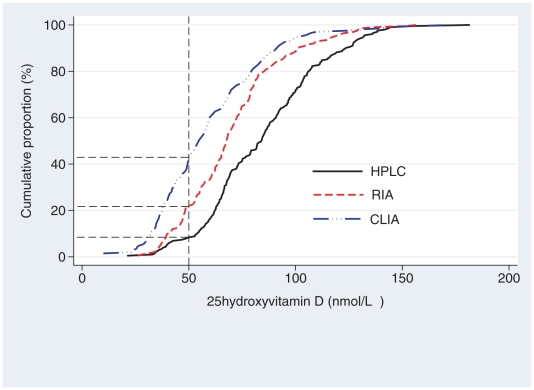
METHODOLOGY/PRINCIPAL FINDINGS: Serum 25-hydroxyvitamin D levels from 204 twins from the Swedish Twin Registry were determined with high-pressure liquid chromatography-atmospheric pressure chemical ionization-mass spectrometry (HPLC-APCI-MS), a radioimmunoassay (RIA) and a chemiluminescent immunoassay (CLIA). High inter-assay disagreement was found. Mean 25-hydroxyvitamin D levels were highest for the HPLC-APCI-MS technique (85 nmol/L, 95% CI 81-89), intermediate for RIA (70 nmol/L, 95% CI 66-74) and lowest with CLIA (60 nmol/L, 95% CI 56-64). Using a 50-nmol/L cut-off, 8% of the subjects were insufficient using HPLC-APCI-MS, 22% with RIA and 43% by CLIA. Because of the heritable component of 25-hydroxyvitamin D status, the accuracy of each method could indirectly be assessed by comparison of within-twin pair correlations. The strongest correlation was found for HPLC-APCI-MS (r = 0.7), intermediate for RIA (r = 0.5) and lowest for CLIA (r = 0.4). Regression analyses between the methods revealed a non-uniform variance (p<0.0001) depending on level of 25-hydroxyvitamin D.
CONCLUSIONS/SIGNIFICANCE: There are substantial inter-assay differences in performance. The most valid method was HPLC-APCI-MS. Calibration between 25-hydroxyvitamin D assays is intricate.
维生素 D 不仅对骨骼健康很重要,还可能影响多种非骨骼疾病的发展。血清 25-羟维生素 D 水平定义的维生素 D 不足取决于临床结果,但也可能是用于定义的分析方法的结果。虽然有许多 25-羟维生素 D 测定方法,但它们的可比性并不确定。因此,我们旨在研究三种常用商业测定方法之间性能差异的精密度、准确性和临床后果。
方法/主要发现:来自瑞典双胞胎登记处的 204 对双胞胎的血清 25-羟维生素 D 水平采用高压液相色谱-大气压化学电离质谱(HPLC-APCI-MS)、放射免疫测定(RIA)和化学发光免疫测定(CLIA)进行测定。发现测定之间存在高度不一致。HPLC-APCI-MS 技术的平均 25-羟维生素 D 水平最高(85 nmol/L,95%CI 81-89),RIA 为 70 nmol/L(95%CI 66-74),CLIA 最低(60 nmol/L,95%CI 56-64)。使用 50-nmol/L 截止值,8%的受试者使用 HPLC-APCI-MS 不足,22%的受试者使用 RIA 不足,43%的受试者使用 CLIA 不足。由于 25-羟维生素 D 状态具有遗传成分,因此可以通过比较双胞胎内的相关性间接评估每种方法的准确性。相关性最强的是 HPLC-APCI-MS(r = 0.7),其次是 RIA(r = 0.5),最弱的是 CLIA(r = 0.4)。方法之间的回归分析显示,取决于 25-羟维生素 D 的水平,存在非均匀的方差(p<0.0001)。
结论/意义:性能存在显著的测定间差异。最有效的方法是 HPLC-APCI-MS。25-羟维生素 D 测定之间的校准很复杂。