Biosystems Department, M3-BIORES, Katholieke Universiteit Leuven, Willem de Croylaan 34, Leuven, Belgium.
Int J Environ Res Public Health. 2010 Jun;7(6):2486-500. doi: 10.3390/ijerph7062486. Epub 2010 Jun 9.
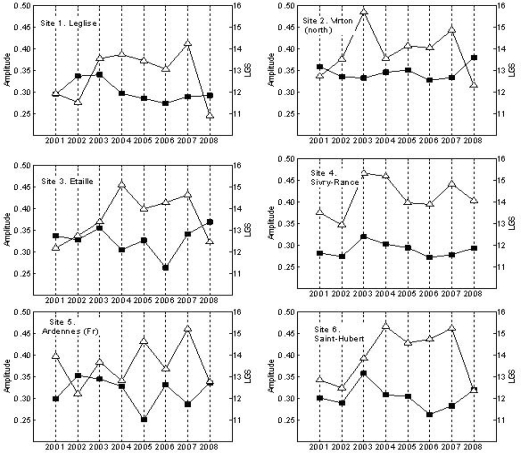
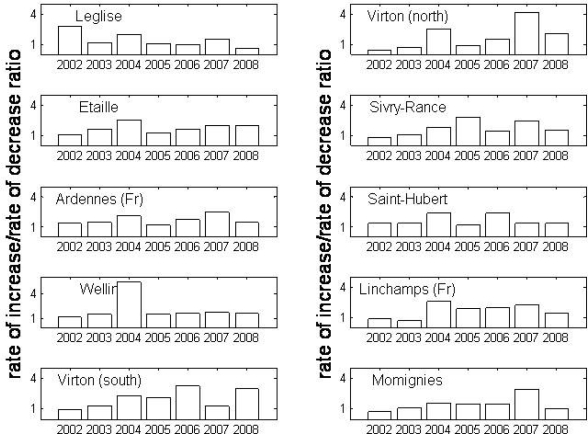
The connection between nephropathia epidemica (NE) and vegetation dynamics has been emphasized in recent studies. Changing climate has been suggested as a triggering factor of recently observed epidemiologic peaks in reported NE cases. We have investigated whether there is a connection between the NE occurrence pattern in Belgium and specific trends in remotely sensed phenology parameters of broad-leaved forests. The analysis of time series of the MODIS Enhanced Vegetation Index revealed that changes in forest phenology, considered in literature as an effect of climate change, may affect the mechanics of NE transmission.
近年来的研究强调了流行性肾综合征(NE)与植被动态之间的联系。有研究认为,气候变化是最近观察到报告的 NE 病例流行高峰的一个触发因素。我们调查了比利时的 NE 发生模式与阔叶林遥感物候参数的特定趋势之间是否存在联系。对 MODIS 增强植被指数时间序列的分析表明,森林物候的变化(文献中认为这是气候变化的影响)可能会影响 NE 传播的机制。