Ostfeld Richard S, Canham Charles D, Oggenfuss Kelly, Winchcombe Raymond J, Keesing Felicia
Institute of Ecosystem Studies, Millbrook, New York, USA.
PLoS Biol. 2006 Jun;4(6):e145. doi: 10.1371/journal.pbio.0040145. Epub 2006 May 9.
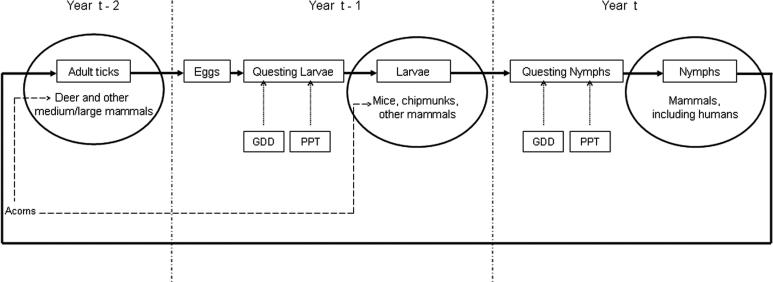
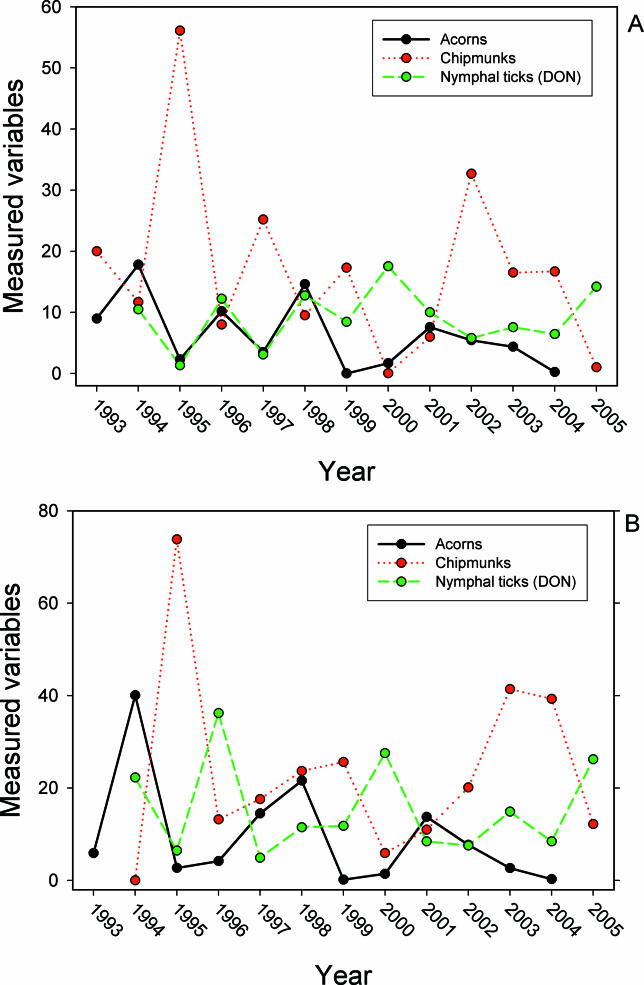
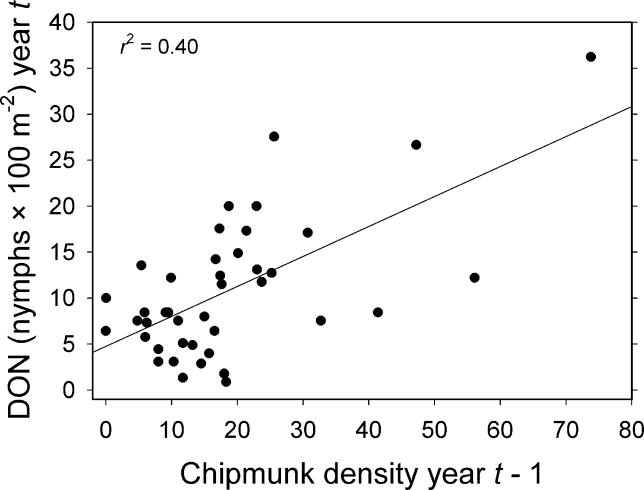
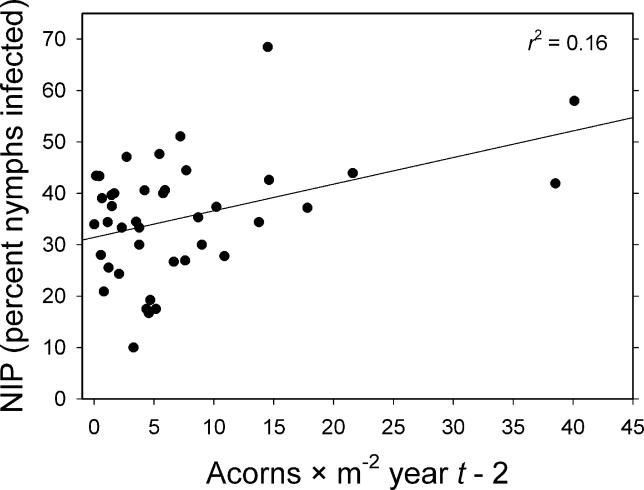
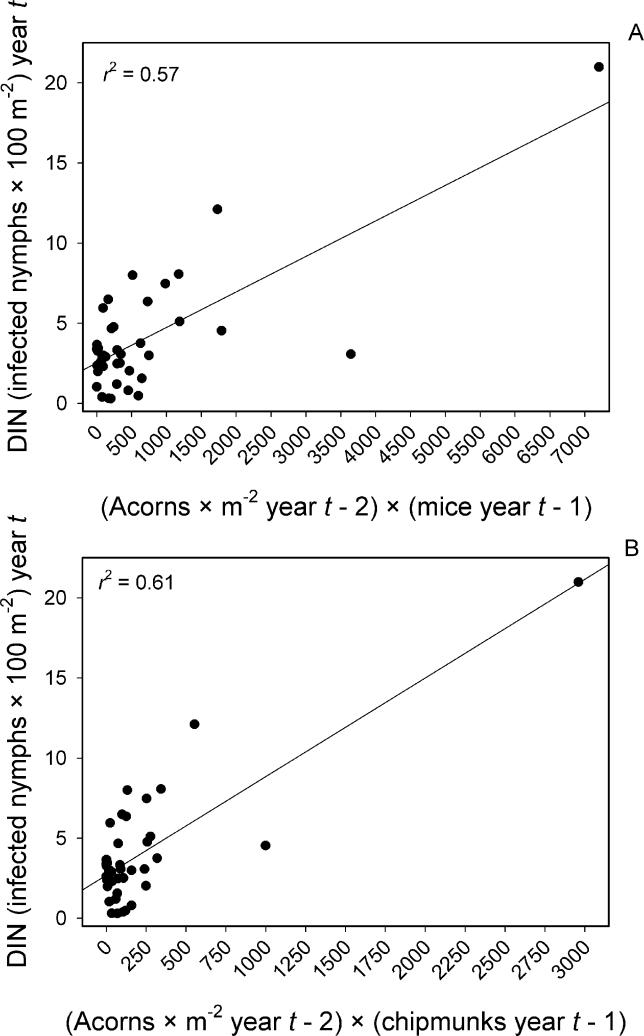
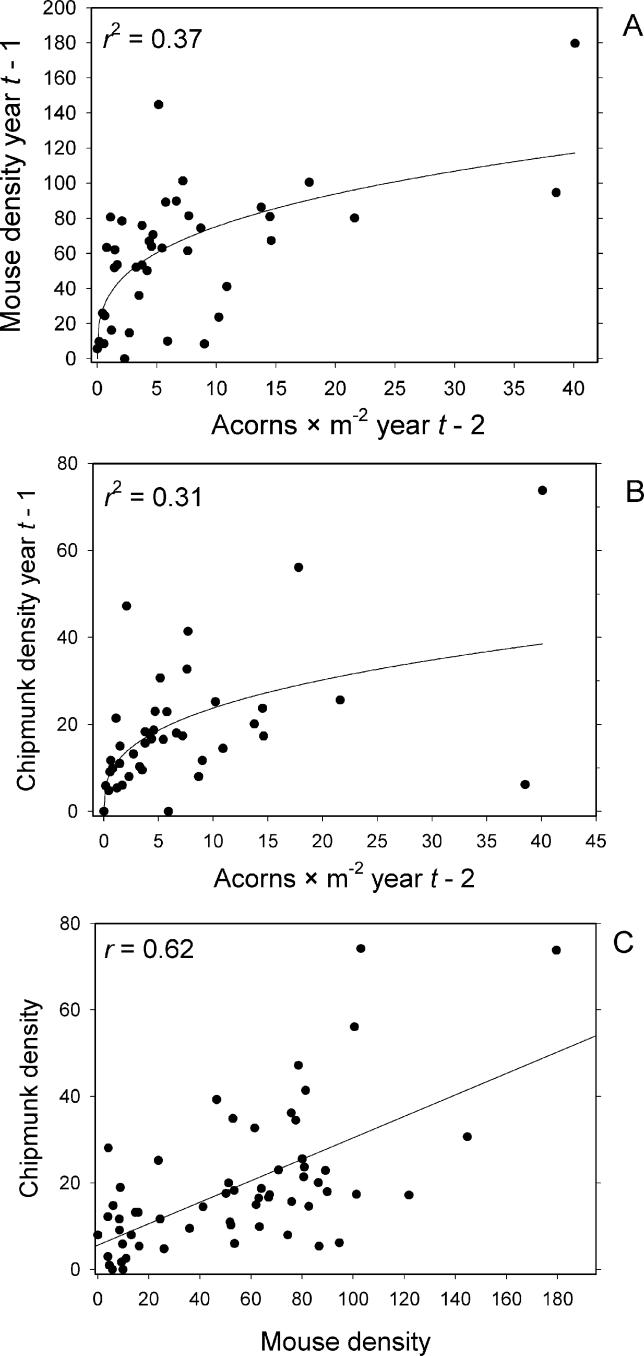
Risk of human exposure to vector-borne zoonotic pathogens is a function of the abundance and infection prevalence of vectors. We assessed the determinants of Lyme-disease risk (density and Borrelia burgdorferi-infection prevalence of nymphal Ixodes scapularis ticks) over 13 y on several field plots within eastern deciduous forests in the epicenter of US Lyme disease (Dutchess County, New York). We used a model comparison approach to simultaneously test the importance of ambient growing-season temperature, precipitation, two indices of deer (Odocoileus virginianus) abundance, and densities of white-footed mice (Peromyscus leucopus), eastern chipmunks (Tamias striatus), and acorns (Quercus spp.), in both simple and multiple regression models, in predicting entomological risk. Indices of deer abundance had no predictive power, and precipitation in the current year and temperature in the prior year had only weak effects on entomological risk. The strongest predictors of a current year's risk were the prior year's abundance of mice and chipmunks and abundance of acorns 2 y previously. In no case did inclusion of deer or climate variables improve the predictive power of models based on rodents, acorns, or both. We conclude that interannual variation in entomological risk of exposure to Lyme disease is correlated positively with prior abundance of key hosts for the immature stages of the tick vector and with critical food resources for those hosts.
人类接触媒介传播的人畜共患病原体的风险取决于媒介的数量和感染率。我们在美国莱姆病中心(纽约州达奇斯县)的东部落叶林内的多个地块上,对13年间莱姆病风险的决定因素(肩突硬蜱若虫的密度和伯氏疏螺旋体感染率)进行了评估。我们采用模型比较方法,在简单和多元回归模型中,同时检验环境生长季节温度、降水量、两个鹿(弗吉尼亚鹿)数量指数,以及白足鼠、东部花栗鼠和橡子密度对预测昆虫学风险的重要性。鹿数量指数没有预测能力,当年降水量和前一年温度对昆虫学风险只有微弱影响。当年风险的最强预测因子是前一年的小鼠和花栗鼠数量以及两年前的橡子数量。在任何情况下,纳入鹿或气候变量都没有提高基于啮齿动物、橡子或两者的模型的预测能力。我们得出结论,接触莱姆病的昆虫学风险的年际变化与蜱虫媒介未成熟阶段的关键宿主的先前数量以及这些宿主的关键食物资源呈正相关。