Division of Molecular Biology/Biocenter, Innsbruck Medical University, Fritz-Pregl-Str. 3, 6020 Innsbruck, Austria.
Microbes Infect. 2010 Nov;12(12-13):1035-41. doi: 10.1016/j.micinf.2010.07.005. Epub 2010 Jul 24.
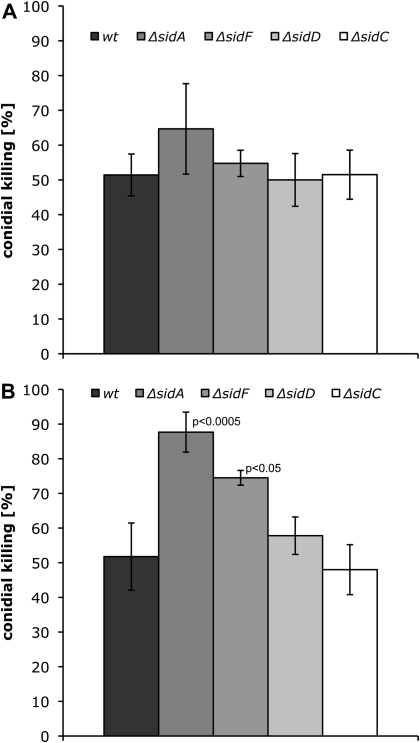
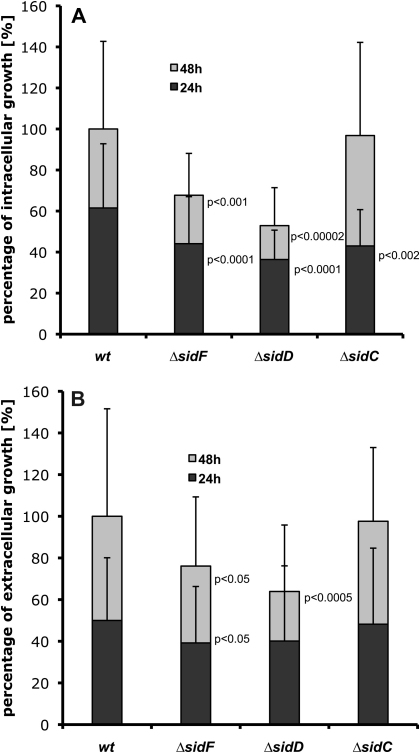
Iron plays a central role in manifestation of infections for a variety of pathogens. To ensure an adequate supply with iron, Aspergillus fumigatus employs extra- and intracellular siderophores (low-molecular mass iron chelators), which are of importance for fungal growth in particular during iron starvation. Here we show that the lack of extracellular siderophores, and especially, the lack of the entire siderophore system cause in immunosuppressed mice in vivo (i) a reduced extracellular growth rate, (ii) a reduced intracellular growth rate in alveolar macrophages, and (iii) an increased susceptibility to conidial growth inhibition by alveolar macrophages. These data underline the crucial role of the fungal siderophore system not only for extracellular growth but also in the interaction with the host immune cells. Moreover, the hyphal growth rate within alveolar macrophages compared to extracellular lavage fluid was significantly decreased indicating that, besides elimination of fungal conidia, inhibition of pathogenic growth is a function of macrophages.
铁在各种病原体感染的表现中起着核心作用。为了确保铁的供应充足,烟曲霉利用了细胞外和细胞内的铁载体(低分子量铁螯合剂),这对于真菌的生长尤其重要,特别是在缺铁的情况下。在这里,我们表明细胞外铁载体的缺乏,特别是整个铁载体系统的缺乏,在免疫抑制的小鼠体内(i)导致细胞外生长速度降低,(ii)肺泡巨噬细胞内生长速度降低,(iii)对肺泡巨噬细胞中孢子生长抑制的敏感性增加。这些数据强调了真菌铁载体系统的关键作用,不仅对细胞外生长,而且对与宿主免疫细胞的相互作用都很重要。此外,与细胞外灌洗液相比,肺泡巨噬细胞内的菌丝生长速度显著降低,表明除了消除真菌孢子外,抑制致病性生长也是巨噬细胞的功能。