Department of Epidemiology, University of Michigan School of Public Health, Ann Arbor, MI 48109, USA.
Health Place. 2010 Nov;16(6):1104-12. doi: 10.1016/j.healthplace.2010.07.001. Epub 2010 Jul 18.
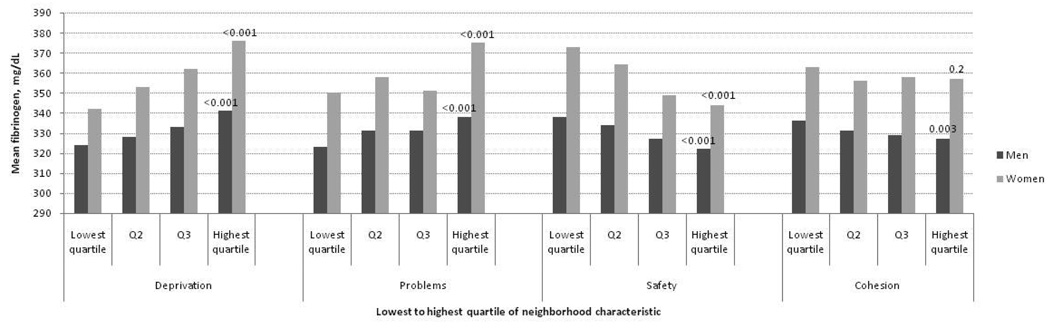
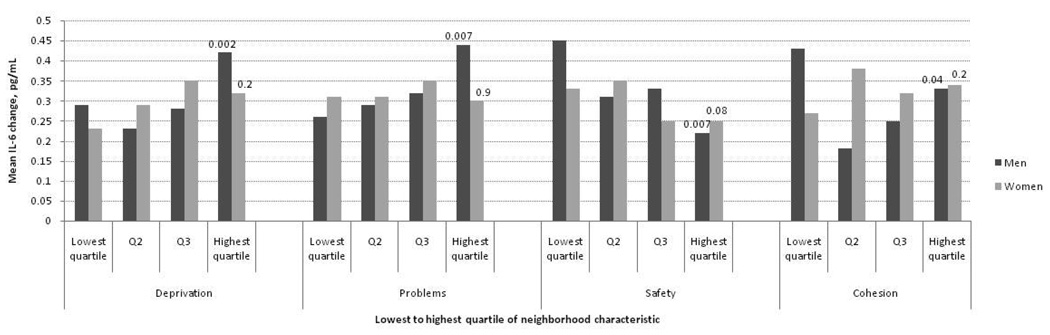
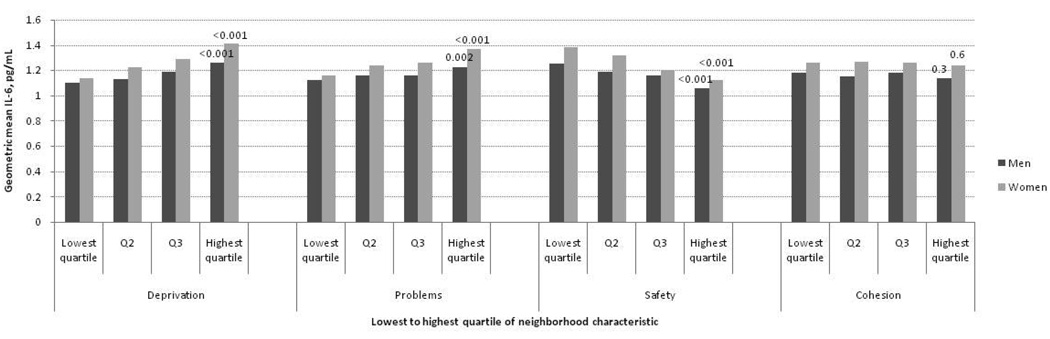
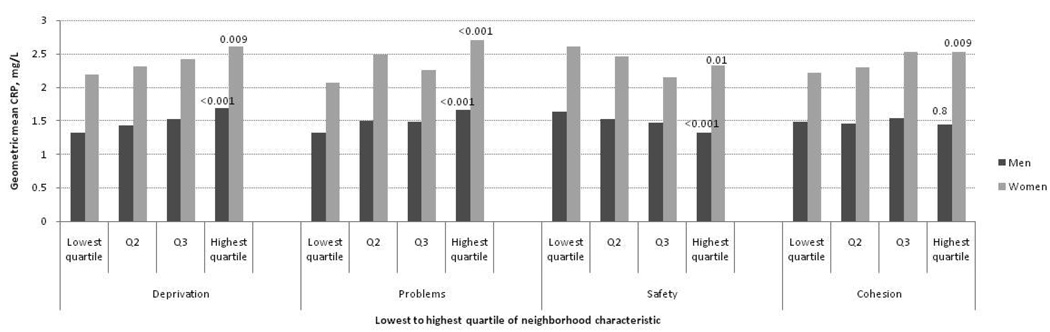
We investigated cross-sectional associations of neighborhood deprivation, problems, safety, and cohesion with circulating levels of fibrinogen, interleukin-6, and C-reactive protein (n = 5370) and longitudinal associations with changes in IL-6 over a 3-4 year period (n = 946). In cross-sectional analyses, higher levels of neighborhood deprivation and problems were associated with higher levels of all three inflammatory markers, whereas higher levels of safety were associated with lower levels. Fibrinogen remained associated with all neighborhood characteristics except cohesion and IL-6 remained associated with safety after adjustment for race and SES. In longitudinal analyses, higher levels of neighborhood deprivation and problems, and lower levels of safety were associated with greater longitudinal increases in IL-6 after adjustment for age, sex, race, and SES. These findings were not substantially modified by further risk factor adjustment. Although findings regarding different inflammatory markers were mixed, the longitudinal results that are less limited by race confounding suggest that inflammatory pathways may contribute to neighborhood differences in cardiovascular disease risk.
我们调查了邻里剥夺、问题、安全和凝聚力与纤维蛋白原、白细胞介素-6 和 C 反应蛋白循环水平之间的横断面关联(n = 5370),以及与 IL-6 在 3-4 年内变化的纵向关联(n = 946)。在横断面分析中,邻里剥夺和问题程度较高与所有三种炎症标志物水平较高有关,而安全程度较高与较低水平有关。除了凝聚力外,纤维蛋白原与所有邻里特征仍有关联,并且在调整种族和 SES 后,IL-6 仍与安全性有关。在纵向分析中,在调整年龄、性别、种族和 SES 后,邻里剥夺和问题程度较高,安全程度较低与 IL-6 的纵向增加更大有关。进一步的风险因素调整并没有显著改变这些发现。尽管关于不同炎症标志物的发现不一致,但受种族混杂影响较小的纵向结果表明,炎症途径可能导致心血管疾病风险的邻里差异。