Department of Thoracic/Head and Neck Medical Oncology, University of Texas M.D. Anderson Cancer Center, Houston, Texas, United States of America.
PLoS One. 2010 Jul 29;5(7):e11847. doi: 10.1371/journal.pone.0011847.
Improved understanding of lung cancer development and progression, including insights from studies of animal models, are needed to combat this fatal disease. Previously, we found that mice with a knockout (KO) of G-protein coupled receptor 5A (Gprc5a) develop lung tumors after a long latent period (12 to 24 months).
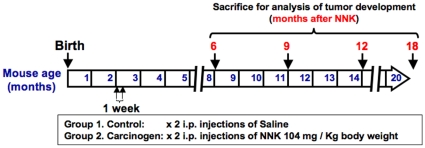
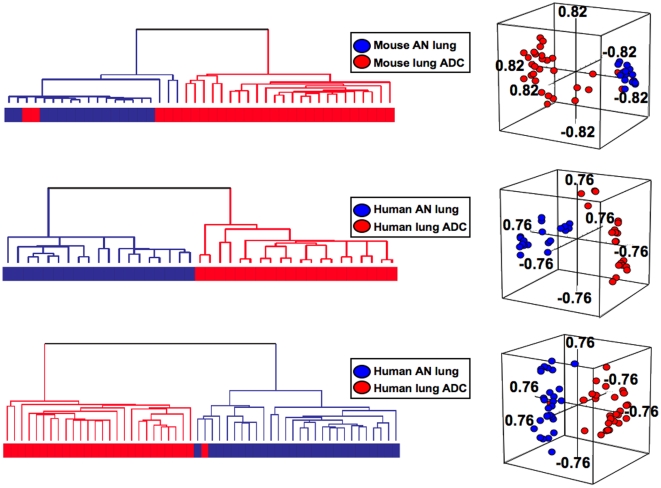
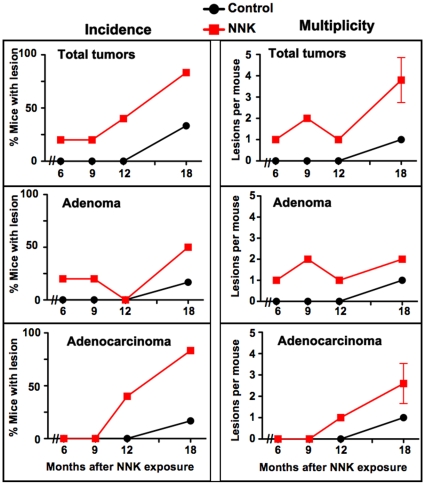
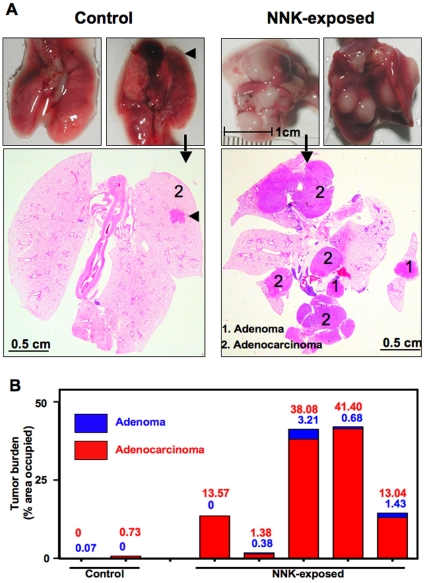
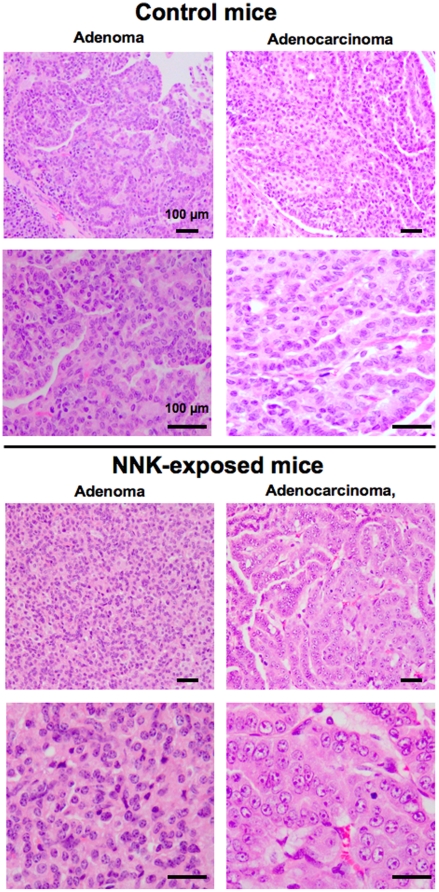
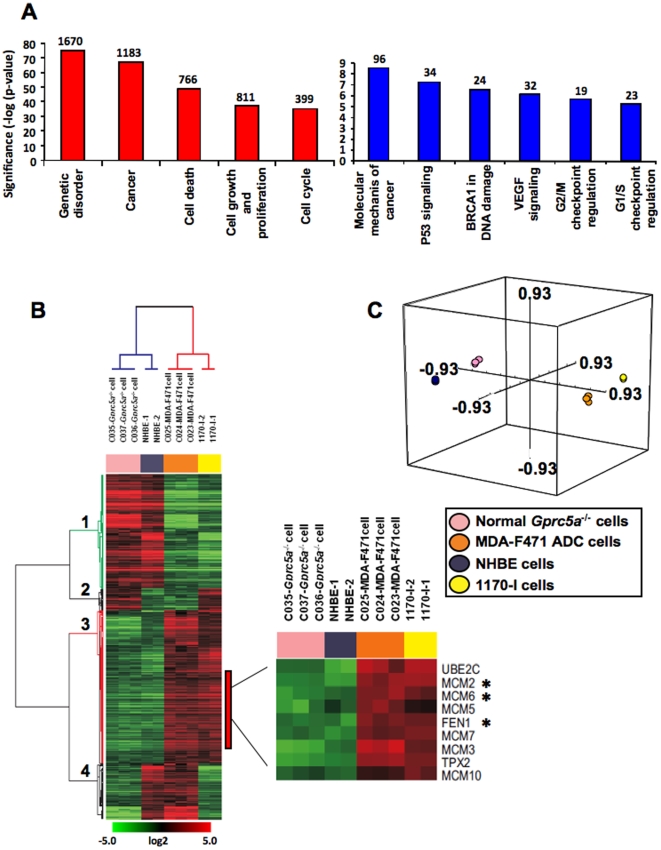
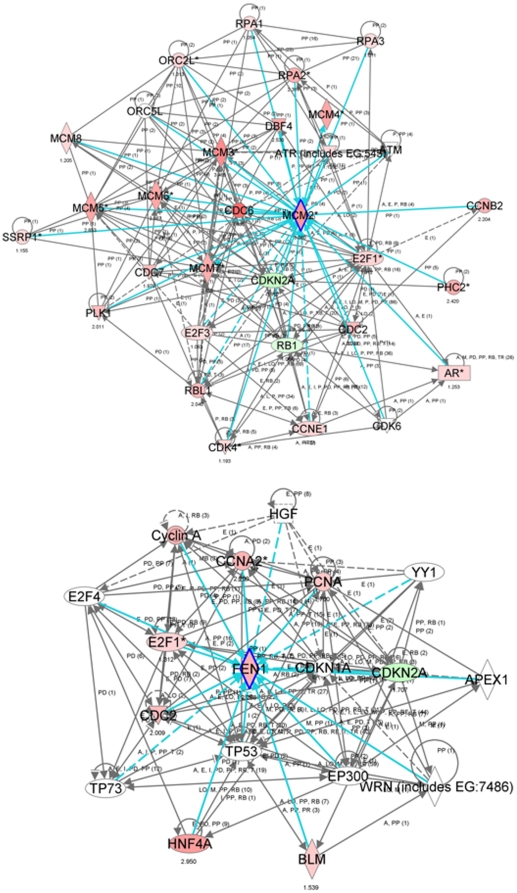
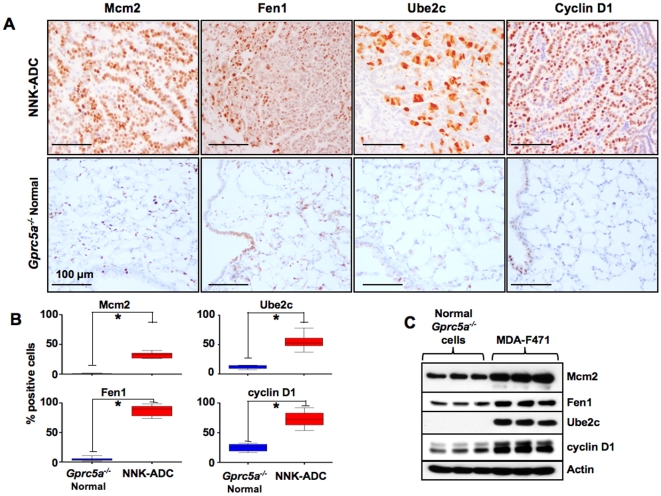
METHODOLOGY/PRINCIPAL FINDINGS: To determine whether a tobacco carcinogen will enhance tumorigenesis in this model, we administered 4-(methylnitrosamino)-1-(3-pyridyl)-1-butanone (NNK) i.p. to 2-months old Gprc5a-KO mice and sacrificed groups (n=5) of mice at 6, 9, 12, and 18 months later. Compared to control Gprc5a-KO mice, NNK-treated mice developed lung tumors at least 6 months earlier, exhibited 2- to 4-fold increased tumor incidence and multiplicity, and showed a dramatic increase in lesion size. A gene expression signature, NNK-ADC, of differentially expressed genes derived by transcriptome analysis of epithelial cell lines from normal lungs of Gprc5a-KO mice and from NNK-induced adenocarcinoma was highly similar to differential expression patterns observed between normal and tumorigenic human lung cells. The NNK-ADC expression signature also separated both mouse and human adenocarcinomas from adjacent normal lung tissues based on publicly available microarray datasets. A key feature of the signature, up-regulation of Ube2c, Mcm2, and Fen1, was validated in mouse normal lung and adenocarcinoma tissues and cells by immunohistochemistry and western blotting, respectively.
CONCLUSIONS/SIGNIFICANCE: Our findings demonstrate that lung tumorigenesis in the Gprc5a-KO mouse model is augmented by NNK and that gene expression changes induced by tobacco carcinogen(s) may be conserved between mouse and human lung epithelial cells. Further experimentation to prove the reliability of the Gprc5a knockout mouse model for the study of tobacco-induced lung carcinogenesis is warranted.
为了对抗这种致命疾病,我们需要深入了解肺癌的发生和发展,包括从动物模型研究中获得的见解。此前,我们发现 G 蛋白偶联受体 5A(Gprc5a)基因敲除(KO)的小鼠在经过较长的潜伏期(12-24 个月)后会发展出肺肿瘤。
方法/主要发现:为了确定烟草致癌物质是否会增强该模型的肿瘤发生,我们向 2 个月大的 Gprc5a-KO 小鼠腹腔内注射 4-(甲基亚硝氨基)-1-(3-吡啶基)-1-丁酮(NNK),并在 6、9、12 和 18 个月后处死各组(n=5)小鼠。与对照 Gprc5a-KO 小鼠相比,NNK 处理的小鼠至少提前 6 个月发展出肺肿瘤,肿瘤发生率和多发性增加了 2-4 倍,病变大小显著增加。通过对 Gprc5a-KO 小鼠正常肺上皮细胞系和 NNK 诱导的腺癌转录组分析得出的差异表达基因的基因表达谱(NNK-ADC)与正常和致瘤性人肺细胞之间观察到的差异表达模式非常相似。NNK-ADC 表达谱也基于公开的微阵列数据集,将小鼠和人类腺癌与相邻的正常肺组织区分开来。该特征的一个关键特征是 Ube2c、Mcm2 和 Fen1 的上调,通过免疫组织化学和 Western blot 分别在小鼠正常肺和腺癌组织和细胞中得到验证。
结论/意义:我们的研究结果表明,NNK 增强了 Gprc5a-KO 小鼠模型中的肺癌发生,烟草致癌物质诱导的基因表达变化可能在小鼠和人肺上皮细胞之间保守。进一步的实验来证明 Gprc5a 敲除小鼠模型在烟草诱导的肺癌发生研究中的可靠性是值得的。