Department of Animal and Plant Sciences, University of Sheffield, Sheffield, United Kingdom.
PLoS One. 2010 Aug 2;5(8):e10223. doi: 10.1371/journal.pone.0010223.
Understanding the distribution of marine biodiversity is a crucial first step towards the effective and sustainable management of marine ecosystems. Recent efforts to collate location records from marine surveys enable us to assemble a global picture of recorded marine biodiversity. They also effectively highlight gaps in our knowledge of particular marine regions. In particular, the deep pelagic ocean--the largest biome on Earth--is chronically under-represented in global databases of marine biodiversity.
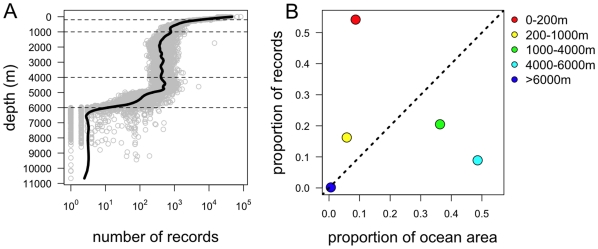
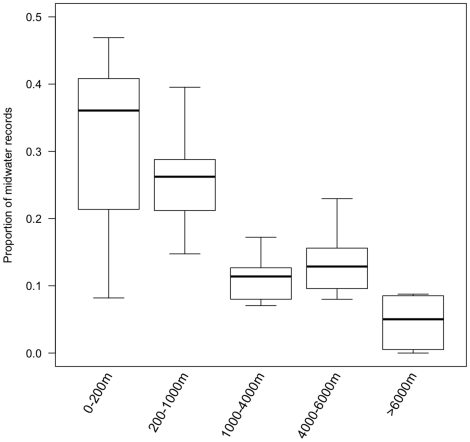
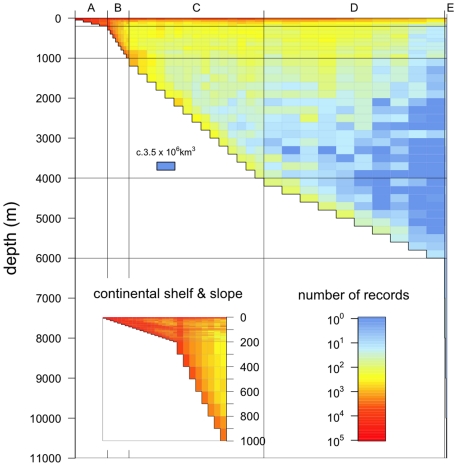
METHODOLOGY/PRINCIPAL FINDINGS: We use data from the Ocean Biogeographic Information System to plot the position in the water column of ca 7 million records of marine species occurrences. Records from relatively shallow waters dominate this global picture of recorded marine biodiversity. In addition, standardising the number of records from regions of the ocean differing in depth reveals that regardless of ocean depth, most records come either from surface waters or the sea bed. Midwater biodiversity is drastically under-represented.
CONCLUSIONS/SIGNIFICANCE: The deep pelagic ocean is the largest habitat by volume on Earth, yet it remains biodiversity's big wet secret, as it is hugely under-represented in global databases of marine biological records. Given both its value in the provision of a range of ecosystem services, and its vulnerability to threats including overfishing and climate change, there is a pressing need to increase our knowledge of Earth's largest ecosystem.
了解海洋生物多样性的分布是对海洋生态系统进行有效和可持续管理的关键第一步。最近,人们努力整理海洋调查的位置记录,使我们能够对已记录的海洋生物多样性有一个全球的了解。这些记录还能有效地突出我们对某些海洋区域的知识空白。特别是,地球上最大的生物群系——深海远洋——在全球海洋生物多样性数据库中严重缺乏记录。
方法/主要发现:我们利用海洋生物地理信息系统的数据,绘制了约 700 万种海洋物种出现位置的水柱图。这个全球记录的海洋生物多样性图主要由来自较浅水域的记录组成。此外,标准化不同深度海洋区域的记录数量表明,无论海洋深度如何,大多数记录要么来自水面,要么来自海底。中层水生物多样性严重缺乏记录。
结论/意义:深海远洋是地球上体积最大的栖息地,但它仍然是生物多样性的一个大秘密,因为它在全球海洋生物记录数据库中严重缺乏记录。鉴于它在提供一系列生态系统服务方面的价值,以及它对包括过度捕捞和气候变化在内的威胁的脆弱性,我们迫切需要增加对地球最大生态系统的了解。