Department of Biology, Molecular Basis of Disease Program, Georgia State University, Atlanta, GA, USA.
FEBS J. 2010 Sep;277(18):3699-714. doi: 10.1111/j.1742-4658.2010.07771.x. Epub 2010 Aug 2.
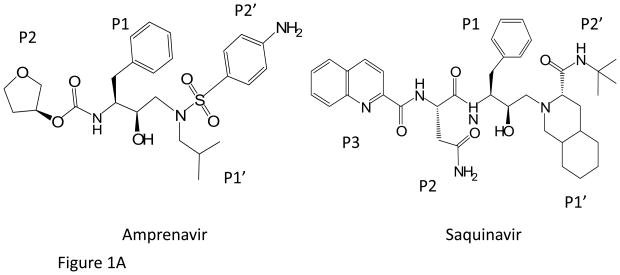
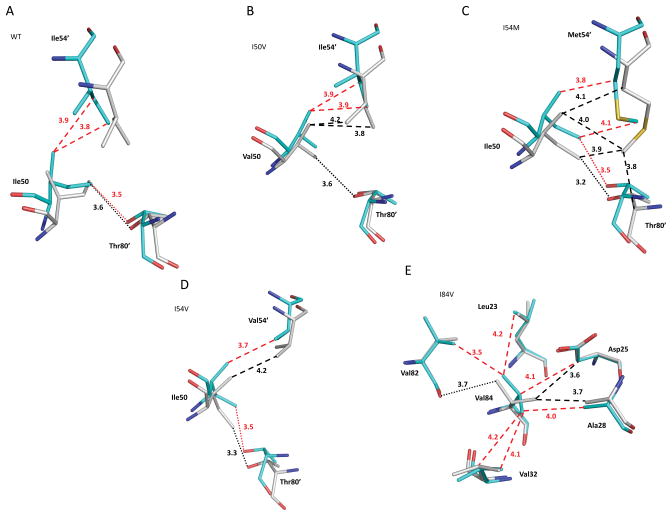
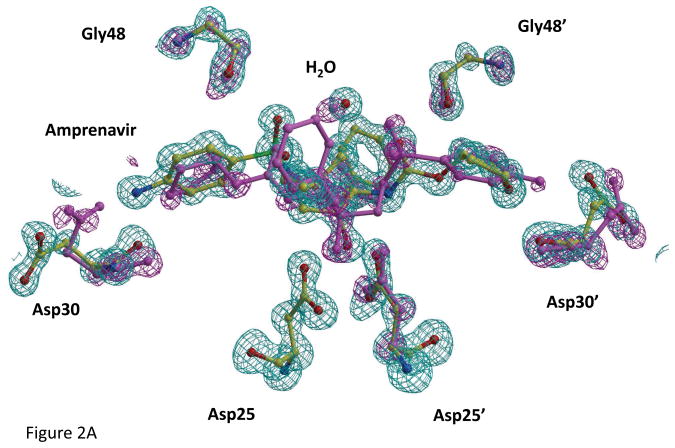
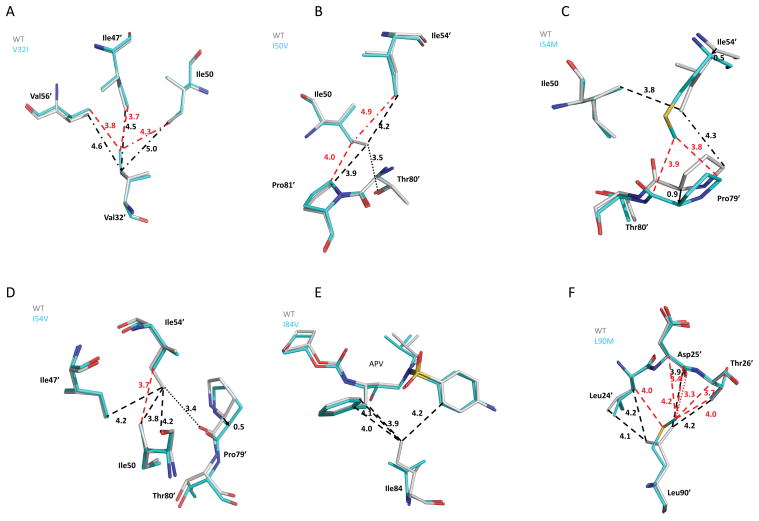
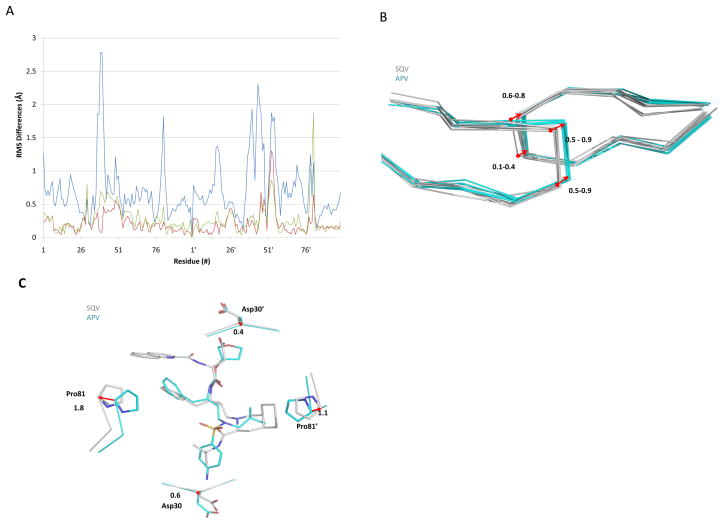
The structural and kinetic effects of amprenavir (APV), a clinical HIV protease (PR) inhibitor, were analyzed with wild-type enzyme and mutants with single substitutions of V32I, I50V, I54V, I54M, I84V and L90M that are common in drug resistance. Crystal structures of the APV complexes at resolutions of 1.02-1.85 Å reveal the structural changes due to the mutations. Substitution of the larger side chains in PR(V32I) , PR(I54M) and PR(L90M) resulted in the formation of new hydrophobic contacts with flap residues, residues 79 and 80, and Asp25, respectively. Mutation to smaller side chains eliminated hydrophobic interactions in the PR(I50V) and PR(I54V) structures. The PR(I84V)-APV complex had lost hydrophobic contacts with APV, the PR(V32I)-APV complex showed increased hydrophobic contacts within the hydrophobic cluster and the PR(I50V) complex had weaker polar and hydrophobic interactions with APV. The observed structural changes in PR(I84V)-APV, PR(V32I)-APV and PR(I50V)-APV were related to their reduced inhibition by APV of six-, 10- and 30-fold, respectively, relative to wild-type PR. The APV complexes were compared with the corresponding saquinavir complexes. The PR dimers had distinct rearrangements of the flaps and 80's loops that adapt to the different P1' groups of the inhibitors, while maintaining contacts within the hydrophobic cluster. These small changes in the loops and weak internal interactions produce the different patterns of resistant mutations for the two drugs.
分析了安普那韦(APV),一种临床 HIV 蛋白酶(PR)抑制剂,对野生型酶和具有单个取代的 V32I、I50V、I54V、I54M、I84V 和 L90M 突变体的结构和动力学影响,这些突变是耐药性中常见的。分辨率为 1.02-1.85 Å 的 APV 复合物的晶体结构揭示了由于突变引起的结构变化。PR(V32I)、PR(I54M) 和 PR(L90M) 的较大侧链取代导致与瓣状残基、残基 79 和 80 以及 Asp25 分别形成新的疏水性接触。较小侧链的突变消除了 PR(I50V)和 PR(I54V)结构中的疏水性相互作用。PR(I84V)-APV 复合物与 APV 失去了疏水性接触,PR(V32I)-APV 复合物在疏水区内显示出增加的疏水性接触,而 PR(I50V)复合物与 APV 的极性和疏水性相互作用较弱。观察到的 PR(I84V)-APV、PR(V32I)-APV 和 PR(I50V)-APV 中的结构变化与它们对 APV 的抑制作用分别降低了 6 倍、10 倍和 30 倍有关,相对于野生型 PR。将 APV 复合物与相应的沙奎那韦复合物进行了比较。PR 二聚体的瓣状结构和 80 环有明显的重排,以适应抑制剂的不同 P1'基团,同时保持疏水簇内的接触。这两种药物的耐药突变模式产生了这些小的环和弱的内部相互作用的变化。