Laboratory of Entomology, Wageningen University and Research Center, Wageningen, The Netherlands.
PLoS One. 2010 Aug 11;5(8):e12081. doi: 10.1371/journal.pone.0012081.
Increasing incidences of insecticide resistance in malaria vectors are threatening the sustainable use of contemporary chemical vector control measures. Fungal entomopathogens provide a possible additional tool for the control of insecticide-resistant malaria mosquitoes. This study investigated the compatibility of the pyrethroid insecticide permethrin and two mosquito-pathogenic fungi, Beauveria bassiana and Metarhizium anisopliae, against a laboratory colony and field population of West African insecticide-resistant Anopheles gambiae s.s. mosquitoes.
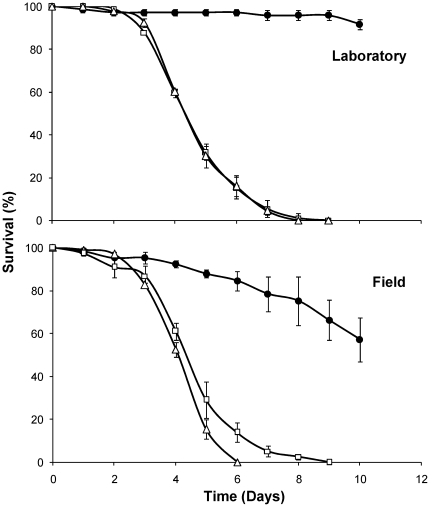
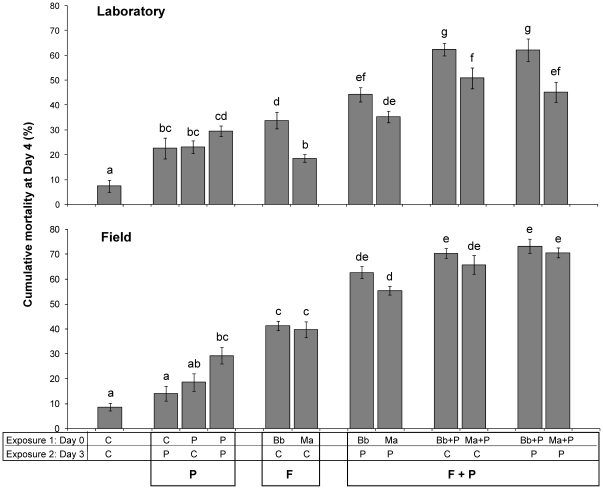
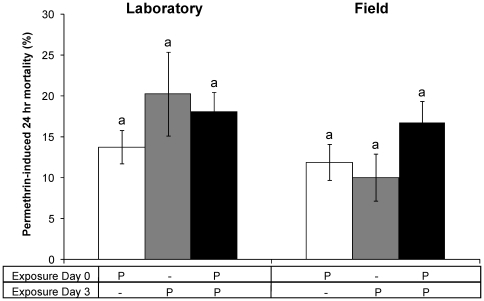
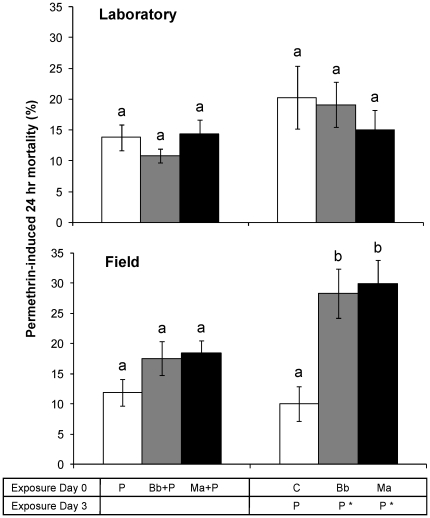
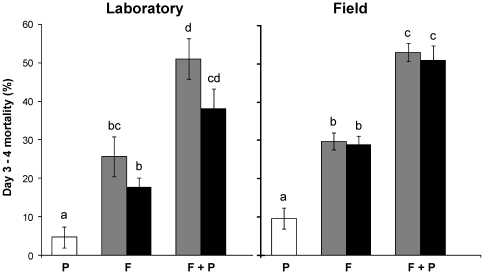
METHODOLOGY/FINDINGS: A range of fungus-insecticide combinations was used to test effects of timing and sequence of exposure. Both the laboratory-reared and field-collected mosquitoes were highly resistant to permethrin but susceptible to B. bassiana and M. anisopliae infection, inducing 100% mortality within nine days. Combinations of insecticide and fungus showed synergistic effects on mosquito survival. Fungal infection increased permethrin-induced mortality rates in wild An. gambiae s.s. mosquitoes and reciprocally, exposure to permethrin increased subsequent fungal-induced mortality rates in both colonies. Simultaneous co-exposure induced the highest mortality; up to 70.3+/-2% for a combined Beauveria and permethrin exposure within a time range of one gonotrophic cycle (4 days).
CONCLUSIONS/SIGNIFICANCE: Combining fungi and permethrin induced a higher impact on mosquito survival than the use of these control agents alone. The observed synergism in efficacy shows the potential for integrated fungus-insecticide control measures to dramatically reduce malaria transmission and enable control at more moderate levels of coverage even in areas where insecticide resistance has rendered pyrethroids essentially ineffective.
不断增加的杀虫剂抗药性蚊媒正在威胁当代化学病媒控制措施的可持续利用。真菌病媒生物防治剂为控制杀虫剂抗性疟蚊提供了一种可能的额外手段。本研究调查了拟除虫菊酯杀虫剂氯菊酯与两种蚊媒致病真菌,球孢白僵菌和金龟子绿僵菌,对实验室饲养的和野外采集的西非杀虫剂抗性按蚊的兼容性。
方法/发现:使用了一系列真菌-杀虫剂组合来测试暴露时间和顺序的影响。实验室饲养和野外采集的蚊子对氯菊酯均具有高度抗性,但对球孢白僵菌和金龟子绿僵菌感染敏感,在九天内可引起 100%的死亡率。杀虫剂和真菌的组合对蚊子的存活率表现出协同作用。真菌感染增加了野生按蚊对氯菊酯诱导的死亡率,反之亦然,暴露于氯菊酯增加了这两个群体随后真菌诱导的死亡率。同时接触诱导的死亡率最高;在一个生殖周期(4 天)内,同时接触球孢白僵菌和氯菊酯可导致高达 70.3+/-2%的死亡率。
结论/意义:将真菌和氯菊酯结合使用比单独使用这些控制剂对蚊子的生存产生了更高的影响。观察到的功效协同作用表明,真菌-杀虫剂综合防治措施具有巨大潜力,可以显著降低疟疾传播,并使控制水平达到更适度的覆盖范围,即使在那些已经使拟除虫菊酯基本无效的杀虫剂抗性地区。