• 文献检索
  • 文档翻译
  • 深度研究
  • 学术资讯
  • Suppr Zotero 插件Zotero 插件
  • 邀请有礼
  • 套餐&价格
  • 历史记录
应用&插件
Suppr Zotero 插件Zotero 插件浏览器插件Mac 客户端Windows 客户端微信小程序
定价
高级版会员购买积分包购买API积分包
服务
文献检索文档翻译深度研究API 文档MCP 服务
关于我们
关于 Suppr公司介绍联系我们用户协议隐私条款
关注我们

Suppr 超能文献

核心技术专利:CN118964589B侵权必究
粤ICP备2023148730 号-1Suppr @ 2026

文献检索

告别复杂PubMed语法,用中文像聊天一样搜索,搜遍4000万医学文献。AI智能推荐,让科研检索更轻松。

立即免费搜索

文件翻译

保留排版,准确专业,支持PDF/Word/PPT等文件格式,支持 12+语言互译。

免费翻译文档

深度研究

AI帮你快速写综述,25分钟生成高质量综述,智能提取关键信息,辅助科研写作。

立即免费体验

从华莱士时期到现在,猩猩相遇率的下降表明该物种曾经更为丰富。

Declining orangutan encounter rates from Wallace to the present suggest the species was once more abundant.

机构信息

People and Nature Consulting International, Jakarta, Indonesia.

出版信息

PLoS One. 2010 Aug 11;5(8):e12042. doi: 10.1371/journal.pone.0012042.

DOI:10.1371/journal.pone.0012042
PMID:20711451
原文链接:https://pmc.ncbi.nlm.nih.gov/articles/PMC2920314/
Abstract

BACKGROUND

Bornean orangutans (Pongo pygmaeus) currently occur at low densities and seeing a wild one is a rare event. Compared to present low encounter rates of orangutans, it is striking how many orangutan each day historic collectors like Alfred Russel Wallace were able to shoot continuously over weeks or even months. Does that indicate that some 150 years ago encounter rates with orangutans, or their densities, were higher than now?

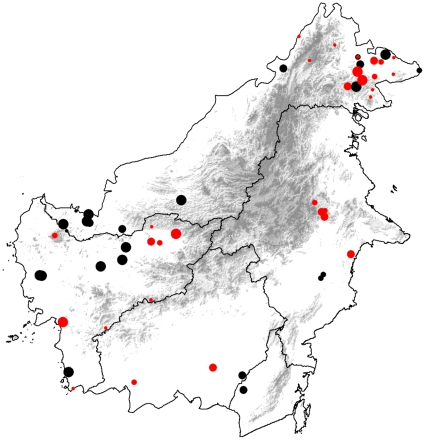
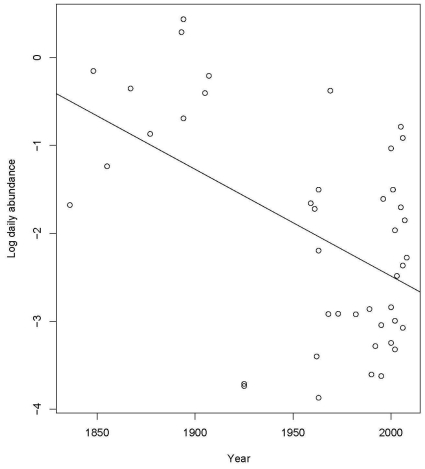
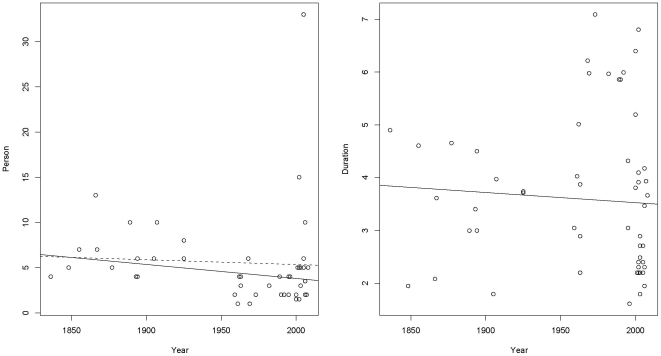
METHODOLOGY/PRINCIPAL FINDINGS: We test this hypothesis by quantifying encounter rates obtained from hunting accounts, museum collections, and recent field studies, and analysing whether there is a declining trend over time. Logistic regression analyses of our data support such a decline on Borneo between the mid-19th century and the present. Even when controlled for variation in the size of survey and hunting teams and the durations of expeditions, mean daily encounter rates appear to have declined about 6-fold in areas with little or no forest disturbance.

CONCLUSIONS/SIGNIFICANCE: This finding has potential consequences for our understanding of orangutans, because it suggests that Bornean orangutans once occurred at higher densities. We explore potential explanations-habitat loss and degradation, hunting, and disease-and conclude that hunting fits the observed patterns best. This suggests that hunting has been underestimated as a key causal factor of orangutan density and distribution, and that species population declines have been more severe than previously estimated based on habitat loss only. Our findings may require us to rethink the biology of orangutans, with much of our ecological understanding possibly being based on field studies of animals living at lower densities than they did historically. Our approach of quantifying species encounter rates from historic data demonstrates that this method can yield valuable information about the ecology and population density of species in the past, providing new insight into species' conservation needs.

摘要

背景

婆罗洲猩猩(Pongo pygmaeus)目前的密度较低,看到野生猩猩是一件罕见的事情。与现在低的猩猩偶遇率相比,历史上的收藏家,如阿尔弗雷德·拉塞尔·华莱士(Alfred Russel Wallace),能够在数周甚至数月内连续射杀多少只猩猩,这令人震惊。这是否表明,大约 150 年前,猩猩的偶遇率或密度比现在更高?

方法/主要发现:我们通过量化狩猎记录、博物馆收藏和最近的实地研究中获得的偶遇率来检验这一假设,并分析是否存在随时间下降的趋势。对我们的数据进行逻辑回归分析支持了这种在 19 世纪中叶到现在的婆罗洲猩猩数量的下降趋势。即使控制了调查和狩猎队的规模以及探险的持续时间的变化,在森林干扰较少或没有森林干扰的地区,平均每日偶遇率似乎下降了约 6 倍。

结论/意义:这一发现可能对我们对猩猩的理解产生潜在影响,因为它表明婆罗洲猩猩曾经的密度更高。我们探讨了潜在的解释——栖息地的丧失和退化、狩猎和疾病,并得出结论认为,狩猎最符合观察到的模式。这表明,狩猎作为猩猩密度和分布的关键因果因素被低估了,而且物种的种群下降比仅基于栖息地丧失所估计的更为严重。我们的发现可能需要我们重新思考猩猩的生物学,我们的许多生态理解可能是基于对历史上密度较低的动物进行实地研究的基础上。我们从历史数据中量化物种偶遇率的方法表明,这种方法可以为过去物种的生态学和种群密度提供有价值的信息,为物种的保护需求提供新的见解。
https://cdn.ncbi.nlm.nih.gov/pmc/blobs/782b/2920314/5fdb5109d59f/pone.0012042.g003.jpg
https://cdn.ncbi.nlm.nih.gov/pmc/blobs/782b/2920314/8f9f5573cb8b/pone.0012042.g001.jpg
https://cdn.ncbi.nlm.nih.gov/pmc/blobs/782b/2920314/a3121a77b3ea/pone.0012042.g002.jpg
https://cdn.ncbi.nlm.nih.gov/pmc/blobs/782b/2920314/5fdb5109d59f/pone.0012042.g003.jpg
https://cdn.ncbi.nlm.nih.gov/pmc/blobs/782b/2920314/8f9f5573cb8b/pone.0012042.g001.jpg
https://cdn.ncbi.nlm.nih.gov/pmc/blobs/782b/2920314/a3121a77b3ea/pone.0012042.g002.jpg
https://cdn.ncbi.nlm.nih.gov/pmc/blobs/782b/2920314/5fdb5109d59f/pone.0012042.g003.jpg

相似文献

1
Declining orangutan encounter rates from Wallace to the present suggest the species was once more abundant.从华莱士时期到现在,猩猩相遇率的下降表明该物种曾经更为丰富。
PLoS One. 2010 Aug 11;5(8):e12042. doi: 10.1371/journal.pone.0012042.
2
Global Demand for Natural Resources Eliminated More Than 100,000 Bornean Orangutans.全球对自然资源的需求导致超过 10 万只婆罗洲猩猩消失。
Curr Biol. 2018 Mar 5;28(5):761-769.e5. doi: 10.1016/j.cub.2018.01.053. Epub 2018 Feb 15.
3
Use of limestone karst forests by Bornean orangutans (Pongo pygmaeus morio) in the Sangkulirang peninsula, east Kalimantan, Indonesia.印度尼西亚东加里曼丹省桑古利朗半岛的婆罗洲猩猩(Pongo pygmaeus morio)对石灰岩岩溶森林的利用情况。
Am J Primatol. 2007 Feb;69(2):212-9. doi: 10.1002/ajp.20341.
4
Terrestriality in the Bornean orangutan (Pongo pygmaeus morio) and implications for their ecology and conservation.婆罗洲猩猩(Pongo pygmaeus morio)的地栖性及其对其生态和保护的影响。
Am J Primatol. 2013 Nov;75(11):1129-38. doi: 10.1002/ajp.22174. Epub 2013 Jun 19.
5
Not by science alone: why orangutan conservationists must think outside the box.不能仅靠科学:为什么猩猩保护主义者必须跳出固有思维。
Ann N Y Acad Sci. 2012 Feb;1249:29-44. doi: 10.1111/j.1749-6632.2011.06288.x. Epub 2011 Dec 16.
6
Oxygen isotopes in orangutan teeth reveal recent and ancient climate variation.猩猩牙齿中的氧同位素揭示了近期和古代的气候变化。
Elife. 2024 Mar 8;12:RP90217. doi: 10.7554/eLife.90217.
7
Speciation and intrasubspecific variation of Bornean orangutans, Pongo pygmaeus pygmaeus.婆罗洲猩猩(Pongo pygmaeus pygmaeus)的物种形成与亚种内变异
Mol Biol Evol. 2001 Apr;18(4):472-80. doi: 10.1093/oxfordjournals.molbev.a003826.
8
Nutritional ecology of wild Bornean orangutans (Pongo pygmaeus wurmbii) in a peat swamp habitat: Effects of age, sex, and season.泥炭沼泽栖息地中野生婆罗洲猩猩(Pongo pygmaeus wurmbii)的营养生态学:年龄、性别和季节的影响。
Am J Primatol. 2017 Apr;79(4):1-20. doi: 10.1002/ajp.22618. Epub 2016 Nov 27.
9
Feeding behavior, diet, and the functional consequences of jaw form in orangutans, with implications for the evolution of Pongo.猩猩的进食行为、饮食以及颌骨形态的功能后果及其对红毛猩猩进化的影响。
J Hum Evol. 2006 Apr;50(4):377-93. doi: 10.1016/j.jhevol.2005.10.006. Epub 2006 Jan 18.
10
Unexpected ecological resilience in Bornean orangutans and implications for pulp and paper plantation management.婆罗洲猩猩具有出人意料的生态恢复力,这对纸浆和造纸种植园管理具有启示意义。
PLoS One. 2010 Sep 22;5(9):e12813. doi: 10.1371/journal.pone.0012813.

引用本文的文献

1
Future coexistence with great apes will require major changes to policy and practice.未来与大型猿类共存将需要对政策和实践进行重大改变。
Nat Hum Behav. 2024 Apr;8(4):632-643. doi: 10.1038/s41562-024-01830-x. Epub 2024 Feb 19.
2
Sociality predicts orangutan vocal phenotype.社交行为预测猩猩的叫声表现型。
Nat Ecol Evol. 2022 May;6(5):644-652. doi: 10.1038/s41559-022-01689-z. Epub 2022 Mar 21.
3
Orangutans venture out of the rainforest and into the Anthropocene.猩猩走出雨林,进入人类世。

本文引用的文献

1
Anecdotes and the shifting baseline syndrome of fisheries.轶事与渔业的变动基准综合征。
Trends Ecol Evol. 1995 Oct;10(10):430. doi: 10.1016/s0169-5347(00)89171-5.
2
Unexpected ecological resilience in Bornean orangutans and implications for pulp and paper plantation management.婆罗洲猩猩具有出人意料的生态恢复力,这对纸浆和造纸种植园管理具有启示意义。
PLoS One. 2010 Sep 22;5(9):e12813. doi: 10.1371/journal.pone.0012813.
3
Historical baselines for large marine animals.大型海洋动物的历史基线。
Sci Adv. 2018 Jun 27;4(6):e1701422. doi: 10.1126/sciadv.1701422. eCollection 2018 Jun.
4
First integrative trend analysis for a great ape species in Borneo.首个关于婆罗洲大型猿类物种的综合趋势分析。
Sci Rep. 2017 Jul 7;7(1):4839. doi: 10.1038/s41598-017-04435-9.
5
Conservation strategies for orangutans: reintroduction versus habitat preservation and the benefits of sustainably logged forest.红毛猩猩的保护策略:重新引入与栖息地保护以及可持续采伐森林的益处。
PLoS One. 2014 Jul 15;9(7):e102174. doi: 10.1371/journal.pone.0102174. eCollection 2014.
6
It's not just conflict that motivates killing of orangutans.促使猩猩被杀的原因不仅仅是冲突。
PLoS One. 2013 Oct 9;8(10):e75373. doi: 10.1371/journal.pone.0075373. eCollection 2013.
7
Effective population size dynamics and the demographic collapse of Bornean orang-utans.有效种群大小动态与婆罗洲猩猩的种群崩溃
PLoS One. 2012;7(11):e49429. doi: 10.1371/journal.pone.0049429. Epub 2012 Nov 15.
8
Understanding the impacts of land-use policies on a threatened species: is there a future for the Bornean orang-utan?了解土地利用政策对受威胁物种的影响:婆罗洲猩猩是否有未来?
PLoS One. 2012;7(11):e49142. doi: 10.1371/journal.pone.0049142. Epub 2012 Nov 7.
9
Long-term field data and climate-habitat models show that orangutan persistence depends on effective forest management and greenhouse gas mitigation.长期的实地数据和气候-栖息地模型表明,猩猩的生存取决于有效的森林管理和温室气体减排。
PLoS One. 2012;7(9):e43846. doi: 10.1371/journal.pone.0043846. Epub 2012 Sep 7.
10
Quantifying killing of orangutans and human-orangutan conflict in Kalimantan, Indonesia.量化印度尼西亚加里曼丹地区猩猩的死亡率和人猿冲突。
PLoS One. 2011;6(11):e27491. doi: 10.1371/journal.pone.0027491. Epub 2011 Nov 11.
Trends Ecol Evol. 2009 May;24(5):254-62. doi: 10.1016/j.tree.2008.12.004. Epub 2009 Feb 27.
4
Genetic signature of anthropogenic population collapse in orang-utans.红毛猩猩人为种群崩溃的基因特征。
PLoS Biol. 2006 Feb;4(2):e25. doi: 10.1371/journal.pbio.0040025. Epub 2006 Jan 24.
5
Determinants of orangutan density in the dryland forests of the Leuser Ecosystem.勒塞尔生态系统旱地森林中猩猩密度的决定因素。
Primates. 2004 Jul;45(3):177-82. doi: 10.1007/s10329-004-0080-1. Epub 2004 Apr 20.
6
Lowland forest loss in protected areas of Indonesian Borneo.印度尼西亚婆罗洲保护区内的低地森林流失
Science. 2004 Feb 13;303(5660):1000-3. doi: 10.1126/science.1091714.