Faculty of Engineering, Electrical-Electronics Engineering Department, Zirve University, Gaziantep, Turkey.
Biomed Eng Online. 2010 Aug 19;9:39. doi: 10.1186/1475-925X-9-39.
Polysomnography (PSG) is used to define physiological sleep and different physiological sleep stages, to assess sleep quality and diagnose many types of sleep disorders such as obstructive sleep apnea. However, PSG requires not only the connection of various sensors and electrodes to the subject but also spending the night in a bed that is different from the subject's own bed. This study is designed to investigate the feasibility of automatic classification of sleep stages and obstructive apneaic epochs using only the features derived from a single-lead electrocardiography (ECG) signal.
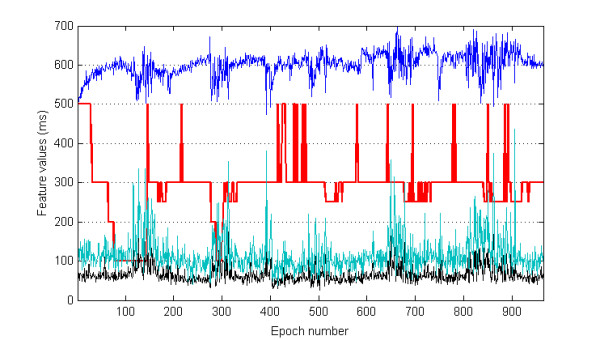
For this purpose, PSG recordings (ECG included) were obtained during the night's sleep (mean duration 7 hours) of 17 subjects (5 men) with ages between 26 and 67. Based on these recordings, sleep experts performed sleep scoring for each subject. This study consisted of the following steps: (1) Visual inspection of ECG data corresponding to each 30-second epoch, and selection of epochs with relatively clean signals, (2) beat-to-beat interval (RR interval) computation using an R-peak detection algorithm, (3) feature extraction from RR interval values, and (4) classification of sleep stages (or obstructive apneaic periods) using one-versus-rest approach. The features used in the study were the median value, the difference between the 75 and 25 percentile values, and mean absolute deviations of the RR intervals computed for each epoch. The k-nearest-neighbor (kNN), quadratic discriminant analysis (QDA), and support vector machines (SVM) methods were used as the classification tools. In the testing procedure 10-fold cross-validation was employed.
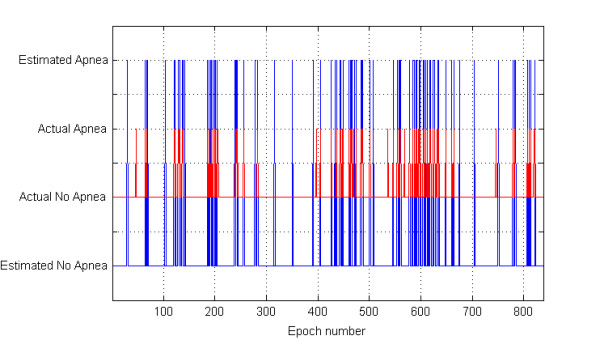
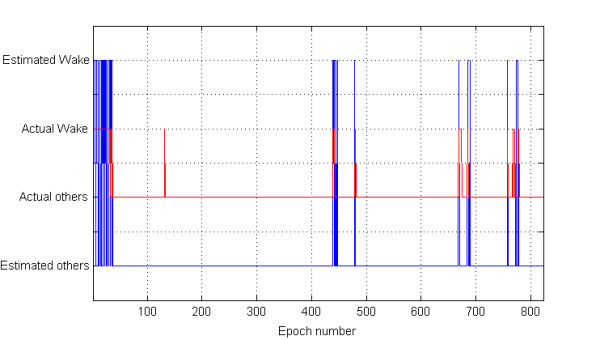
QDA and SVM performed similarly well and significantly better than kNN for both sleep stage and apneaic epoch classification studies. The classification accuracy rates were between 80 and 90% for the stages other than non-rapid-eye-movement stage 2. The accuracies were 60 or 70% for that specific stage. In five obstructive sleep apnea (OSA) patients, the accurate apneaic epoch detection rates were over 89% for QDA and SVM.
This study, in general, showed that RR-interval based classification, which requires only single-lead ECG, is feasible for sleep stage and apneaic epoch determination and can pave the road for a simple automatic classification system suitable for home-use.
多导睡眠图(PSG)用于定义生理睡眠和不同的生理睡眠阶段,评估睡眠质量并诊断多种睡眠障碍,如阻塞性睡眠呼吸暂停。然而,PSG 不仅需要将各种传感器和电极连接到受试者身上,还需要在与受试者自己的床不同的床上过夜。本研究旨在探讨仅使用单导联心电图(ECG)信号中提取的特征来自动分类睡眠阶段和阻塞性呼吸暂停期的可行性。
为此,在 17 名受试者(5 名男性)的夜间睡眠(平均持续时间为 7 小时)期间获得了包括 ECG 在内的 PSG 记录。基于这些记录,睡眠专家对每个受试者进行了睡眠评分。本研究包括以下步骤:(1)对每个 30 秒时段的 ECG 数据进行视觉检查,并选择信号相对干净的时段;(2)使用 R 波检测算法计算逐拍间隔(RR 间隔);(3)从 RR 间隔值中提取特征;(4)使用一对一比较方法对睡眠阶段(或阻塞性呼吸暂停期)进行分类。本研究中使用的特征是每个时段计算的 RR 间隔的中位数、75 和 25 百分位值之间的差值以及均方根偏差。使用 K-最近邻(kNN)、二次判别分析(QDA)和支持向量机(SVM)方法作为分类工具。在测试过程中,采用 10 折交叉验证。
QDA 和 SVM 的表现与 kNN 相似,对于睡眠阶段和呼吸暂停期分类研究,均显著优于 kNN。对于非快速眼动睡眠阶段 2 以外的其他阶段,分类准确率在 80%至 90%之间。对于特定阶段,准确率为 60%或 70%。在 5 名阻塞性睡眠呼吸暂停(OSA)患者中,QDA 和 SVM 的准确呼吸暂停期检测率超过 89%。
本研究总体表明,仅基于 RR 间隔的分类,仅需单导联 ECG,对于睡眠阶段和呼吸暂停期的确定是可行的,并为适合家庭使用的简单自动分类系统铺平了道路。