Bokuda Kanako, Ichihara Atsuhiro, Sakoda Mariyo, Mito Asako, Kinouchi Kenichiro, Itoh Hiroshi
Department of Internal Medicine, Keio University School of Medicine, Tokyo, Japan.
Vasc Health Risk Manag. 2010 Aug 9;6:571-8. doi: 10.2147/vhrm.s11958.
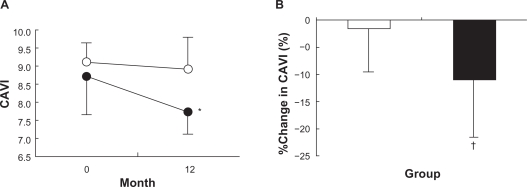
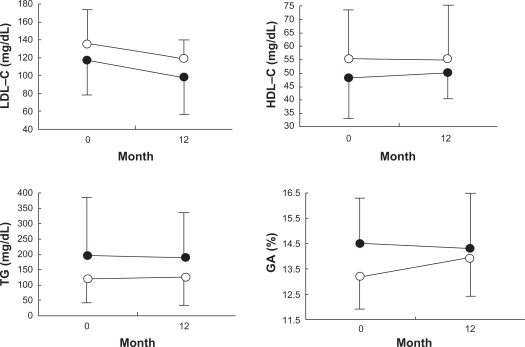
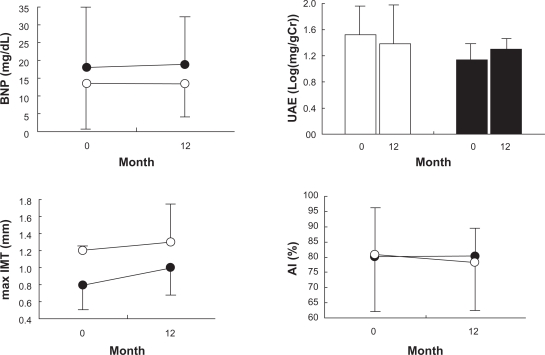
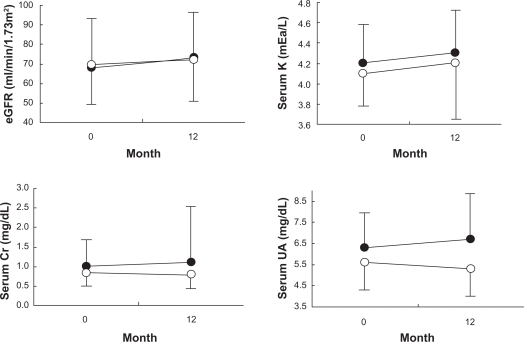
Angiotensin receptor blockers (ARBs) are known to reduce the cardiovascular risk in hypertensive patients. This study was designed to examine the effect of an ARB candesartan on subclinical atherosclerosis assessed by cardio-ankle vascular index (CAVI) in comparison with calcium channel blockers (CCBs) alone in hypertensive patients with metabolic syndrome (MetS). A total of 53 consecutive hypertensive patients with MetS were randomly assigned to the candesartan group, in which candesartan was added on, or the CCBs group, in which CCBs were added on. Clinical and biological parameters were obtained before and after the 12-month treatment period. The primary measure of efficacy was the %change in CAVI. When treated with candesartan, but not CCBs, CAVI significantly decreased from 8.7 to 7.7 by 11%. Blood pressure (BP) significantly decreased with both treatments, but the differences between groups were not significant. The changes in other parameters remained unchanged in both the groups. Analysis of covariance found that both the BP reduction and the therapy difference contributed to the decrease in CAVI, but the BP reduction was not involved in the decrease in CAVI caused by the difference in the therapy. Candesartan may be a better antihypertensive drug than CCBs to improve subclinical atherosclerosis of patients with MetS.
已知血管紧张素受体阻滞剂(ARBs)可降低高血压患者的心血管风险。本研究旨在比较在患有代谢综合征(MetS)的高血压患者中,与单独使用钙通道阻滞剂(CCBs)相比,ARB坎地沙坦对通过心踝血管指数(CAVI)评估的亚临床动脉粥样硬化的影响。共有53例连续的患有MetS的高血压患者被随机分配至坎地沙坦组(加用坎地沙坦)或CCBs组(加用CCBs)。在12个月治疗期前后获取临床和生物学参数。疗效的主要衡量指标是CAVI的变化百分比。使用坎地沙坦治疗时,而非CCBs,CAVI显著从8.7降至7.7,降幅为11%。两种治疗方法均使血压(BP)显著降低,但组间差异不显著。两组中其他参数的变化均未改变。协方差分析发现,血压降低和治疗差异均导致CAVI降低,但血压降低并非由治疗差异引起的CAVI降低所导致。对于改善患有MetS患者的亚临床动脉粥样硬化,坎地沙坦可能是比CCBs更好的抗高血压药物。