Department of Orthopaedic Surgery, David Geffen School of Medicine at UCLA, University of California-Los Angeles, CA 90095, USA.
Eur Spine J. 2011 Jan;20(1):71-8. doi: 10.1007/s00586-010-1558-8. Epub 2010 Aug 25.
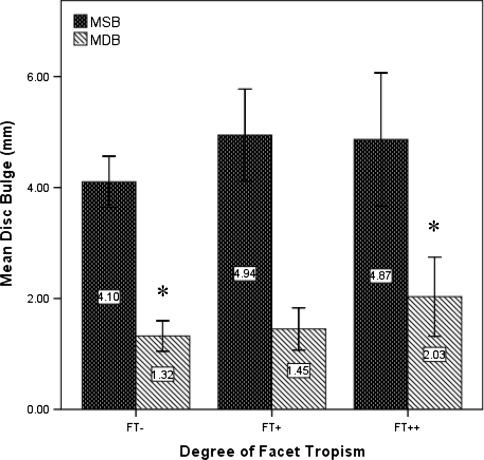
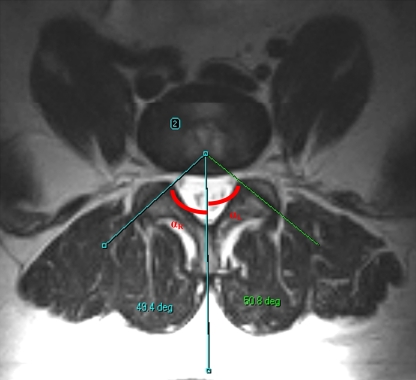
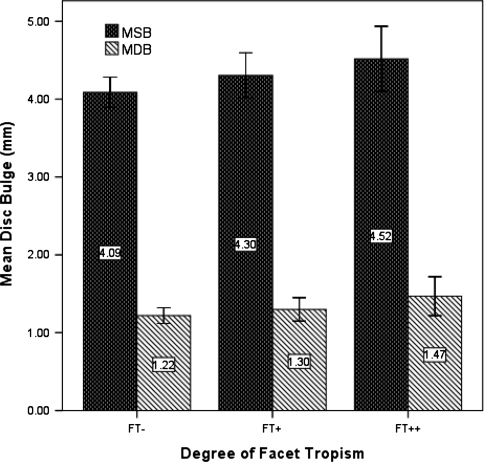
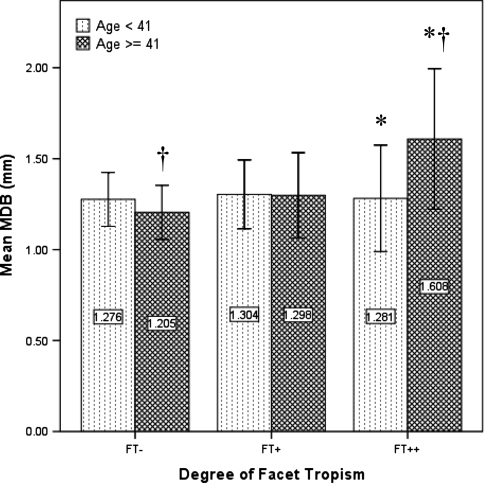
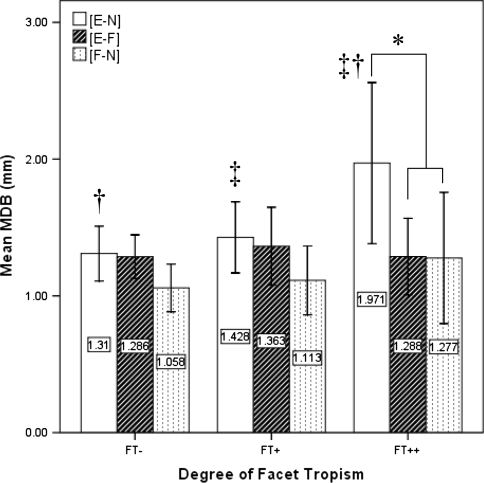
Facet tropism has been investigated as a predisposing factor for degenerative changes in the lumbar spine; however, no prior study has evaluated the relationship between disc bulge and facet tropism. In this study, we used kinetic magnetic resonance imaging (kMRI) to investigate the association between degree of facet tropism and amount of disc bulge in the lumbar spine in relation to age. kMRIs in the flexion, neutral, and extension positions were performed on 410 consecutive patients with low back pain. T2-weighted midsagittal and axial mid-disc cuts were analyzed to measure disc bulge and facet angle. Facet asymmetry was calculated and classified as: no facet tropism, <6°; mild facet tropism, 6-11°; or severe facet tropism, ≥11°. Maximal static bulge (MSB), maximal dynamic bulge (MDB), and age in the facet tropism groups were compared by age subpopulations and MDB categories, defined by the positions between which the largest change in disc bulge occurs. We found the severe facet tropism group to be associated with a nearly significant increase in MSB and MDB over the no facet tropism group in the older subpopulation at the L4-L5 level only, and a larger MDB in the L4-L5 MDB category [E-N], where the greatest change in disc bulge occurs between neutral and extension positions (p = 0.013). Our findings suggest that severe facet tropism is associated with increased disc bulge at L4-L5 in only a subset of older age patients, but may in large part be due to biomechanical factors that define the [E-N] category.
节段性趋化已被研究为腰椎退行性改变的一个诱发因素;然而,尚无研究评估椎间盘膨出与小关节偏斜之间的关系。在这项研究中,我们使用动态磁共振成像(kMRI)来研究腰椎小关节偏斜程度与椎间盘膨出程度与年龄的关系。对 410 例腰痛连续患者进行了屈、伸、中和位的 kMRI。分析 T2 加权矢状面和轴向中椎间盘切片,以测量椎间盘膨出和小关节角度。计算小关节不对称,并分为:无小关节偏斜,<6°;轻度小关节偏斜,6-11°;或严重小关节偏斜,≥11°。通过年龄亚组和 MDB 分类(定义为椎间盘膨出最大变化发生的位置之间)比较 facet tropism 组的最大静态膨出(MSB)、最大动态膨出(MDB)和年龄。我们发现,在仅 L4-L5 水平的老年亚组中,严重小关节偏斜组与无小关节偏斜组相比,MSB 和 MDB 几乎显著增加,并且在 L4-L5 MDB [E-N]分类中 MDB 更大,其中椎间盘膨出最大变化发生在中立位和伸展位之间(p=0.013)。我们的研究结果表明,严重的小关节偏斜仅与部分老年患者的 L4-L5 椎间盘膨出增加有关,但可能在很大程度上归因于定义 [E-N] 分类的生物力学因素。